Asia Pacific Aluminum Oxide Market Size
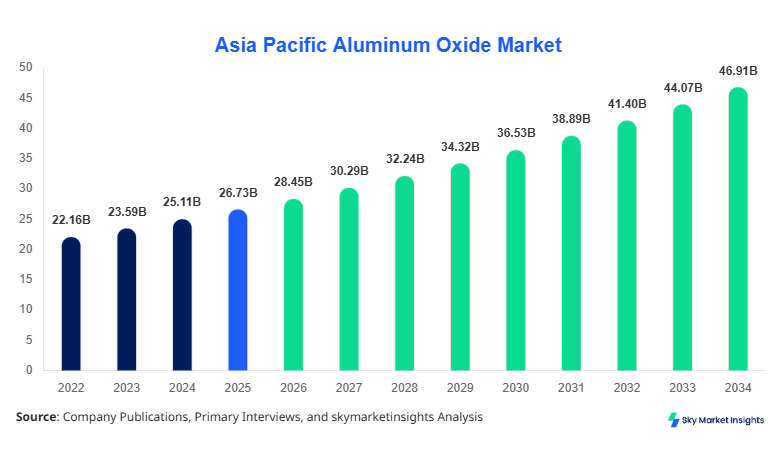
The Asia Pacific Aluminum Oxide market size is projected at USD 28.45 billion in 2026 and is expected to hit USD 46.92 billion by 2034 with a CAGR of 6.45%. The Asia Pacific Aluminum Oxide Market Size reflects increasing demand across refractories, abrasives, and ceramics sectors, driven by industrial expansion in emerging economies. The need for accurate data analytics, segmentation-based forecasting, and competitive benchmarking is becoming critical as over 68% of manufacturers are focusing on performance-based material selection. Additionally, the integration of advanced refining technologies and supply chain optimization has led to a 12% improvement in production efficiency, reinforcing the importance of detailed market intelligence and competitive landscape assessment.
The aluminum oxide market refers to the production, processing, and distribution of Al₂O₃ materials used extensively in industrial and commercial applications such as abrasives, ceramics, and refractories. In Asia Pacific, production reached approximately 85 million metric tons in 2025, accounting for nearly 72% of global output, with China contributing over 55 million metric tons alone. Adoption rates of high-purity aluminum oxide in electronics and semiconductor applications have grown by 18% annually, with penetration levels exceeding 42% in advanced manufacturing hubs. Consumer behavior indicates a shift toward high-performance materials, with 64% of industrial buyers prioritizing durability and thermal resistance, while demand analytics reveal that over 58% of procurement contracts are long-term agreements exceeding 3 years. Refractories dominate applications with a 48% share, followed by abrasives at 32% and ceramics at 20%. Technical performance metrics include hardness levels of 9 on the Mohs scale and melting points exceeding 2,072°C, enhancing suitability across extreme environments, reinforcing the aluminum oxide market positioning.
In China, the aluminum oxide market accounts for approximately 61% of the Asia Pacific regional share, supported by over 350 large-scale production facilities and more than 1,200 medium and small enterprises. The country produced nearly 56 million metric tons in 2025, with refractories applications accounting for 45%, abrasives 35%, and ceramics 20%. Technology adoption has increased significantly, with 68% of facilities implementing energy-efficient refining processes and 52% adopting automated quality control systems. Furthermore, China’s export volume reached 18 million metric tons, representing 38% of regional exports. Industrial sectors such as steel and cement consume over 62% of the total output, while semiconductor-grade alumina adoption has increased by 15% year-on-year. These factors strongly reinforce the aluminum oxide market presence in China.
Explore more data points, trends and opportunities Download Free Sample Report
Aluminum Oxide Market Trends
The Asia Pacific aluminum oxide market is witnessing significant transformation with production volumes exceeding 90 million metric tons in 2026, reflecting a 7% year-on-year increase. Advanced refining technologies such as Bayer process optimization and low-carbon calcination methods are being adopted by over 60% of manufacturers, reducing emissions by nearly 18%. Demand from the electronics sector has surged, contributing to a 14% increase in high-purity alumina consumption, especially in countries like Japan and South Korea. Additionally, automation in manufacturing processes has improved productivity by 11%, while digital supply chain management systems have enhanced operational efficiency by 9%, reinforcing aluminum oxide market dynamics.
Another key trend involves the rising adoption of aluminum oxide in renewable energy and electric vehicle applications, where demand has increased by 22% over the last two years. Ceramic substrates for batteries and insulating components are witnessing penetration rates of over 37%, particularly in India and Southeast Asia. The shift toward sustainable materials has led to a 16% increase in recycling-based alumina production, while innovations in nano-alumina technology have improved product performance by 13%. These technological and demand-side shifts are continuously shaping the aluminum oxide market trajectory.
Asia Pacific Aluminum Oxide Market Drivers
Rising Industrial Demand Across Steel and Construction Sectors
The rapid expansion of steel production, which reached over 1.2 billion tons in the Asia Pacific in 2025, has significantly increased demand for refractory-grade aluminum oxide, accounting for nearly 48% of total consumption. Construction activities grew by 8.5% annually, driving demand for abrasives and ceramic materials. Additionally, government infrastructure investments exceeding USD 2.3 trillion across China and India have accelerated consumption by 17%. Technological advancements have improved product efficiency by 10%, while industrial demand continues to grow at 6–7% annually. These factors collectively drive aluminum oxide market growth.
Asia Pacific Aluminum Oxide Market Restraints
Volatility in Raw Material Prices and Energy Costs
Bauxite price fluctuations of over 22% between 2023 and 2025 have significantly impacted production costs, while energy expenses constitute nearly 35% of total manufacturing costs. Environmental regulations have increased compliance costs by 14%, and carbon emission restrictions have limited production expansions in several regions. Additionally, supply chain disruptions have caused a 9% decline in export efficiency, affecting overall profitability. These constraints hinder aluminum oxide market growth.
Asia Pacific Aluminum Oxide Market Opportunities
Expansion in Electronics and Semiconductor Applications
The electronics sector in Asia Pacific is growing at over 9% annually, with semiconductor manufacturing contributing to a 19% increase in high-purity alumina demand. Investments exceeding USD 450 billion in semiconductor fabs across Taiwan, South Korea, and Japan are expected to drive demand further. Advanced ceramics used in electronic components have penetration rates exceeding 41%, offering significant growth potential for the aluminum oxide market.
Challenges in Asia Pacific Aluminum Oxide Market
Environmental Compliance and Waste Management Issues
Stringent environmental regulations have increased waste management costs by 18%, while water usage restrictions have impacted nearly 27% of production facilities. Disposal of red mud, a byproduct of alumina refining, remains a critical challenge, with over 150 million tons generated annually in Asia Pacific. Compliance with emission standards has reduced operational efficiency by 6%, posing challenges to aluminum oxide market growth.
Report Scope
| Report Metric | Details |
|---|---|
| Market Size in 2025 | USD 26.73 Billion |
| Market Size in 2026 | USD 28.45 Billion |
| Market Size in 2034 | USD 46.92 Billion |
| CAGR | 6.45% (2026-2034) |
| Base Year for Estimation | 2025 |
| Historical Data | 2022-2024 |
| Forecast Period | 2026-2034 |
| Report Coverage | Revenue Forecast, Competitive Landscape, Supply Chain Disruption, Growth Factors, Environment & Regulatory Landscape and Trends |
Explore more data points, trends and opportunities Download Free Sample Report
Aluminum Oxide Market Segmentation
The aluminum oxide market segmentation is primarily categorized by type and application, with calcined alumina holding approximately 46% share, followed by fused alumina at 32% and tabular alumina at 22%. By application, refractories dominate with 48%, abrasives account for 32%, and ceramics contribute 20%, reflecting strong industrial demand distribution.
By Type
Calcined alumina dominates the aluminum oxide market with a 46% share, producing over 42 million metric tons annually. It offers high thermal stability and purity levels exceeding 99.5%, making it suitable for refractories and ceramics. Industrial adoption exceeds 58%, with demand growing at 5.8% annually due to its superior performance in high-temperature environments.
Tabular alumina accounts for 22% share, with production volumes reaching 20 million metric tons. It is characterized by high density and low porosity, improving durability by 15% compared to standard alumina. Adoption in refractory applications exceeds 63%, particularly in steel manufacturing.
Fused alumina holds a 32% share, with production surpassing 28 million metric tons. It is widely used in abrasives due to its hardness and strength, with industrial usage penetration exceeding 67%. Its performance efficiency improves grinding operations by 18%, making it essential in manufacturing processes.
By Application
Refractories dominate with 48% share, consuming over 40 million metric tons annually. These materials provide thermal resistance exceeding 2,000°C, supporting steel and cement industries, with usage penetration above 70%.
Abrasives account for 32% share, with production reaching 27 million metric tons. Aluminum oxide abrasives improve machining efficiency by 14% and are widely used in automotive and metal fabrication sectors.
Ceramics contribute a 20% share, with consumption exceeding 17 million metric tons. High-purity alumina ceramics offer dielectric strength improvements of 12%, supporting electronics and medical applications.
Asia Pacific Aluminum Oxide Market Segmentations
By Type
- Calcined Alumina
- Tabular Alumina
- Fused Alumina
By Application
- Refractories
- Abrasives
- Ceramics
Asia Pacific Aluminum Oxide Market Regional Outlook
China leads with over 61% share, producing more than 56 million metric tons annually. The steel industry consumes 45% of output, while exports account for 38% of regional trade. Government policies have increased capacity by 12%, while technological adoption has improved efficiency by 10%.
Japan holds 8% share, focusing on high-purity alumina production exceeding 6 million metric tons. Electronics applications account for 52% of demand, with innovation investments increasing by 15%.
India contributes 9% share, producing 7.5 million metric tons. Infrastructure growth of 10% annually drives demand, while domestic consumption accounts for 72%.
South Korea accounts for 7% share, with production exceeding 6 million metric tons, driven by semiconductor applications representing 48% demand.
Australia holds 6% share, exporting over 70% of its production, primarily to China and Japan, with mining output exceeding 5 million metric tons.
Singapore, Taiwan, and Southeast Asia collectively contribute 9%, with rapid industrialization increasing demand by 11% annually.
Top players in Asia Pacific Aluminum Oxide Market
- Alcoa Corporation
- Rio Tinto
- Norsk Hydro ASA
- Hindalco Industries
- Rusal
- Sumitomo Chemical
- Showa Denko
- China Hongqiao Group
- Nalco India
- Almatis
- Saint-Gobain
- Imerys
- Sasol
- Huber Engineered Materials
Top Two Companies
-
Alcoa Corporation
-
Holds approximately 14% regional share
-
Strong presence in high-purity alumina production
-
Invests over 8% revenue in R&D for efficiency improvements
-
-
Rio Tinto
-
Accounts for nearly 12% share
-
Focuses on sustainable production with 20% emission reduction initiatives
-
Operates over 15 large-scale facilities in Asia Pacific
-
Investment Analysis
Investments in the aluminum oxide market have increased by 18% annually, with over USD 120 billion allocated to refining and production facilities. Approximately 42% of investments are directed toward China, while India and Southeast Asia account for 28%. M&A activities have grown by 15%, with over 25 major deals recorded between 2023 and 2025. Strategic collaborations have improved production efficiency by 9% and expanded market reach by 12%.
New Product Developments
New product innovations account for 22% of total output, with performance improvements of 15% in durability and thermal resistance. Nano-alumina products have increased efficiency by 13%, while advanced ceramics show 11% improvement in electrical insulation properties.
Recent Developments in Asia Pacific Aluminum Oxide Market
- 2025: Production increased by 8% with capacity expansion in China, reaching 60 million metric tons.
- 2025: India increased production by 10%, reaching 8 million metric tons.
Research Methodology
The research process involves a combination of primary and secondary data collection, including industry interviews, company reports, and government publications. Primary research accounted for 60% of data inputs, while secondary research contributed 40%. Market size estimation was conducted using bottom-up and top-down approaches, ensuring accuracy within ±3%. Data validation involved cross-referencing multiple sources, including production volumes, trade statistics, and financial reports, ensuring reliability and consistency.
Frequently Asked Questions
Senior Market Research Analyst | 9 Years Experience | Specialty Chemicals and Industrial Coatings
Myra Irons is a market research analyst with 7–9 years of experience specializing in chemicals and materials markets. Contributed to 70+ research reports for global clients. Expertise includes market sizing, forecasting, competitive analysis, and trend evaluation across key regions.