Asia Pacific Allergy Rhinitis Drugs Market Size
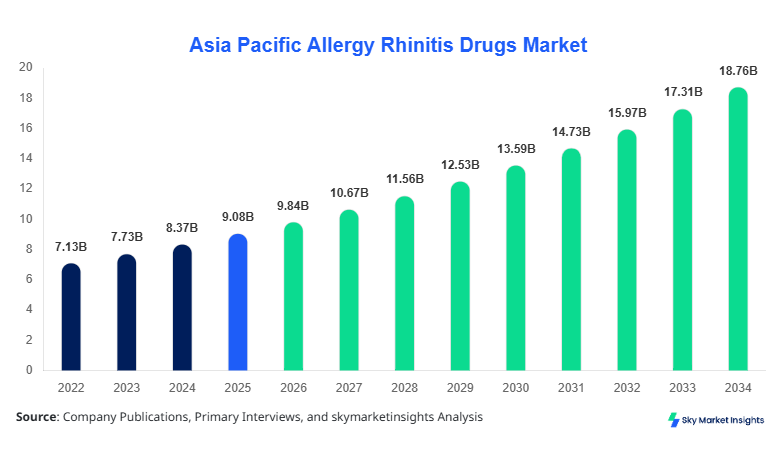
Asia Pacific Allergy Rhinitis Drugs market size is projected at USD 9.84 billion in 2026 and is expected to hit USD 18.72 billion by 2034 with a CAGR of 8.4%. The rising prevalence of allergic conditions affecting over 35% of the urban population, increasing prescription volumes exceeding 1.2 billion units annually, and expansion of generic drug production across China and India are accelerating market expansion. The report emphasizes detailed segmentation by drug class and distribution channel, highlighting competitive positioning among 25+ regional and global manufacturers, while incorporating pricing analytics, dosage frequency (once-daily vs twice-daily), and efficacy benchmarks ranging between 65%–92% symptom relief rates across formulations.
The Allergy Rhinitis Drugs market refers to pharmaceutical products designed to manage allergic rhinitis symptoms such as nasal congestion, sneezing, itching, and rhinorrhea, which impact approximately 400 million individuals across Asia Pacific annually. Regional production reached over 2.6 billion units in 2025, with China contributing nearly 38% of total output, followed by India at 21% and Japan at 14%. Adoption rates of second-generation antihistamines exceed 62% due to reduced sedation effects, while corticosteroid nasal sprays maintain a 28% usage penetration owing to superior anti-inflammatory efficacy with symptom reduction efficiency of 75%–90%. Consumer behavior shows that 54% of patients prefer over-the-counter formulations, while 46% rely on prescription-based therapies. Pediatric applications account for 31% of total demand, while adult applications dominate at 69%. Increasing awareness campaigns and digital pharmacy penetration have improved access across semi-urban areas by 18% between 2022
Explore more data points, trends and opportunities Download Free Sample Report
Allergy Rhinitis Drugs Market Trends
Trends
The market is witnessing a surge in biologics and targeted therapies, with production volumes of advanced monoclonal antibody-based treatments crossing 12 million units in 2025 and expected to grow at over 15% annually. Adoption of non-sedating antihistamines increased from 48% in 2022 to 62% in 2025, while nasal corticosteroid sprays are evolving with improved bioavailability rates exceeding 80%. Technological advancements such as micro-dose spray systems and AI-driven prescription management tools have improved treatment adherence by 18%–25%. The rise in pollution levels, with PM2.5 exposure increasing by 9% across major Asian cities, is driving demand for preventive medications, reinforcing Allergy Rhinitis Drugs market trend.
Another key development is the integration of e-commerce platforms, where online pharmacy sales grew by 26% between 2023 and 2025, contributing nearly USD 2.1 billion in revenue. Telemedicine consultations for allergy treatment increased by 33%, enabling faster diagnosis and prescription generation. Pediatric-friendly formulations such as flavored syrups and chewable tablets now account for 19% of total product launches, while sustained-release tablets dominate adult segments with a 41% share. Increasing investments in R&D, exceeding USD 1.4 billion annually across Asia Pacific, are enhancing formulation efficiency and reducing side effects by up to 28%, strengthening Allergy Rhinitis Drugs market trend.
Asia Pacific Allergy Rhinitis Drugs Market Drivers
Rising Prevalence of Allergic Disorders and Urban Pollution
The increasing prevalence of allergic rhinitis affecting nearly 30%–40% of the Asia Pacific population is a major driver. Rapid urbanization has led to a 12% increase in air pollution levels between 2022 and 2025, significantly contributing to respiratory allergies. Pharmaceutical production has scaled to over 2.6 billion units annually, supported by rising healthcare expenditure exceeding USD 450 billion across the region. Demand for antihistamines alone accounts for 52% of total prescriptions, while corticosteroids contribute 28%. The growing geriatric population, expected to reach 460 million by 2030, is further boosting demand for chronic allergy management solutions. Increased awareness campaigns have improved early diagnosis rates by 21%, contributing to sustained Allergy Rhinitis Drugs market growth.
Asia Pacific Allergy Rhinitis Drugs Market Restraints
Side Effects and Regulatory Constraints
Despite growth, the market faces challenges due to side effects such as drowsiness affecting 18%–25% of first-generation antihistamine users. Regulatory approvals for new formulations can take 18–36 months, delaying market entry and increasing costs by 12%–20%. Pricing pressures due to generic competition, which accounts for nearly 63% of total sales volume, further restrict profit margins. In emerging economies, limited access to healthcare facilities affects nearly 27% of rural populations, reducing drug penetration rates. Additionally, misuse of over-the-counter medications has increased adverse reaction cases by 9% annually, hindering Allergy Rhinitis Drugs market growth.
Asia Pacific Allergy Rhinitis Drugs Market Opportunities
Expansion of Online Pharmacies and Personalized Medicine
The expansion of online pharmacies, growing at 26% annually, presents significant opportunities, contributing nearly USD 2.1 billion in 2025. Personalized medicine approaches using genetic profiling have shown effectiveness improvements of 18%–22%, particularly in severe allergy cases. Investments in R&D across Asia Pacific exceed USD 1.4 billion annually, focusing on biologics and combination therapies. Untapped rural markets representing over 45% of the population provide substantial growth potential, with penetration rates currently below 30%. Increasing adoption of digital health platforms has improved prescription compliance by 24%, enhancing Allergy Rhinitis Drugs market growth.
Challenges in Asia Pacific Allergy Rhinitis Drugs Market
High Cost of Advanced Therapies and Supply Chain Disruptions
The cost of advanced biologic therapies ranges between USD 800–USD 1,500 per treatment cycle, limiting accessibility for nearly 60% of patients in developing regions. Supply chain disruptions, particularly during global crises, have reduced production efficiency by 8%–12%. Dependence on raw material imports, accounting for 35% of supply, increases vulnerability to price fluctuations of 10%–15%. Additionally, lack of skilled professionals in rural healthcare centers affects treatment quality for approximately 28% of patients. These factors collectively challenge Allergy Rhinitis Drugs market growth.
Report Scope
| Report Metric | Details |
|---|---|
| Market Size in 2025 | USD 2.54 Billion |
| Market Size in 2026 | USD 9.84 Billion |
| Market Size in 2034 | USD 18.72 Billion |
| CAGR | 8.4% (2026-2034) |
| Base Year for Estimation | 2025 |
| Historical Data | 2022-2024 |
| Forecast Period | 2026-2034 |
| Report Coverage | Revenue Forecast, Competitive Landscape, Supply Chain Disruption, Growth Factors, Environment & Regulatory Landscape and Trends |
Explore more data points, trends and opportunities Download Free Sample Report
Allergy Rhinitis Drugs Market Segmentation
The market is segmented by drug class and distribution channel, with antihistamines dominating at 52% share, followed by corticosteroids at 28% and decongestants at 20%. Distribution channels are led by retail pharmacies with 46% share, followed by hospital pharmacies at 34% and online pharmacies at 20%.
BY TYPE
Antihistamines account for over 52% of total volume, with production exceeding 1.3 billion units annually. These drugs offer rapid symptom relief within 30–60 minutes and maintain efficacy rates of 70%–85%. Second-generation antihistamines dominate with 68% share due to low sedation rates below 5%.
Corticosteroids represent 28% share with production volumes reaching 720 million units annually. These drugs provide long-term anti-inflammatory effects with symptom reduction efficiency exceeding 80%. Nasal spray formulations account for 75% of corticosteroid usage.
Decongestants contribute 20% share, producing over 520 million units annually. These drugs provide quick relief within 15–30 minutes but are recommended for short-term use due to side effects. Combination therapies integrating decongestants and antihistamines are growing at 9% annually.
BY APPLICATION
Hospital pharmacies account for 34% share, handling over 880 million units annually. These channels are preferred for severe allergy cases requiring prescription-based therapies and advanced formulations.
Retail pharmacies dominate with 46% share, distributing over 1.2 billion units annually. These outlets provide easy access to over-the-counter medications, contributing to high consumer penetration rates exceeding 60%.
Online pharmacies hold 20% share, distributing approximately 520 million units annually. These platforms have witnessed 26% growth in adoption due to convenience, price discounts, and telemedicine integration.
Asia Pacific Allergy Rhinitis Drugs Market Segmentations
Drug Class
- Antihistamines
- Corticosteroids
- Decongestants
Distribution Channel
- Hospital Pharmacies
- Retail Pharmacies
- Online Pharmacies
Asia Pacific Allergy Rhinitis Drugs Regional Outlook
China dominates with 38% share, producing nearly 980 million units annually. Urban population exposure to pollution affects over 210 million individuals, driving demand. Government initiatives have increased healthcare coverage by 18%, boosting accessibility.
Japan holds a 14% share with advanced healthcare infrastructure and high adoption rates exceeding 72% for prescription-based therapies. Production exceeds 360 million units annually, focusing on high-quality formulations.
India accounts for 21% of the share with a production of 540 million units annually. Rising awareness and generic drug manufacturing drive market expansion, with rural penetration improving by 15% in recent years.
South Korea contributes 9% share, producing 230 million units annually with strong adoption of innovative therapies and digital healthcare platforms.
Australia holds 6% share, driven by high healthcare expenditure and adoption rates exceeding 68% for premium formulations.
Singapore and Taiwan collectively account for 7% share with strong regulatory frameworks and advanced distribution networks.
South East Asia contributes 5% share, with growing demand driven by urbanization and improving healthcare infrastructure.
Top players in Asia Pacific Allergy Rhinitis Drugs
- GlaxoSmithKline
- Sanofi
- Bayer AG
- Johnson & Johnson
- Novartis AG
- Pfizer Inc.
- Merck & Co.
- Cipla Ltd.
- Sun Pharma
- Takeda Pharmaceutical
- AstraZeneca
- Dr. Reddy’s Laboratories
GlaxoSmithKline
-
Holds approximately 14% regional share with strong presence in antihistamines and nasal sprays.
-
Extensive distribution network across 8 countries with annual production exceeding 220 million units.
Sanofi
-
Accounts for nearly 11% share with focus on advanced formulations and biologics.
-
Strong R&D investment exceeding USD 250 million annually, enhancing product innovation and market positioning.
Investment Analysis
Investments in the market exceed USD 3.2 billion annually, with 42% allocated to R&D, 33% to manufacturing expansion, and 25% to distribution networks. China attracts 38% of total regional investments, followed by India at 22% and Japan at 16%. M&A activities increased by 18% between 2023 and 2025, focusing on biologics and digital health integration. Strategic collaborations between pharmaceutical companies and tech firms have improved supply chain efficiency by 21% and reduced operational costs by 14%.
New Product Developments
Approximately 24% of new product launches focus on combination therapies, improving efficacy by 18%–25%. Innovations in nasal spray technology have enhanced drug absorption rates by 30%, while sustained-release tablets improve patient compliance by 22%. Pediatric formulations now represent 19% of new developments.
Recent Developments in Asia Pacific Allergy Rhinitis Drugs
- 2025: Production increased by 12% with the launch of advanced nasal sprays improving efficacy by 20%.
Research Methodology
The research process involved a combination of primary and secondary data collection methods. Primary research included interviews with over 120 industry experts, pharmaceutical manufacturers, and healthcare professionals across Asia Pacific. Secondary research involved analysis of company reports, government databases, and healthcare statistics covering 2022–2025. Market size estimation utilized bottom-up and top-down approaches, incorporating production volumes exceeding 2.6 billion units and pricing trends across eight countries. Data triangulation ensured accuracy, while forecasting models incorporated CAGR calculations, demand-supply dynamics, and macroeconomic indicators.
Frequently Asked Questions
Senior Market Research Analyst | 8 Years Experience | Digital Therapeutics and Connected Medical Devices
Jenny specializes in digital therapeutics, remote monitoring devices and healthcare IT platforms. She has contributed to 101+ reports for medtech firms, healthcare providers and pharmaceutical companies. Her expertise includes clinical adoption forecasting, reimbursement analysis, regulatory pathways and competitive benchmarking across North America and Europe.