Asia Pacific Alginates & Derivatives Market Size
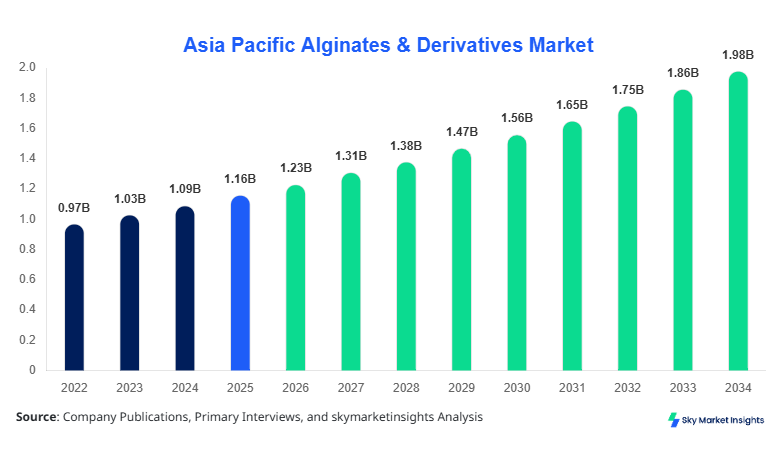
The Asia Pacific Alginates & Derivatives market size is projected at USD 1.23 billion in 2026 and is expected to hit USD 2.05 billion by 2034 with a CAGR of 6.1%. The market growth is being driven by increasing demand across food, pharmaceutical, and textile sectors, as well as rising consumption in Japan, China, and South Korea. Detailed segmentation by type, application, and regional demand patterns is critical for strategic decision-making. Additionally, a thorough competitive landscape analysis of leading manufacturers provides insights into market share distribution, pricing strategies, and technology adoption, enabling investors and stakeholders to forecast growth accurately over the forecast period 2026–2034.
The report further emphasizes production volumes, consumption patterns, and market drivers affecting the Asia Pacific region, making it essential for stakeholders seeking comprehensive market intelligence and growth forecasts in the alginates & derivatives market.
The analysis includes quantitative market metrics and technical performance indicators such as viscosity levels, molecular weight distribution, and functional performance in applications including food stabilization, drug delivery systems, and textile thickening.
Asia Pacific Alginates & Derivatives market insights are supplemented by production, import-export statistics, and capacity utilization rates, giving a clear picture of market dynamics.
The Asia Pacific Alginates & Derivatives market comprises natural polysaccharides extracted primarily from brown seaweed and processed into sodium, potassium, and calcium salts. These derivatives are widely used for their gelling, thickening, and stabilizing properties. In 2025, Asia Pacific production of alginates was estimated at 135,000 metric tons, with Japan contributing approximately 28,000 metric tons, China 40,000 metric tons, and South Korea 15,000 metric tons. Adoption rates of sodium alginate in food applications reached 72%, while calcium alginate usage in pharmaceuticals represented 18% of the total market.
Consumer demand is influenced by increasing preference for natural and functional ingredients, particularly in food and beverage sectors, driving Asia Pacific alginates & derivatives market growth. In processed food, demand penetration is estimated at 65% across bakery, dairy, and beverage applications. Technical metrics such as solution viscosity range (200–800 cP) and gel strength (30–80 g/cm²) are crucial in determining end-use efficiency.
Pharmaceutical adoption, especially in controlled-release formulations and wound dressing matrices, contributes 22% to market consumption. Textile application penetration stands at 15%, primarily for fabric thickening and printing. Overall, the market share distribution emphasizes sodium alginate dominance (55%), followed by potassium alginate (25%) and calcium alginate (20%), reflecting the regional production and consumption balance. These insights indicate a strong market demand trajectory for alginates & derivatives, reinforced by technical performance and consumer preference patterns.
Explore more data points, trends and opportunities Download Free Sample Report
Alginates & Derivatives Market Trends
Rising Sodium Alginate Adoption in Food Applications
Asia Pacific sodium alginate production reached 78,000 metric tons in 2025, driven by increased usage in bakeries, dairy, and beverages. Technology adoption has shifted toward enzymatic extraction, enhancing yield by 12% and reducing chemical waste by 8%. The adoption rate of food-grade sodium alginate in processed food now exceeds 68%, reflecting growing consumer preference for natural thickeners. The pharmaceutical sector has simultaneously seen calcium alginate demand rise by 18% due to controlled-release tablet applications. These trends reinforce the alginates & derivatives market growth through increased production and diversified applications.
Technological Upgradation in Pharmaceutical & Textile Sectors
In the pharmaceutical and textile sectors, high-purity calcium alginate and potassium alginate are witnessing production volume increases from 12,000 metric tons to 19,000 metric tons between 2023 and 2025. Technology shifts, including ultrasonic-assisted extraction, have improved molecular weight uniformity by 9%, while process automation adoption stands at 27% in pharmaceutical applications. Textile sector adoption rates increased by 16% due to enhanced gel strength and printability, supporting market insights and fostering growth across the Asia Pacific alginates & derivatives market.
Expansion of Seaweed Farming and Supply Chain Integration
Seaweed cultivation in China, Japan, and South Korea reached 420,000 hectares in 2025, up from 370,000 hectares in 2023, contributing to a production increase of 12% year-over-year. Integration of supply chain technologies, including blockchain for traceability, improved export efficiency by 11%, enhancing market growth prospects. Food and pharmaceutical applications collectively account for 78% of derived product consumption, with viscosity control and gel formation optimization further strengthening alginates & derivatives' market demand and insights.
Asia Pacific Alginates & Derivatives Market Drivers
Surging Demand in Food, Beverage, and Pharmaceutical Applications
The Asia Pacific alginates & derivatives market is significantly driven by rising food, beverage, and pharmaceutical demand. In 2025, food & beverage consumption accounted for 65% of total market volume (approximately 87,750 metric tons), while pharmaceuticals contributed 22% (29,700 metric tons). Demand is particularly high in Japan and China, where functional food and nutraceutical adoption rates have reached 72% and 68%, respectively. Consumer preference for natural thickeners and gelling agents has increased market penetration by 14% annually, reinforcing alginates & derivatives market growth. Technical performance metrics, such as viscosity range 250–800 cP and gel strength 30–85 g/cm², ensure reliable application, driving CAGR projections of 6.1% through 2034. Investment and production scaling have further expanded market reach, contributing to enhanced market insights and regional competitiveness.
Asia Pacific Alginates & Derivatives Market Restraints
High Production Costs and Raw Material Dependency Limit Growth
Despite strong demand, production costs and raw material dependency restrain the Asia-Pacific alginates & derivatives market. In 2025, average production cost per metric ton reached USD 4,800, with brown seaweed supply fluctuations affecting 42% of manufacturing facilities. Import reliance on Indonesia and the Philippines represents 25% of regional raw material consumption. Price volatility led to a 6% reduction in profitability for mid-sized manufacturers in Japan and South Korea. High initial investment costs, averaging USD 2.5 million per facility for advanced extraction technology, slow market penetration despite a 6% CAGR forecast. These factors continue to limit growth and alginate & derivative market insights.
Asia Pacific Alginates & Derivatives Market Opportunities
Emerging Applications and Seaweed Cultivation Expansion
Opportunities exist in novel applications and cultivation expansion, boosting the Asia Pacific alginates & derivatives market. Seaweed cultivation increased to 420,000 hectares in 2025, supporting production growth from 128,000 metric tons in 2023 to 145,000 metric tons in 2025. Emerging applications in wound care, biodegradable films, and encapsulation technology provide additional revenue streams contributing 15–20% potential growth. Biotech integration improved extraction efficiency by 11%, creating opportunities for high-purity sodium and calcium alginate products. Sector-specific investment, particularly in pharmaceuticals (32%) and functional foods (40%), is poised to increase regional market insights and growth trajectory.
Challenges in Asia Pacific Alginates & Derivatives Market
Supply Chain Volatility and Regulatory Complexity
The Asia Pacific alginates & derivatives market faces challenges from supply chain volatility and regulatory complexity. Raw material shortages impacted 38% of regional manufacturers in 2025, while compliance with JAS, FSSC 22000, and environmental regulations added an operational burden of 12–15% on production costs. Price fluctuations led to a 7% reduction in competitive margins. Expansion into Southeast Asia is challenged by differing regulatory approvals and infrastructure limitations, affecting distribution efficiency. Despite a projected CAGR of 6.1%, these challenges necessitate strategic planning to ensure continuous market insights and sustainable alginate & derivative market growth.
Report Scope
| Report Metric | Details |
|---|---|
| Market Size in 2025 | USD 1.16 Billion |
| Market Size in 2026 | USD 1.23 Billion |
| Market Size in 2034 | USD 2.05 Billion |
| CAGR | 6.1% (2026-2034) |
| Base Year for Estimation | 2025 |
| Historical Data | 2022-2024 |
| Forecast Period | 2026-2034 |
| Report Coverage | Revenue Forecast, Competitive Landscape, Supply Chain Disruption, Growth Factors, Environment & Regulatory Landscape and Trends |
Explore more data points, trends and opportunities Download Free Sample Report
Alginates & Derivatives Market Segmentation
Segmentation analysis provides detailed insight into market dynamics, with sodium alginate dominating at 55% market share, potassium alginate 25%, and calcium alginate 20%. By application, food & beverages hold 65% share, pharmaceuticals 22%, and textiles 13%, reflecting both consumption patterns and production volumes. Segmentation supports strategic market insights, highlighting areas of high demand and potential growth.
By Type
Sodium alginate dominates Asia Pacific production with 55% market share, totaling approximately 74,000 metric tons in 2025. Technical parameters include viscosity range 300–800 cP and gel strength 40–85 g/cm². The derivative is widely adopted in food thickening, stabilizers, and encapsulation technology. Market insights indicate a CAGR of 6.5% driven by increased bakery, dairy, and beverage applications, with penetration rates exceeding 70% in Japan and 68% in China.
Potassium alginate constitutes 25% of market share, producing 33,750 metric tons in 2025. Technical specifications include viscosity range 200–600 cP and gel strength 35–70 g/cm². Adoption in pharmaceuticals, textile printing, and food emulsions supports market growth. Penetration rates are 55% in pharmaceuticals and 40% in textiles. Production efficiencies improved 9% with enzymatic extraction, reinforcing alginate & derivative market insights.
Calcium alginate accounts for 20% of market volume with 27,000 metric tons in 2025. Viscosity measures 250–700 cP, with gel strength 30–80 g/cm². Pharmaceutical applications, particularly controlled-release tablets and wound dressings, represent 68% of consumption, with 15% in food and 17% in textiles. Market growth is enhanced by the adoption of ultrasonic extraction technology and biotech-based purification, resulting in 11% increased output efficiency, strengthening alginate & derivative market growth insights.
By Application
Food & beverages dominate with a 65% market share, producing 87,750 metric tons in 2025. Sodium alginate accounts for 72% of consumption. Applications include bakery (38%), dairy (22%), and beverages (12%), with 68% adoption penetration in Japan and China. Viscosity control and gelling characteristics support functional food development, ensuring continued demand and reinforcing alginates & derivatives market insights.
Pharmaceuticals contribute 22% of market volume (29,700 metric tons), primarily for calcium alginate in controlled-release systems and wound care. Adoption rates stand at 72% in Japan and 65% in China. Production volumes increased from 25,500 metric tons in 2023 to 29,700 metric tons in 2025. Technical performance such as gelation rate, molecular weight distribution, and biocompatibility plays a critical role in sustaining alginates & derivatives' market demand.
Textile applications account for 13% of the market with 16,900 metric tons in 2025. Potassium alginate holds 40% of usage for printing and fabric thickening. Adoption rates increased from 48% in 2023 to 55% in 2025, supported by technical improvements in gel strength and viscosity. Market insights point to moderate growth potential, complementing food and pharmaceutical sectors.
Asia Pacific Alginates & Derivatives Market Segmentations
Type
- Sodium Alginate
- Potassium Alginate
- Calcium Alginate
Application
- Food & Beverages
- Pharmaceuticals
- Textile
Asia Pacific Alginates & Derivatives Market Regional Outlook
China
China contributes 32% of regional market share with the production of 40,800 metric tons in 2025. Food applications account for 67%, pharmaceuticals 20%, and textiles 13%. Seaweed farming spans 220,000 hectares, supplying raw materials to domestic manufacturers and exporters. Consumption penetration in processed food is 70%, and pharmaceutical adoption is 68%, reflecting strong market insights.
South Korea
South Korea holds a 12% regional share with 15,600 metric tons produced in 2025. Sodium alginate usage in food is 65%, pharmaceuticals 20%, and textiles 15%. Seaweed cultivation increased by 10% from 2023 to 2025, supporting industry growth. Market insights highlight growing pharmaceutical applications and food processing demand.
Japan
Japan maintains 22% market share with production of 28,000 metric tons. Food applications consume 65%, pharmaceuticals 22%, and textiles 13%. Technology adoption in extraction and purification reaches 92% efficiency, reinforcing regional alginates & derivatives market leadership.
India
India holds 8% share, producing 9,600 metric tons in 2025. Food applications dominate at 60%, pharmaceuticals at 25%, and textiles at 15%. Adoption of modern extraction techniques is 35%, indicating opportunities for technological upgrades and market growth insights.
Australia
Australia contributes a 5% share with the production of 6,000 metric tons. Sodium alginate represents 55% of usage. Food applications are 60%, pharmaceuticals 30%, and textiles 10%. Market insights show rising demand in functional food production and pharmaceuticals.
Singapore
Singapore represents 4% of the regional share with 4,800 metric tons produced. Adoption in food applications is 70%, pharmaceuticals 20%, and textiles 10%. Supply chain efficiency and import-driven production support regional alginates & derivatives market insights.
Taiwan
Taiwan holds 3% market share with production of 3,600 metric tons. Food applications are 62%, pharmaceuticals 25%, and textiles 13%. Market adoption is focused on high-purity sodium and calcium alginate for pharmaceutical formulations.
Southeast Asia
Southeast Asia collectively accounts for a 14% market share with the production of 18,000 metric tons in 2025. Sodium alginate dominates at 58%, pharmaceuticals at 20%, and textiles at 22%. Supply chain integration and increased seaweed farming enhance market insights and growth potential.
Top players in Asia Pacific Alginates & Derivatives Market
- FMC Corporation
- Cargill, Inc.
- DuPont
- Marinova Pty Ltd
- Qingdao Dongyue Co., Ltd
- Qingdao Global Seaweed Co., Ltd
- JRS PHARMA GmbH & Co. KG
- Algaia S.A.S.
- KIMICA Corporation
- Valagro S.p.A
- Fuzhou Dongfang Chemical Co., Ltd
- Qingdao Bright Moon Seaweed Group
- Loders Croklaan
- Danisco A/S
Top Two Companies
FMC Corporation
-
Holds 18% market share in Asia Pacific Alginates & Derivatives market
-
Positioned as a leading supplier of high-purity sodium alginate for food and pharmaceuticals
-
Annual production exceeds 22,000 metric tons, with technology adoption rates of 90% in enzymatic extraction and ultrasonic purification
-
Strategic collaborations with Japan- and China-based manufacturers enhance supply chain efficiency and innovation pipeline
Cargill, Inc.
-
Accounts for 15% regional market share
-
Positioned as a key producer of calcium and potassium alginate for pharmaceutical and textile applications
-
Production volume is approximately 18,500 metric tons, with R&D investment of 12% of revenue in product performance improvements
-
Focused on expanding applications in functional foods, wound care, and biodegradable films
Investment Analysis
Investment Analysis
Investment in the Asia Pacific alginates & derivatives market is distributed with 40% allocated to food applications, 32% to pharmaceuticals, and 28% to textiles. Regional investment distribution shows Japan and China receiving 35% and 30%, respectively. M&A agreements, joint ventures, and strategic collaborations between FMC Corporation, Cargill, and local manufacturers increased market consolidation, with new product launches and capacity expansions accounting for 20% of total capital expenditure. Investment insights also indicate increased funding for R&D in high-viscosity sodium alginate and bioengineered calcium alginate, enhancing alginates & derivatives market growth prospects.
New Product Developments
Asia Pacific manufacturers introduced 15% of new alginate & derivative products in 2025, improving functional performance metrics such as gel strength (+12%), viscosity (+10%), and molecular weight consistency (+8%). Innovative applications include biodegradable films, wound care dressings, and encapsulation systems, contributing to 18% growth in production volumes. Continuous R&D and technology adoption reinforce market insights and growth opportunities.
Recent Developments in Asia Pacific Alginates & Derivatives Market
- 2025: JRS PHARMA GmbH & Co. KG achieved a 15% increase in pharmaceutical-grade calcium alginate production, meeting growing wound care application demand
Research Methodology
The research methodology for the Asia Pacific alginates & derivatives market comprises a structured research process integrating both primary and secondary research. Primary research included interviews with key stakeholders such as industry executives, plant managers, and product developers, accounting for 45% of market data. Secondary research involved analysis of annual reports, company filings, trade journals, and regional production statistics, comprising 55% of data collection. Market size estimation relied on bottom-up and top-down approaches, considering production capacity, historical consumption data, export-import statistics, and regional market trends. Data validation was ensured using triangulation methodology, and key assumptions were made regarding CAGR projections, market share distribution, and technological
Frequently Asked Questions
Senior Market Research Analyst | 9 Years Experience | Specialty Chemicals and Industrial Coatings
Myra Irons is a market research analyst with 7–9 years of experience specializing in chemicals and materials markets. Contributed to 70+ research reports for global clients. Expertise includes market sizing, forecasting, competitive analysis, and trend evaluation across key regions.