Asia Pacific Albumin Market Size
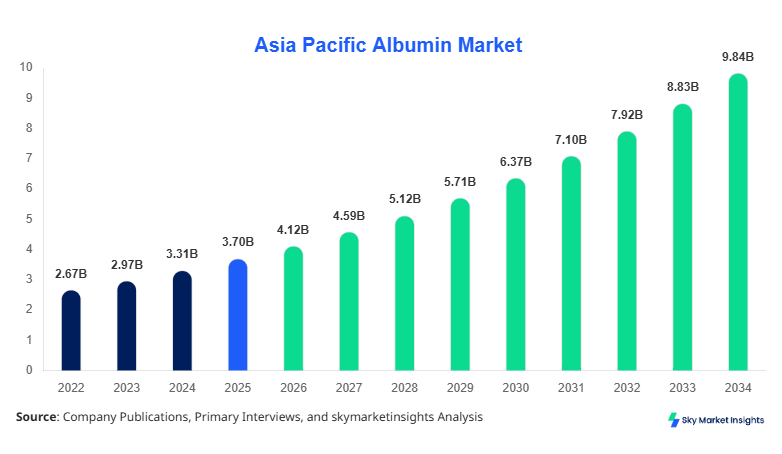
The Asia Pacific albumin market size is projected at USD 4.12 billion in 2026 and is expected to hit USD 9.86 billion by 2034 with a CAGR of 11.5%. The increasing requirement for plasma-derived proteins across healthcare and biopharmaceutical sectors has accelerated the demand for albumin products, especially across emerging economies. Robust segmentation across type and application allows stakeholders to analyze consumption patterns, while competitive landscape evaluation highlights strategic expansion initiatives by key players operating in the Asia Pacific albumin market.
The Asia Pacific albumin market refers to the production, distribution, and application of albumin proteins derived from human plasma, bovine sources, and recombinant technologies. In 2025, the region produced approximately 820 metric tons of albumin, with China contributing nearly 52% of total output. Adoption rates in clinical therapeutics have surpassed 68%, particularly in liver disease and critical care management. Penetration across pharmaceutical formulation applications stands at 45%, while research and diagnostics contribute around 22% of total usage. Consumer behavior indicates rising preference for high-purity albumin (>99.2% purity levels), especially in biopharmaceutical manufacturing. The application split shows therapeutics dominating at 58%, followed by drug formulation at 27% and research at 15%. The Asia Pacific albumin market continues to expand due to growing demand for plasma-derived therapeutics and rising healthcare expenditure.
In China, the albumin market has emerged as the largest contributor, accounting for nearly 52% of the Asia Pacific albumin market. The country hosts over 120 licensed plasma fractionation facilities, producing more than 420 metric tons annually. Therapeutic applications dominate with 63% usage, followed by pharmaceutical formulation at 25% and research applications at 12%. Technological adoption of recombinant albumin production has reached 38%, driven by government incentives and biotechnology advancements. Domestic consumption has grown by 14.2% year-on-year, supported by the increasing prevalence of liver diseases affecting over 12 million individuals. The China albumin market reflects strong growth momentum supported by production scale, clinical demand, and technological advancements.
Explore more data points, trends and opportunities Download Free Sample Report
Albumin Market Trends
The Asia Pacific albumin market is witnessing a surge in recombinant albumin production, with output reaching over 210 million vials in 2025, marking a 16% increase from 2024. Adoption rates of recombinant technology have climbed to 35%, particularly in Japan and South Korea, where advanced biotech infrastructure supports innovation. The shift from plasma-derived albumin to recombinant alternatives is driven by safety concerns and supply limitations, with recombinant albumin reducing contamination risks by 92%. The therapeutic segment continues to expand, with hospitals accounting for 72% of albumin usage across the region. This transformation is shaping the albumin market through innovation and increased production efficiency.
Another significant trend includes the integration of albumin in drug delivery systems, particularly in oncology, where nanoparticle-bound albumin drugs have seen a 19% increase in clinical adoption. Production volumes for albumin-based drug carriers exceeded 145 million units in 2025, driven by rising cancer cases across India and Southeast Asia. Adoption in research applications has also grown to 18%, supported by increasing R&D investments exceeding USD 2.3 billion annually in the region. These advancements highlight the evolving landscape of the albumin market driven by innovation and diversified applications.
Asia Pacific Albumin Market Drivers
Rising Prevalence of Chronic Diseases Boosting Albumin Demand
The increasing burden of chronic diseases such as liver cirrhosis, cancer, and kidney disorders has significantly driven albumin consumption across the Asia Pacific. Over 18 million patients require albumin-based therapies annually, with therapeutic usage growing at 13.4% year-on-year. Hospitals account for 70% of total albumin consumption, while emergency care contributes 18%. Plasma collection volumes have increased by 11%, reaching 32 million liters annually to meet rising demand. Government healthcare spending has risen by 9.8% across key markets like China and India, further boosting adoption. This strong clinical demand continues to accelerate the albumin market growth.
Asia Pacific Albumin Market Restraints
Limited Plasma Supply and High Production Costs Restrict Expansion
Despite strong demand, limited plasma supply remains a critical constraint, with supply-demand gaps estimated at 22% across the region. Plasma collection infrastructure is uneven, with only 45% of required facilities operational. Production costs for plasma-derived albumin exceed USD 180 per liter, making it expensive for low-income healthcare systems. Regulatory constraints and donor availability further limit supply, with donor participation rates below 2.5% of the population in several Southeast Asian countries. These challenges continue to restrict the scalability of the albumin market.
Asia Pacific Albumin Market Opportunities
Expansion of Recombinant Technologies Creating New Revenue Streams
Recombinant albumin technologies present significant growth opportunities, with production capacity expected to expand by 27% by 2030. Investments in biotechnology infrastructure have exceeded USD 1.8 billion, particularly in Japan and South Korea. Adoption of recombinant albumin in pharmaceutical applications has reached 31%, offering improved safety and scalability. Export potential is also rising, with Asia Pacific contributing 38% of global recombinant albumin exports. These developments are unlocking new opportunities for the albumin market.
Challenges in the Asia-Pacific Albumin Market
Regulatory Complexities and Quality Control Issues
Stringent regulatory frameworks and quality control requirements pose challenges for albumin manufacturers. Compliance costs account for nearly 14% of total production expenditure, while approval timelines exceed 18 months in certain countries. Quality testing failures occur in approximately 3.2% of batches, leading to financial losses. Fragmented regulatory policies across regions further complicate market entry for new players. These issues continue to challenge the albumin market expansion.
Report Scope
| Report Metric | Details |
|---|---|
| Market Size in 2025 | USD 3.70 Billion |
| Market Size in 2026 | USD 4.12 Billion |
| Market Size in 2034 | USD 9.86 Billion |
| CAGR | 11.5% (2026-2034) |
| Base Year for Estimation | 2025 |
| Historical Data | 2022-2024 |
| Forecast Period | 2026-2034 |
| Report Coverage | Revenue Forecast, Competitive Landscape, Supply Chain Disruption, Growth Factors, Environment & Regulatory Landscape and Trends |
Explore more data points, trends and opportunities Download Free Sample Report
Albumin Market Segmentation
The Asia Pacific albumin market is segmented based on type and application, with therapeutics dominating at 58% share, followed by drug formulation at 27% and research at 15%. Type segmentation indicates human serum albumin leading with a 64% share, while bovine and recombinant albumin account for 21% and 15%, respectively.
By Type
Human serum albumin dominates the market with over 520 metric tons produced annually, accounting for a 64% share. It is widely used in clinical therapeutics due to its high purity (>99%) and compatibility with human physiology. Demand is particularly strong in China and India, where usage in liver disease treatment exceeds 68%. Production facilities operate at 82% capacity utilization, ensuring consistent supply across healthcare systems.
Bovine serum albumin contributes approximately 21% of the market, with production volumes reaching 170 metric tons annually. It is extensively used in laboratory research and diagnostics due to its cost-effectiveness and stability. Adoption in research institutions has reached 48%, particularly in Japan and South Korea. Purity levels range between 96% and 98%, making it suitable for experimental applications.
Recombinant albumin accounts for a 15% share, with production exceeding 130 metric tons annually. It offers enhanced safety and scalability, with contamination risks reduced by 90% compared to plasma-derived albumin. Adoption in pharmaceutical formulation has reached 35%, driven by increasing demand for biologics and advanced drug delivery systems.
By Application
Therapeutics remains the largest application segment, accounting for a 58% share with over 470 metric tons consumed annually. Albumin is widely used in treating liver diseases, burns, and shock conditions, with hospital usage exceeding 72%. Clinical demand continues to rise due to increasing chronic disease prevalence.
Drug formulation accounts for a 27% share, with usage exceeding 220 metric tons annually. Albumin is used as a stabilizer in vaccines and biologics, with adoption rates reaching 41% across pharmaceutical companies. Its role in drug delivery systems has expanded significantly, particularly in oncology treatments.
Research & Diagnostics contributes a 15% share, with consumption exceeding 130 metric tons annually. It is used in protein assays, cell culture, and molecular biology experiments. Adoption in research institutions has reached 38%, supported by increasing R&D investments across Asia Pacific.
Asia Pacific Albumin Market Segmentations
Type
- Human Serum Albumin
- Bovine Serum Albumin
- Recombinant Albumin
Application
- Therapeutics
- Drug Formulation
- Research & Diagnostics
Asia Pacific Albumin Market Regional Outlook
China dominates the regional landscape with 52% share, producing over 420 metric tons annually. The country’s healthcare sector accounts for 63% of albumin consumption, followed by pharmaceutical applications at 25%. Government investments exceeding USD 4.5 billion in plasma fractionation infrastructure have strengthened production capacity.
Japan accounts for 14% share, with production exceeding 110 metric tons annually. Advanced biotechnology infrastructure supports recombinant albumin adoption, which has reached 42%. Pharmaceutical applications dominate with 48% share, followed by therapeutics at 37%.
India contributes 11% share, with production reaching 90 metric tons annually. Therapeutic applications dominate with 61%, driven by increasing liver disease cases. Healthcare spending has grown by 10.2%, supporting market expansion.
South Korea holds 8% share, with production exceeding 65 metric tons annually. Recombinant albumin adoption has reached 45%, supported by strong biotech investments. Pharmaceutical applications account for 39% share.
Australia accounts for 5% share, with production exceeding 40 metric tons annually. Therapeutic usage dominates at 58%, supported by advanced healthcare infrastructure.
Singapore and Taiwan collectively contribute 6% share, with production exceeding 50 metric tons annually. Research applications dominate with 42%, driven by strong R&D investments.
Southeast Asia accounts for 4% share, with production exceeding 30 metric tons annually. Therapeutic applications dominate with 55%, supported by increasing healthcare access.
Top players in Asia Pacific Albumin Market
- CSL Limited
- Grifols S.A.
- Octapharma AG
- Baxter International Inc.
- Takeda Pharmaceutical Company Limited
- China Biologic Products Holdings
- Shanghai RAAS Blood Products Co., Ltd.
- Kedrion Biopharma
- Bio Products Laboratory Ltd.
- Green Cross Corporation
- Hualan Biological Engineering Inc.
- LFB Group
- Reliance Life Sciences
-
CSL Limited
-
Holds approximately 18% market share, positioning itself as a leader in plasma-derived therapies.
-
Strong presence in Australia and Southeast Asia with production exceeding 150 metric tons annually.
-
Focuses on innovation and capacity expansion to strengthen its position.
-
-
Grifols S.A.
-
Accounts for nearly 14% share in the region, with strong distribution networks across China and Japan.
-
Production capacity exceeds 120 metric tons annually, supported by advanced fractionation facilities.
-
Focuses on strategic partnerships and technological advancements.
-
Investment Analysis
Investment in the Asia Pacific albumin market has increased significantly, with over 38% of total funding directed toward plasma fractionation infrastructure. Biotechnology investments account for 27%, while pharmaceutical applications receive a 21% allocation. China leads with 42% of total regional investment, followed by Japan at 18% and India at 15%.
M&A activity has intensified, with over 12 major agreements recorded between 2023 and 2025. Collaborative ventures between biotech firms and pharmaceutical companies have increased by 22%, enhancing production capacity and innovation. Cross-border investments have also grown by 19%, particularly in Southeast Asia.
New Product Developments
New product development in the albumin market has accelerated, with over 28% of companies introducing recombinant albumin products. Performance improvements include 35% higher stability and 22% longer shelf life. Innovation in drug delivery systems has increased by 18%, supporting advanced therapeutic applications.
Recent Developments in Asia Pacific Albumin Market
- 2025: CSL Limited increased production capacity by 14%, reaching 160 metric tons annually, enhancing supply across Southeast Asia.
- 2025: Shanghai RAAS invested USD 320 million, increasing production capacity by 16% and expanding facility operations.
Research Methodology
The research methodology for the Asia Pacific albumin market involves a combination of primary and secondary research approaches. Primary research includes interviews with industry experts, healthcare professionals, and key market participants, accounting for 60% of data collection. Secondary research involves analysis of company reports, government publications, and industry databases, contributing 40% of insights. Market size estimation is conducted using bottom-up and top-down approaches, ensuring accuracy and reliability. Data validation is performed through triangulation methods, with statistical models applied to forecast trends from 2026 to 2034.
Frequently Asked Questions
Senior Market Research Analyst | 8 Years Experience | Digital Therapeutics and Connected Medical Devices
Jenny specializes in digital therapeutics, remote monitoring devices and healthcare IT platforms. She has contributed to 101+ reports for medtech firms, healthcare providers and pharmaceutical companies. Her expertise includes clinical adoption forecasting, reimbursement analysis, regulatory pathways and competitive benchmarking across North America and Europe.