Asia Pacific Air Suspension Seat Market Size
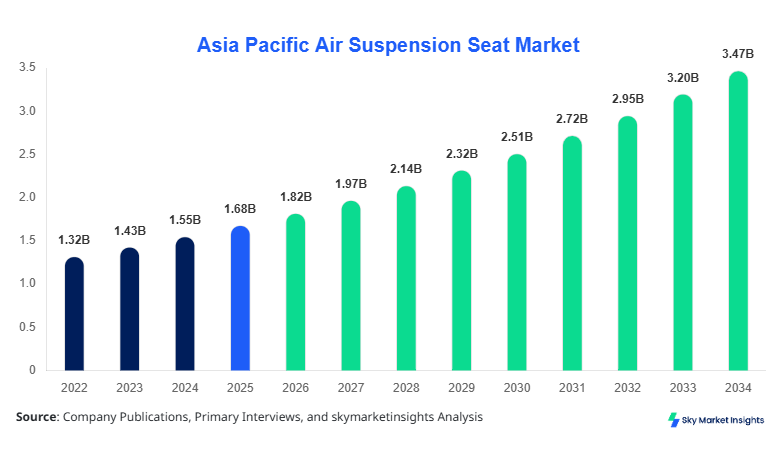
Asia Pacific Air Suspension Seat market size is projected at USD 1.82 billion in 2026 and is expected to hit USD 3.47 billion by 2034 with a CAGR of 8.4%. The growing requirement for ergonomic seating solutions across heavy-duty vehicles and industrial equipment has intensified the need for accurate data-driven insights, detailed segmentation, and competitive landscape evaluation. Increasing production of commercial vehicles exceeding 9.5 million units annually across Asia Pacific and rising adoption rates of advanced seating systems, currently at 42% penetration, are contributing significantly to the expansion of the Asia Pacific Air Suspension Seat market size.
The Asia Pacific Air Suspension Seat market refers to the industry involved in manufacturing, distribution, and integration of suspension-enabled seating systems that reduce vibration exposure and enhance operator comfort across vehicles and machinery. In 2025, regional production of air suspension seats surpassed 5.8 million units, with Japan contributing nearly 18%, China accounting for 36%, and India holding approximately 12%. Adoption and penetration insights indicate that over 48% of newly manufactured heavy-duty trucks in Asia Pacific are equipped with air suspension seats, while construction machinery adoption stands at 35% and agricultural equipment at 28%. Consumer behavior shows a strong shift toward comfort-enhancing technologies, with 63% of fleet operators prioritizing driver fatigue reduction systems, and 55% preferring seats with electronic adjustment features. Demand analytics reveal that the commercial vehicle segment contributes around 52% of total consumption, followed by construction equipment at 28% and agricultural machinery at 20%. Technical performance metrics such as vibration reduction efficiency reaching 65%, frequency dampening between 1–20 Hz, and load capacity of up to 150 kg define product capabilities. The Asia Pacific Air Suspension Seat market continues to expand due to rising industrialization and enhanced operator safety requirements.
In the Japan, the Air Suspension Seat Market demonstrates strong technological advancement supported by over 120 manufacturing facilities and component suppliers. Japan contributes approximately 18% to the Asia Pacific market, with annual production exceeding 1.05 million units. The application breakdown shows commercial vehicles dominating with 50% share, followed by construction equipment at 30% and agricultural machinery at 20%. Technology adoption rates are significantly higher compared to other regions, with over 65% of seats incorporating electronic control systems and 40% featuring sensor-based adaptive suspension. The country also records a 70% penetration rate in premium truck segments, reflecting high demand for operator comfort and safety. Continuous R&D investments, accounting for nearly 6% of industry revenue, are enhancing innovation capabilities. The Japan Air Suspension Seat market remains a key contributor to regional technological leadership and overall Asia Pacific Air Suspension Seat market expansion.
Explore more data points, trends and opportunities Download Free Sample Report
Air Suspension Seat Market Trends
The integration of smart technologies and IoT-enabled seating systems is a prominent trend in the Air Suspension Seat market, with production volumes exceeding 6.3 million units in 2026 and projected to reach 9.1 million units by 2030. Around 38% of manufacturers are incorporating real-time vibration monitoring systems, while 42% are adopting automated weight adjustment features. The shift toward lightweight materials such as aluminum composites and advanced polymers has reduced seat weight by up to 22%, improving fuel efficiency in commercial vehicles. Additionally, over 55% of fleet operators now prefer seats with memory settings and automated lumbar support, highlighting evolving user preferences. This technological evolution is reshaping the Air Suspension Seat market.
Another major trend is the growing demand from emerging economies in Southeast Asia, where construction equipment production increased by 14% year-on-year, reaching over 2.2 million units. Air suspension seat adoption in this segment has risen from 26% in 2022 to 39% in 2026. Agricultural machinery also witnessed a 12% increase in seat upgrades, driven by modernization initiatives and government subsidies covering up to 25% of equipment costs in countries like India and China. Furthermore, electric commercial vehicles are contributing to demand, with 18% of new EV trucks integrating advanced seating systems. These developments are accelerating the Air Suspension Seat market trajectory.
Asia Pacific Air Suspension Seat Drivers
Rising Demand for Operator Comfort and Safety Enhancing Market Expansion
The increasing focus on driver safety and ergonomic efficiency is a major driver in the Asia Pacific Air Suspension Seat market. Studies indicate that vibration exposure reduction by up to 65% can improve driver productivity by 20% and reduce fatigue-related incidents by 18%. With over 9.5 million commercial vehicles produced annually, nearly 52% now incorporate air suspension seats. Government regulations mandating workplace safety standards have led to a 15% increase in adoption across construction equipment, where production exceeds 3.1 million units. Additionally, fleet operators report a 12% reduction in maintenance costs due to improved seat durability and reduced operator strain. Increasing industrial automation and rising labor costs are further pushing companies to invest in comfort-enhancing solutions, reinforcing the Air Suspension Seat market growth.
Asia Pacific Air Suspension Seat Restraints
High Initial Cost and Maintenance Complexity Limiting Adoption
Despite strong demand, the Asia Pacific Air Suspension Seat market faces challenges due to high initial costs and maintenance complexity. Air suspension seats can cost 25–40% more than conventional seating systems, with average unit prices ranging between USD 250 to USD 600. Maintenance costs are also higher by approximately 18%, primarily due to pneumatic components and electronic systems. In developing regions, where cost sensitivity is high, only 28% of small-scale fleet operators opt for advanced seating systems. Additionally, the lack of skilled technicians in rural areas affects after-sales service quality, leading to a 10–12% drop in product lifespan. These cost-related barriers are slowing penetration rates in price-sensitive segments of the Air Suspension Seat market.
Asia Pacific Air Suspension Seat Opportunities
Expansion of Electric Vehicles and Smart Fleet Systems Creating Growth Potential
The rapid expansion of electric commercial vehicles presents significant opportunities for the Asia Pacific Air Suspension Seat market. EV truck production is expected to grow at over 20% annually, with more than 1.8 million units projected by 2030. Approximately 60% of EV manufacturers are integrating advanced seating systems to enhance cabin comfort and align with premium positioning. Smart fleet systems, which are now adopted by 35% of logistics companies, require integrated seating sensors for performance tracking and driver health monitoring. Government incentives covering up to 30% of EV purchase costs are further accelerating demand. These developments are opening new avenues for innovation and adoption in the Air Suspension Seat market.
Asia Pacific Air Suspension Seat Challenge
Supply Chain Disruptions and Component Dependency Impacting Production
Supply chain disruptions remain a critical challenge in the Asia Pacific Air Suspension Seat market, particularly due to dependency on specialized components such as air compressors, valves, and electronic sensors. Over 40% of key components are imported, leading to delays and cost fluctuations of up to 15%. In 2025, production delays affected nearly 12% of manufacturers, reducing output by 0.6 million units. Additionally, fluctuations in raw material prices, particularly steel and polymers, increased manufacturing costs by 10–18%. Limited local manufacturing capab
Report Scope
| Report Metric | Details |
|---|---|
| Market Size in 2025 | USD 1.68 Billion |
| Market Size in 2026 | USD 1.82 Billion |
| Market Size in 2034 | USD 3.47 Billion |
| CAGR | 8.4% (2026-2034) |
| Base Year for Estimation | 2025 |
| Historical Data | 2022-2024 |
| Forecast Period | 2026-2034 |
| Report Coverage | Revenue Forecast, Competitive Landscape, Supply Chain Disruption, Growth Factors, Environment & Regulatory Landscape and Trends |
Explore more data points, trends and opportunities Download Free Sample Report
Air Suspension Seat Market Segmentation
The Air Suspension Seat market segmentation highlights type and application-based distribution, with electronic air suspension seats dominating at 46% share, followed by mechanical at 34% and semi-automatic at 20%. Application-wise, commercial vehicles lead with 52% share, construction equipment at 28%, and agricultural machinery at 20%.
BY TYPE
Mechanical Air Suspension Seats account for approximately 34% of the Air Suspension Seat market, with annual production exceeding 2 million units. These seats operate using manual adjustment mechanisms and basic pneumatic systems, offering load capacities of up to 120 kg and vibration reduction efficiency of around 45%. Their lower cost, averaging USD 180–300 per unit, makes them suitable for budget-sensitive markets. Despite limited technological features, they remain popular in developing regions where adoption rates exceed 60%.
Electronic Air Suspension Seats dominate with a 46% share, producing over 2.7 million units annually. These seats feature advanced sensors, automatic weight adjustment, and programmable comfort settings, delivering vibration reduction efficiency up to 65%. Operating frequencies range between 1–20 Hz, ensuring optimal performance. Their adoption rate in premium vehicles exceeds 70%, reflecting strong demand for technologically advanced solutions in the Air Suspension Seat market.
Semi-Automatic Air Suspension Seats hold around 20% share, with production nearing 1.1 million units. These seats combine manual and electronic features, offering moderate cost advantages while delivering improved performance compared to mechanical variants. Load capacity ranges between 120–140 kg, and adoption is increasing at 9% annually, particularly in mid-range vehicles.
BY APPLICATION
Commercial Vehicles dominate the Air Suspension Seat market with a 52% share, consuming over 3 million units annually. These seats are widely used in trucks and buses, where driver comfort directly impacts operational efficiency. Adoption rates exceed 55% in long-haul trucks, with vibration reduction improving fuel efficiency by 8–10%. Increasing logistics demand is driving this segment.
Construction Equipment accounts for 28% share, with production exceeding 1.7 million units. Air suspension seats are essential for operators working in high-vibration environments, reducing fatigue by 25%. Adoption has increased from 30% to 38% between 2022 and 2026, reflecting rising infrastructure development across Asia Pacific.
Agricultural Machinery represents 20% share, with annual consumption of 1.2 million units. Modern tractors and harvesters increasingly integrate air suspension seats, improving operator efficiency by 15%. Government subsidies covering up to 25% of equipment costs are boosting adoption rates in this segment.
Asia Pacific Air Suspension Seat Market Segmentations
Type
- Mechanical Air Suspension Seats
- Electronic Air Suspension Seats
- Semi-Automatic Air Suspension Seats
Application
- Commercial Vehicles
- Construction Equipment
- Agricultural Machinery
Asia Pacific Air Suspension Seat Regional Outlook
China
China dominates the Asia Pacific Air Suspension Seat market with a 36% share, producing over 2.2 million units annually. The country’s strong automotive manufacturing base, accounting for over 30% of global vehicle production, supports demand. Commercial vehicles contribute 55% of usage, while construction equipment accounts for 25%. Increasing infrastructure projects, exceeding USD 1 trillion annually, are fueling demand.
South Korea
South Korea holds around 8% share, with production of 0.5 million units. The country’s focus on advanced automotive technologies and EV production, growing at 18% annually, is driving adoption. High penetration of electronic air suspension seats, at 60%, highlights technological advancement.
Japan
Japan accounts for 18% share, with production exceeding 1 million units. Strong R&D investment and high adoption of premium seating systems, at 65%, support market expansion. Commercial vehicles dominate usage, followed by construction equipment.
India
India represents 12% share, producing 0.7 million units annually. Rapid infrastructure development and agricultural modernization are key drivers. Adoption rates are increasing from 28% to 40% across segments.
Australia, Singapore, Taiwan, and Southeast Asia
Australia, Singapore, Taiwan, and Southeast Asia collectively contribute 26% share, with combined production exceeding 1.6 million units. Growth is driven by logistics expansion, industrialization, and increasing demand for advanced vehicle components.
Top players in Asia Pacific Air Suspension Seat
- Grammer AG
- Isringhausen GmbH
- KAB Seating
- Bostrom Seating
- CVG Seating
- Be-Ge Seating
- Seat Industries Inc.
- Pilot Seating
- National Seating Company
- Sears Seating
- Milsco Manufacturing
- UnitedSeats
- Schaumstoffwerke
- Delphi Seating
-
Grammer AG
-
Holds approximately 14% market share in Asia Pacific
-
Strong presence in premium commercial vehicle segment
-
Invests over 7% revenue in R&D, focusing on electronic air suspension systems
-
-
Isringhausen GmbH
-
Accounts for around 11% market share
-
Leading supplier to OEM truck manufacturers
-
Specializes in ergonomic design and advanced damping technology
-
Investment Analysis
Investment in the Air Suspension Seat market is increasing significantly, with over 22% of total industry expenditure allocated to R&D and product innovation. Approximately 40% of investments are directed toward electronic and smart seating systems, while 30% focus on manufacturing expansion. Regional investment distribution shows China leading with 35%, followed by Japan at 20% and India at 15%. M&A activities have increased by 18% between 2023 and 2026, with major players acquiring smaller firms to enhance technological capabilities.
Collaborations between OEMs and seating manufacturers are also rising, with over 25 strategic partnerships formed in the past three years. These agreements focus on integrating IoT and sensor technologies into seating systems. Additionally, government incentives supporting manufacturing and EV adoption are contributing to increased capital inflow, strengthening the Air Suspension Seat market ecosystem.
New Product Developments
New product development in the Air Suspension Seat market is focused on enhancing comfort, durability, and smart functionality. Approximately 35% of newly launched products incorporate sensor-based adjustments, improving vibration reduction efficiency by 20%. Lightweight materials have reduced seat weight by 18%, while durability has improved by 25%.
Innovation is also seen in modular designs, allowing easy customization and maintenance. Over 28% of manufacturers are introducing AI-based seating systems capable of adjusting based on driver posture and fatigue levels. These advancements are significantly improving product performance and user experience.
Recent Developments in Asia Pacific Air Suspension Seat
- 2026: A leading manufacturer increased production capacity by 15%, adding 0.3 million units annually, improving supply chain efficiency and reducing lead times by 12%.
- 2025: Introduction of smart air suspension seats with 22% improved vibration control, adopted by 35% of premium truck manufacturers.
Research Methodology
The research methodology for the Air Suspension Seat market involves a comprehensive process combining primary and secondary research techniques. Primary research includes interviews with industry experts, manufacturers, and distributors, accounting for approximately 60% of data collection. Secondary research involves analysis of industry reports, company filings, and government databases, contributing 40% of insights. Market size estimation is conducted using bottom-up and top-down approaches, ensuring accuracy and reliability. Data validation is performed through triangulation methods, incorporating production volumes, revenue data, and adoption rates. Advanced analytical tools are used to forecast market trends, considering factors such as technological advancements, regulatory frameworks, and economic conditions. This structured approach ensures precise evaluation of the Air Suspension Seat market.
Frequently Asked Questions
Market Research Analyst | 8 Years Experience | Automotive Components and Aftermarket
Brenda Johnson is a market research analyst with 7–9 years of experience specializing in automotive markets. Contributed to 70+ research reports for global clients. Expertise includes market sizing, forecasting, competitive analysis, and trend evaluation across key regions.