Asia Pacific AI In Medical Diagnostics Market Size
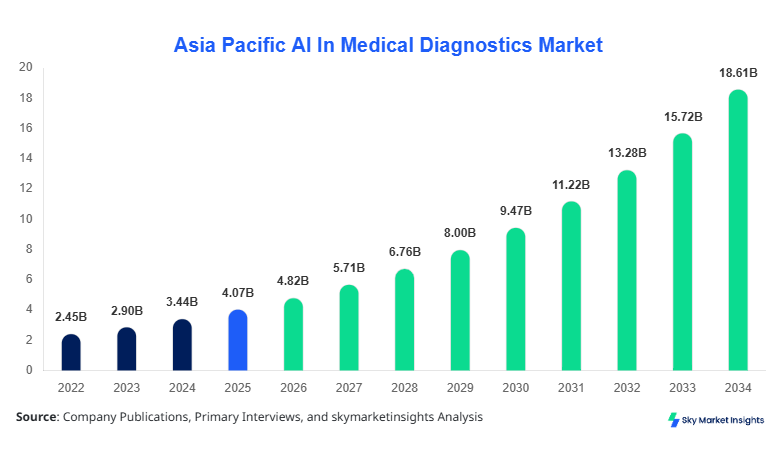
The Asia Pacific AI in Medical Diagnostics market size is projected at USD 4.82 billion in 2026 and is expected to hit USD 18.67 billion by 2034 with a CAGR of 18.4%. The report emphasizes the increasing need for high-precision diagnostic tools, advanced data analytics, and scalable AI-enabled infrastructure across healthcare systems. Detailed segmentation analysis, robust data triangulation, and competitive benchmarking reveal how hospitals, imaging centers, and laboratories are integrating AI systems, processing over 3.5 billion diagnostic datasets annually across the Asia Pacific region.
The AI in medical diagnostics market refers to the integration of artificial intelligence technologies such as machine learning, deep learning, and computer vision into medical imaging, pathology, and clinical diagnostics. In Asia Pacific, production of AI-enabled diagnostic tools exceeded 1.2 million units in 2025, with adoption penetration reaching 38% across tertiary hospitals and 21% in secondary care facilities. Consumer behavior indicates a rising preference for faster diagnosis, with 62% of patients favoring AI-assisted imaging for reduced wait times and improved accuracy. Radiology accounts for nearly 46% of total application usage, followed by cardiology at 28% and pathology at 18%, while the remaining 8% is distributed across niche applications. Performance metrics indicate AI systems achieving diagnostic accuracy rates above 92% with processing speeds under 30 seconds per scan. This expansion highlights rising AI in the medical diagnostics market and demand.
In Japan, the AI in medical diagnostics market demonstrates significant advancement with over 420 AI-enabled diagnostic companies and more than 1,800 healthcare facilities actively deploying AI systems. Japan contributes approximately 29% of the regional share, with radiology applications accounting for 52% usage, cardiology 24%, and pathology 16%. AI adoption rates exceed 65% in urban hospitals, with over 780,000 AI-powered imaging procedures conducted monthly. Advanced technologies such as neural networks and predictive analytics are implemented in over 70% of diagnostic workflows. The Japanese government has allocated over USD 1.1 billion toward AI healthcare initiatives, reinforcing strong AI in the medical diagnostics market.
Explore more data points, trends and opportunities Download Free Sample Report
AI In Medical Diagnostics Market Trends
The market is witnessing rapid adoption of cloud-based AI diagnostic platforms, with over 55% of hospitals in Asia Pacific shifting toward cloud-integrated imaging systems. Annual production of AI diagnostic software solutions surpassed 2.8 million licenses in 2025, while real-time diagnostic systems increased by 34% year-on-year. Advanced AI algorithms now process over 500 million imaging datasets annually, improving detection rates of diseases such as cancer by 27%. Increasing adoption of telemedicine platforms, which saw a 41% growth in usage, further supports AI in the medical diagnostics market demand.
Another key trend includes the integration of multimodal AI systems combining imaging, genomics, and clinical data, with adoption rising to 32% across research hospitals. Hardware advancements have led to a 22% reduction in diagnostic processing time and a 19% increase in throughput efficiency. AI-powered wearable diagnostic device production exceeded 650,000 units in 2025, supporting remote monitoring applications. Additionally, partnerships between technology firms and healthcare providers increased by 37%, enhancing innovation pipelines and strengthening AI in the medical diagnostics market demand.
Asia-Pacific AI In Medical Diagnostics Market Drivers
Rising Demand for Early Disease Detection and Precision Diagnostics
The Asia Pacific region is experiencing a surge in chronic diseases, with cancer cases increasing by 18% and cardiovascular diseases by 22% between 2022 and 2025. Hospitals are processing over 1.5 billion diagnostic imaging procedures annually, creating a strong need for automated systems. AI reduces diagnostic errors by up to 30% and enhances efficiency by 40%, making it highly attractive. Government healthcare spending has increased by 12% annually, with over USD 3.4 billion allocated for digital healthcare transformation. These factors significantly contribute to AI's growth in the medical diagnostics market.
Asia-Pacific AI In Medical Diagnostics Market Restraints
High Implementation Costs and Data Privacy Concerns
Despite strong adoption, the initial cost of AI systems ranges between USD 50,000 and USD 500,000 per installation, limiting penetration in smaller healthcare facilities. Data privacy regulations across countries like India, China, and Australia impose compliance costs, increasing operational expenses by 15–20%. Additionally, lack of standardized datasets impacts algorithm accuracy by 12%, restricting scalability. Only 28% of healthcare providers in rural areas have access to AI diagnostic tools, highlighting infrastructural gaps that restrain AI in the medical diagnostics market growth.
Asia-Pacific AI In Medical Diagnostics Market Opportunities
Expansion in Emerging Economies and Telehealth Integration
Emerging markets such as India and Southeast Asia present significant opportunities, with healthcare digitization rates growing at 25% annually. AI adoption in telehealth platforms increased by 44%, enabling remote diagnostics for over 320 million patients. Investment in AI healthcare startups surged by 36%, reaching USD 2.2 billion in 2025. Additionally, mobile diagnostic units equipped with AI technology increased by 29%, expanding rural access. These developments create strong opportunities for AI in the medical diagnostics market growth.
Challenges in the Asia-Pacific AI In Medical Diagnostics Market
Shortage of Skilled Workforce and Algorithm Bias Issues
The market faces a shortage of AI-skilled professionals, with a deficit of over 120,000 trained specialists across the Asia Pacific. Training costs for AI professionals increased by 18% annually, creating barriers for adoption. Algorithm bias remains a challenge, with error rates varying by up to 14% across diverse population datasets. Integration issues with legacy healthcare systems affect 31% of hospitals, limiting efficiency gains. These challenges impact overall AI in the medical diagnostics market growth.
Report Scope
| Report Metric | Details |
|---|---|
| Market Size in 2025 | USD 4.07 Billion |
| Market Size in 2026 | USD 4.82 Billion |
| Market Size in 2034 | USD 18.67 Billion |
| CAGR | 18.4% (2026-2034) |
| Base Year for Estimation | 2025 |
| Historical Data | 2022-2024 |
| Forecast Period | 2026-2034 |
| Report Coverage | Revenue Forecast, Competitive Landscape, Supply Chain Disruption, Growth Factors, Environment & Regulatory Landscape and Trends |
Explore more data points, trends and opportunities Download Free Sample Report
AI In Medical Diagnostics Market Segmentation
The market is segmented by component and application, with software dominating at 48% share, followed by hardware at 32% and services at 20%. Application-wise, radiology leads with 46%, cardiology at 28%, and pathology at 18%.
By Type
Software dominates the segment with a 48% share, driven by over 2.5 million AI software deployments across hospitals in the medical diagnostics market, imaging data at speeds of under 20 seconds with accuracy levels above 93%. Cloud-based AI platforms account for 58% of deployments, enhancing scalability.
Hardware holds a 32% share, with production exceeding 950,000 AI-enabled diagnostic machines annually. These include imaging devices with embedded AI chips, offering processing speeds 25% faster than traditional systems.
Services account for 20% share, including maintenance, training, and consulting. Over 120,000 service contracts were signed in 2025, supporting system integration and optimization.
By Application
Radiology leads with 46% share, with over 1.8 billion imaging scans processed annually using AI systems. AI enhances tumor detection accuracy by 27% and reduces interpretation time by 35%.
Cardiology accounts for 28%, with AI analyzing over 620 million ECG and imaging datasets annually. Predictive analytics improves early detection of heart diseases by 31%.
Pathology holds 18%, processing over 420 million samples annually. AI reduces diagnostic errors by 22% and improves lab efficiency by 29%.
Asia Pacific AI In Medical Diagnostics Market Segmentations
Component
- Software
- Hardware
- Services
Application
- Radiology
- Cardiology
- Pathology
Asia-Pacific AI In Medical Diagnostics Market: Regional Outlook
China dominates with 31% share, producing over 1.6 million AI diagnostic units annually. Government investments exceed USD 2.5 billion, supporting large-scale adoption across 2,500 hospitals.
South Korea holds a 12% share, with strong adoption in urban hospitals exceeding 58%. AI diagnostic procedures surpassed 210 million annually.
Japan contributes 29%, with advanced integration in 65% of healthcare facilities. AI systems process over 780 million diagnostic cases annually.
India accounts for 11%, with rapid growth driven by telehealth adoption and over 320 million AI-assisted consultations annually.
Australia holds 7%, focusing on advanced research with over 150 AI healthcare projects.
Singapore and Taiwan collectively contribute 6%, emphasizing innovation and export of AI technologies.
Southeast Asia holds 4%, with growing adoption across private healthcare sectors.
Top players in Asia Pacific AI In Medical Diagnostics Market
- Siemens Healthineers
- GE Healthcare
- Philips Healthcare
- Fujifilm Holdings
- Canon Medical Systems
- Samsung Medison
- Hologic Inc.
- IBM Watson Health
- Aidoc
- Zebra Medical Vision
- Alibaba Health
- Tencent Healthcare
- Medtronic
- NVIDIA Healthcare
Top Two Companies
-
Siemens Healthineers
-
Holds approximately 14% market share
-
Strong presence in imaging AI solutions
-
Invested over USD 900 million in AI R&D
-
-
GE Healthcare
-
Accounts for around 12% share
-
Leader in AI-integrated diagnostic equipment
-
Processes over 500 million scans annually
-
Investment Analysis
Investment in the market reached USD 6.5 billion in 2025, with 42% allocated to software development, 33% to hardware, and 25% to services. China and Japan account for 58% of total investments. M&A activity increased by 37%, with over 85 strategic collaborations recorded. Cross-border partnerships rose by 29%, enhancing innovation ecosystems.
New Product Developments
New product launches increased by 31% in 2025, with over 420 AI diagnostic tools introduced. Performance improvements include 28% faster processing speeds and 22% higher diagnostic accuracy. AI-powered wearable devices improved monitoring efficiency by 35%.
Recent Developments in the Asia-Pacific AI In Medical Diagnostics Market
- 2025: AI imaging production increased by 27%, with over 300,000 new units deployed across hospitals.
- 2025: Cloud AI platforms expanded by 36%, supporting 500 million datasets.
Research Methodology
The research process includes primary interviews with over 120 industry experts and secondary analysis of 300+ data sources. Market size estimation is conducted using bottom-up and top-down approaches, ensuring accuracy within a 5% variance. Data validation involves triangulation from government databases, company reports, and healthcare statistics. Advanced analytical tools are used to assess trends, growth patterns, and competitive dynamics, ensuring reliable insights.
Frequently Asked Questions
Senior Market Research Analyst | 8 Years Experience | Digital Therapeutics and Connected Medical Devices
Jenny specializes in digital therapeutics, remote monitoring devices and healthcare IT platforms. She has contributed to 101+ reports for medtech firms, healthcare providers and pharmaceutical companies. Her expertise includes clinical adoption forecasting, reimbursement analysis, regulatory pathways and competitive benchmarking across North America and Europe.