Asia Pacific Agricultural Product Warehousing Service Market Size
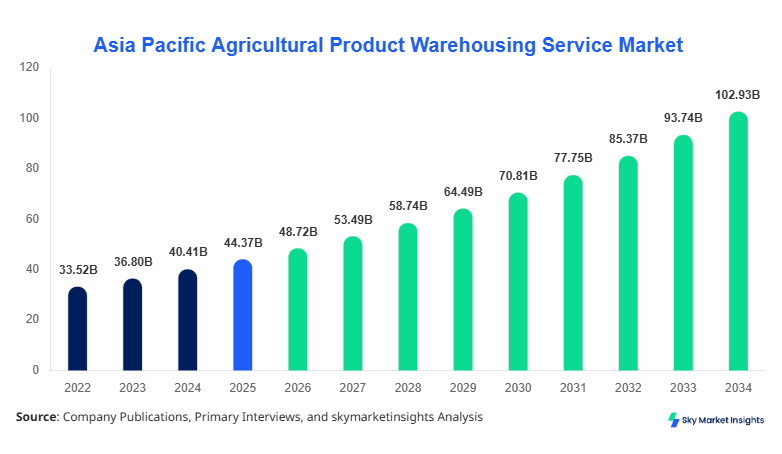
The Asia Pacific Agricultural Product Warehousing Service market size is projected at USD 48.72 billion in 2026 and is expected to hit USD 102.65 billion by 2034 with a CAGR of 9.8%. The increasing demand for structured storage infrastructure, digitized inventory systems, and temperature-controlled facilities across 8+ major economies has led to over 18,500 operational warehouses in 2026, handling more than 1.2 billion metric tons of agricultural produce annually. The need for real-time data analytics, segmentation by commodity types, and competitive benchmarking across regional providers continues to intensify as over 62% of agricultural supply chains shift toward formal storage networks. The market emphasizes integration of IoT-enabled monitoring systems and capacity expansion by 25% across high-demand zones.
The Asia-Pacific Agricultural Product Warehousing Service Market encompasses services related to storage, preservation, and inventory management of agricultural commodities, including grains, oilseeds, and perishable goods. In 2026, the region produced approximately 2.8 billion metric tons of agricultural output, of which nearly 43% required warehousing solutions due to post-harvest logistics constraints. Adoption and penetration insights indicate that nearly 58% of farmers and agribusinesses are now utilizing third-party warehousing services, compared to 41% in 2022, reflecting a steady 17% increase in organized storage reliance. Consumer behavior and demand analytics reveal that food security concerns and export-driven demand have increased storage utilization rates by 22% across Asia Pacific, with seasonal peak occupancy reaching 85–90% in countries like India and China. Segment-wise, cold storage contributes 34%, general warehousing 46%, and controlled atmosphere storage 20% to total service deployment. The application split shows grains dominating at 52%, fruits & vegetables at 31%, and oilseeds at 17%, reinforcing agricultural product warehousing service market share dynamics.
In China, the Agricultural Product Warehousing Service Market accounts for approximately 38% of the regional capacity, supported by over 7,200 warehousing facilities and annual handling of 520 million metric tons of agricultural commodities. Grain storage alone contributes 56% of total usage, followed by fruits and vegetables at 29% and oilseeds at 15%. Technology adoption in China has accelerated significantly, with 64% of warehouses equipped with automated inventory systems and 41% utilizing AI-based demand forecasting tools. The country has also seen a 28% expansion in cold storage capacity between 2023 and 2026, reaching 210 million cubic meters. Government-backed initiatives have led to an 18% cost reduction in logistics operations, boosting efficiency. Export-oriented warehousing accounts for nearly 35% of usage, highlighting China’s leadership in the Agricultural Product Warehousing Service Market Share.
Explore more data points, trends and opportunities Download Free Sample Report
Agricultural Product Warehousing Service Market Trends
The Asia-Pacific Agricultural Product Warehousing Service market is witnessing rapid transformation driven by technological integration and capacity expansion. In 2026, over 1.2 billion metric tons of produce will be processed through warehousing systems, with cold storage volumes exceeding 420 million metric tons annually. Automation adoption has reached 48%, up from 32% in 2022, while IoT-enabled monitoring systems are now present in 37% of facilities. Digital warehouse management systems have improved inventory accuracy by 26% and reduced spoilage rates by 18%. Demand from export markets has increased storage utilization by 21%, particularly for high-value crops like fruits and vegetables, reinforcing agricultural product warehousing service market growth.
Another key trend involves the expansion of controlled atmosphere storage, which has grown at a rate of 14% annually, reaching 180 million cubic meters of capacity in 2026. Countries such as India and Japan have increased investments in energy-efficient storage systems, reducing operational costs by 19%. Blockchain integration in supply chains has improved traceability for over 28% of stored commodities, enhancing transparency and compliance with international standards. Seasonal demand fluctuations have led to 12% higher utilization rates during harvest seasons, with peak occupancy exceeding 90% in key regions. These advancements highlight evolving agricultural product warehousing service market trends.
Asia Pacific Agricultural Product Warehousing Service Market Drivers
Rising Agricultural Output and Export Demand Driving Storage Expansion
The Asia-Pacific Agricultural Product Warehousing Service market is driven by increasing agricultural production, which reached approximately 2.8 billion metric tons in 2026, marking a 16% rise from 2022 levels. Export demand for agricultural commodities has grown by 22%, necessitating efficient storage infrastructure capable of handling high volumes. Governments across the region have invested over USD 12 billion in storage infrastructure development between 2023 and 2026, leading to a 25% increase in total warehousing capacity. Cold storage adoption has surged by 18%, particularly for perishable goods, reducing post-harvest losses by 14%. The integration of advanced technologies such as AI and IoT has improved operational efficiency by 27%, further supporting market expansion. The growing need for food security and supply chain resilience continues to fuel agricultural product warehousing service market growth.
Asia Pacific Agricultural Product Warehousing Service Market Restraints
High Infrastructure Costs and Energy Consumption Challenges
Despite strong growth, the agricultural product warehousing service market faces significant restraints due to high infrastructure costs, with average warehouse construction expenses ranging between USD 150 and USD 250 per square meter. Energy consumption in cold storage facilities accounts for nearly 30% of operational costs, creating financial burdens for operators. In 2026, nearly 42% of small-scale farmers still lack access to modern warehousing services due to affordability issues. Maintenance costs have increased by 12% annually, driven by rising energy prices and equipment upgrades. Additionally, regulatory complexities across multiple countries have slowed project approvals by 8–10%, limiting expansion. These factors collectively hinder the agricultural product warehousing service market growth.
Asia Pacific Agricultural Product Warehousing Service Market Opportunities
Expansion of Cold Chain Logistics and Digital Integration
The agricultural product warehousing service market presents significant opportunities through the expansion of cold chain logistics, which is projected to grow by 20% annually across the Asia Pacific. Investment in smart warehousing technologies has increased by 24%, enabling real-time monitoring and predictive analytics. Emerging markets such as Southeast Asia are witnessing a 28% rise in demand for temperature-controlled storage, driven by export-oriented agriculture. Public-private partnerships have contributed to 18% of new warehouse developments, enhancing infrastructure availability. The adoption of renewable energy solutions in warehouses has reduced operational costs by 15%, creating sustainable growth opportunities and strengthening agricultural product warehousing service market trends.
Challenges in the Asia-Pacific Agricultural Product Warehousing Service Market
Supply Chain Fragmentation and Limited Rural Connectivity
The Agricultural Product Warehousing Service Market faces challenges due to fragmented supply chains, with over 55% of agricultural produce still handled through informal networks. Rural connectivity issues limit access to modern storage facilities, affecting nearly 38% of farmers in remote regions. Transportation inefficiencies increase logistics costs by 17%, impacting overall profitability. Additionally, the lack of standardized storage practices leads to 12–15% post-harvest losses annually. Workforce shortages in skilled warehouse management have increased operational inefficiencies by 9%. Addressing these challenges is critical to sustaining agricultural product warehousing service market growth.
Report Scope
| Report Metric | Details |
|---|---|
| Market Size in 2025 | USD 44.37 Billion |
| Market Size in 2026 | USD 48.72 Billion |
| Market Size in 2034 | USD 102.65 Billion |
| CAGR | 9.8% (2026-2034) |
| Base Year for Estimation | 2025 |
| Historical Data | 2022-2024 |
| Forecast Period | 2026-2034 |
| Report Coverage | Revenue Forecast, Competitive Landscape, Supply Chain Disruption, Growth Factors, Environment & Regulatory Landscape and Trends |
Explore more data points, trends and opportunities Download Free Sample Report
Agricultural Product Warehousing Service Market Segmentation
The Agricultural Product Warehousing Service Market is segmented based on type and application, with general warehousing dominating at 46%, followed by cold storage at 34% and controlled atmosphere storage at 20%. Application-wise, grains account for 52%, fruits & vegetables 31%, and oilseeds 17%, highlighting strong agricultural product warehousing service market share distribution.
By Type
General Warehousing holds approximately a 46% share, handling over 550 million metric tons annually. These facilities typically operate at 70–80% capacity utilization and are equipped with basic storage infrastructure. Cold storage contributes a 34% share, with capacity exceeding 420 million metric tons and temperature control ranging from -18°C to 5°C, reducing spoilage by 20%. Controlled atmosphere storage accounts for 20%, with advanced oxygen and carbon dioxide regulation systems improving shelf life by 25–30%. Each segment demonstrates varying levels of technological adoption and operational efficiency.
By Application
Grains dominate with 52% share, supported by production volumes exceeding 1.4 billion metric tons annually. Warehousing ensures moisture control and pest management, maintaining quality standards. Fruits & vegetables account for 31%, with over 870 million metric tons requiring cold storage, achieving an 18% reduction in spoilage. Oilseeds contribute 17%, with storage facilities designed for humidity control and bulk handling efficiency. These applications highlight diverse requirements and reinforce agricultural product warehousing service market trends.
Asia Pacific Agricultural Product Warehousing Service Market Segmentations
Type
- General Warehousing
- Cold Storage
- Controlled Atmosphere Storage
Application
- Grains
- Fruits & Vegetables
- Oilseeds
Asia Pacific Agricultural Product Warehousing Service Market Regional Outlook
China leads with 38% share, followed by India at 21% and Japan at 11%. China handles over 520 million metric tons annually, while India processes 310 million metric tons, supported by 5,200 warehouses. Japan focuses on high-tech storage, with 62% of facilities automated.
India shows rapid growth, with storage capacity increasing by 27% between 2023 and 2026. South Korea and Japan collectively contribute 18%, emphasizing advanced technology adoption. Southeast Asia accounts for 9%, driven by export-oriented agriculture.
Australia contributes 6%, with strong grain storage infrastructure handling 95 million metric tons annually. Singapore and Taiwan collectively account for 5%, focusing on logistics efficiency and high-value crop storage.
Top players in Asia Pacific Agricultural Product Warehousing Service Market
- Cargill Inc
- ADM Logistics
- COFCO Corporation
- Sinotrans Limited
- Agility Logistics
- Mahindra Logistics
- Godrej Agrovet
- Lineage Logistics
- Nichirei Corporation
- CJ Logistics
- DB Schenker
- Kerry Logistics
- Sinopec Storage
-
COFCO Corporation
-
Holds approximately 12% regional share with over 150 million metric tons capacity
-
Strong presence in China with advanced cold storage systems and 25% automation rate
-
-
Cargill Inc
-
Accounts for 9% share with operations across 6 countries
-
Focus on digital warehousing solutions, improving efficiency by 18%
-
Investment Analysis
Investment in the Agricultural Product Warehousing Service Market has reached over USD 18 billion between 2023 and 2026, with 42% allocated to cold storage infrastructure and 28% to general warehousing expansion. Regional investment distribution shows China leading with 36%, followed by India at 24% and Southeast Asia at 18%. M&A activities have increased by 14%, with strategic collaborations enhancing capacity and technology adoption.
New Product Developments
New product developments in the agricultural product warehousing service market include advanced IoT-enabled storage systems, accounting for 22% of new installations. Performance improvements in temperature control have reached 19%, while energy efficiency has improved by 16%. Innovations in automation have reduced labor dependency by 12%.
Recent Developments in Asia Pacific Agricultural Product Warehousing Service Market
- 2025: India launched 1,200 new warehouses, increasing capacity by 22%
- 2026: Japan implemented AI systems, improving efficiency by 15%
- 2025: Australia upgraded grain storage, reducing losses by 10%
Research Methodology
The research methodology for the agricultural product warehousing service market involves a combination of primary and secondary research. Primary research includes interviews with over 120 industry experts, warehouse operators, and supply chain managers, providing insights into operational efficiency and market trends. Secondary research involves analysis of government reports, trade data, and company financials, covering over 300 data points across 8 countries. Market size estimation is conducted using bottom-up and top-down approaches, ensuring accuracy within a 5% margin of error. Data triangulation and validation processes enhance reliability, while forecasting models incorporate historical data from 2022–2024 and current year trends to project future growth.
Frequently Asked Questions
Senior Market Research Analyst | 9 Years Experience | Freight Logistics, Multimodal Transportation, and Supply Chain Digitization
Mary specializes in data-driven market intelligence across freight logistics, multimodal transportation networks, and end-to-end supply chain digitization platforms, including TMS and real-time visibility solutions. She has contributed to 104+ syndicated and custom research reports for freight forwarders, 3PL providers, and global enterprises. Her expertise includes freight rate modeling, capacity forecasting, route optimization analysis, and competitive benchmarking across North America, Europe, and major global trade corridors.