Asia Pacific Agricultural Pneumatic Integrated Equipment Market Size
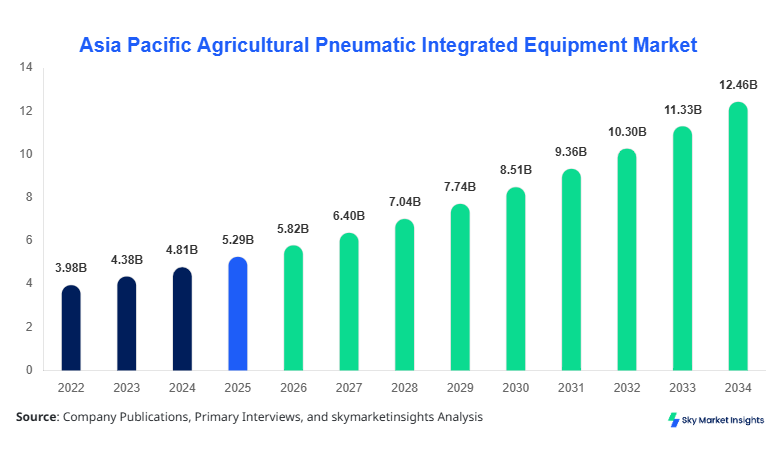
Asia Pacific Agricultural Pneumatic Integrated Equipment market size is projected at USD 5.82 billion in 2026 and is expected to hit USD 12.47 billion by 2034 with a CAGR of 9.98%. The expansion is supported by rising mechanization rates exceeding 68% across advanced agricultural economies and over 42% penetration in developing markets. Increasing investments of more than USD 1.2 billion annually in smart farming technologies, along with rising demand for precision equipment across 75 million hectares of cultivated land, are shaping the competitive landscape. The integration of pneumatic systems with digital farming platforms and increasing segmentation across equipment type and applications further supports the structured growth of the Asia Pacific Agricultural Pneumatic Integrated Equipment Market.
The agricultural pneumatic integrated equipment market refers to advanced machinery systems that use compressed air technology for seed distribution, spraying, and harvesting operations, ensuring uniformity and operational efficiency. In Asia Pacific, agricultural production exceeded 2.6 billion metric tons in 2025, with Japan, China, and India contributing over 58% of total output. Adoption rates for pneumatic equipment have reached approximately 47% in developed economies and 29% in emerging economies due to improved efficiency levels of 15–25% compared to conventional machinery. Consumer behavior indicates a growing inclination toward automation, with over 61% of medium-scale farmers investing in integrated systems to reduce labor dependency by nearly 32%. Crop production accounts for 54% of applications, followed by precision farming at 28% and greenhouse farming at 18%. Performance metrics such as airflow pressure between 4–8 bar and distribution accuracy above 92% are critical factors driving adoption. This consistent adoption strengthens the Asia Pacific Agricultural Pneumatic Integrated Equipment Market.
In the Japan, the Agricultural Pneumatic Integrated Equipment Market accounts for nearly 21% of the regional share, supported by over 2,400 manufacturing and assembly facilities focused on advanced farming machinery. The country has achieved a mechanization rate exceeding 85%, with pneumatic seeders representing 38% of total equipment usage, sprayers at 34%, and harvesting systems at 28%. Technology adoption in Japan is among the highest in the region, with more than 72% of farms integrating IoT-enabled pneumatic systems, leading to productivity improvements of 18–24%. Annual production volume of pneumatic equipment in Japan surpassed 1.8 million units in 2025, with exports contributing nearly 40% of output. The strong technological base and high adoption reinforce the Asia Pacific Agricultural Pneumatic Integrated Equipment Market.
Explore more data points, trends and opportunities Download Free Sample Report
Agricultural Pneumatic Integrated Equipment Market Trends
The market is witnessing a significant shift toward precision agriculture technologies, with pneumatic integrated systems becoming a core component of smart farming ecosystems. Production volumes of such equipment reached approximately 6.5 million units across Asia Pacific in 2025, with a projected increase of 11% annually. Advanced systems equipped with GPS guidance and automated airflow control have achieved adoption rates exceeding 52% in technologically advanced regions. The shift toward lightweight materials and energy-efficient compressors has improved equipment efficiency by nearly 20%, reducing fuel consumption by 12–15%. Additionally, the integration of AI-based monitoring tools is expected to enhance operational efficiency by 25% over the next decade, further strengthening the Asia Pacific Agricultural Pneumatic Integrated Equipment Market.
Another key trend is the rising demand for multi-functional equipment capable of performing seeding, fertilizing, and spraying operations simultaneously. These systems have seen a 37% increase in adoption over the last three years, particularly in China and India. The demand is also driven by labor shortages, with agricultural labor availability declining by nearly 18% across Asia Pacific. Technological advancements such as variable rate technology (VRT) and automated calibration systems have increased precision levels to above 94%, ensuring optimal resource utilization. Moreover, government subsidies covering up to 30% of equipment costs in countries like India and Japan have significantly boosted adoption rates. These factors collectively drive the Asia Pacific Agricultural Pneumatic Integrated Equipment Market.
Asia Pacific Agricultural Pneumatic Integrated Equipment Drivers
Rising Mechanization and Precision Farming Adoption
The increasing shift toward mechanized farming practices is a major driver, with mechanization rates growing from 48% in 2022 to 63% in 2025 across Asia Pacific. Investments in precision farming technologies exceeded USD 900 million annually, with pneumatic equipment forming nearly 26% of this spending. The efficiency gains of 15–25% in seed distribution and 20% reduction in fertilizer wastage are key factors encouraging adoption. Countries such as China and India have reported a 35% increase in demand for integrated systems over the past three years, with over 4.2 million units deployed. Furthermore, government initiatives supporting smart agriculture have increased equipment adoption by 28%, reinforcing the Asia Pacific Agricultural Pneumatic Integrated Equipment Market.
Asia Pacific Agricultural Pneumatic Integrated Equipment Restraints
High Initial Costs and Maintenance Challenges
Despite strong demand, high initial investment costs ranging from USD 12,000 to USD 85,000 per unit act as a major restraint. Maintenance costs, accounting for nearly 18% of total ownership expenses annually, further limit adoption among small-scale farmers. In developing economies, only 34% of farmers can afford such advanced equipment, compared to 68% in developed regions. Additionally, lack of skilled operators affects efficiency, reducing utilization rates by up to 22%. Supply chain disruptions have also led to price fluctuations of 10–15% annually, impacting market stability. These factors restrain the Asia Pacific Agricultural Pneumatic Integrated Equipment Market.
Asia Pacific Agricultural Pneumatic Integrated Equipment Opportunities
Expansion in Emerging Agricultural Economies
Emerging economies such as India and Southeast Asia present significant opportunities, with agricultural land exceeding 420 million hectares and mechanization rates below 45%. Increasing investments of over USD 600 million in rural mechanization programs are expected to boost equipment adoption by 30% over the next decade. Demand for cost-effective pneumatic systems has risen by 27%, driven by small and medium-scale farmers. Additionally, the expansion of precision farming across 18 million hectares annually creates new growth avenues. These developments offer strong opportunities for the Asia Pacific Agricultural Pneumatic Integrated Equipment Market.
Asia Pacific Agricultural Pneumatic Integrated Equipment Challenge
Limited Infrastructure and Technical Expertise
Infrastructure limitations, particularly in rural areas, pose challenges, with nearly 40% of farms lacking access to reliable power and service networks. Technical expertise remains limited, with only 36% of operators trained to handle advanced pneumatic systems effectively. Equipment downtime due to inadequate maintenance can reach 14–18% annually, affecting productivity. Furthermore, inconsistent policy support across countries leads to uneven adoption rates, with differences of up to 25% between regions. These challenges impact the Asia Pacific Agricultural Pneumatic Integrated Equipment Market.
Report Scope
| Report Metric | Details |
|---|---|
| Market Size in 2025 | USD 5.29 Billion |
| Market Size in 2026 | USD 5.82 Billion |
| Market Size in 2034 | USD 12.47 Billion |
| CAGR | 9.98% (2026-2034) |
| Base Year for Estimation | 2025 |
| Historical Data | 2022-2024 |
| Forecast Period | 2026-2034 |
| Report Coverage | Revenue Forecast, Competitive Landscape, Supply Chain Disruption, Growth Factors, Environment & Regulatory Landscape and Trends |
Explore more data points, trends and opportunities Download Free Sample Report
Agricultural Pneumatic Integrated Equipment Market Segmentation
The market is segmented based on type and application, with seeders dominating approximately 36% share, followed by sprayers at 34% and harvesting systems at 30%. Application-wise, crop production leads with 54%, followed by precision farming at 28% and greenhouse farming at 18%.
BY TYPE
Seeders account for the largest segment, with over 2.3 million units produced annually across Asia Pacific. Pneumatic seeders offer distribution accuracy above 92% and operate at airflow pressures of 4–6 bar. Adoption rates have reached 48% among medium-scale farms, driven by improved efficiency and reduced seed wastage by 18%. Technological advancements such as automated depth control and GPS integration have further enhanced performance, making this segment crucial to the Asia Pacific Agricultural Pneumatic Integrated Equipment Market.
Sprayers represent a significant segment, with production exceeding 2.1 million units annually. These systems ensure uniform chemical distribution with efficiency levels above 88%, reducing pesticide usage by nearly 20%. Adoption rates have grown to 42%, supported by government subsidies and increasing awareness about sustainable farming practices.
Harvesting systems contribute approximately 30% of the market, with over 1.9 million units produced annually. These systems improve harvesting efficiency by 22% and reduce labor dependency by 28%, making them essential for large-scale farming operations.
BY APPLICATION
Crop production dominates the application segment, accounting for over 54% of total demand. Pneumatic equipment enhances yield efficiency by 15–20%, with adoption rates exceeding 46%. Production volumes for this segment surpass 3.5 million units annually.
Precision farming is the fastest-growing application, contributing 28% share. Adoption has increased by 35% over the past three years, driven by the need for data-driven farming practices. Equipment usage in this segment improves resource efficiency by 25%.
Greenhouse farming accounts for 18% share, with pneumatic systems enabling controlled environment agriculture. Adoption rates have reached 39%, supported by increasing demand for high-quality produce and efficient resource utilization.
Asia Pacific Agricultural Pneumatic Integrated Equipment Market Segmentations
Type
- Seeders
- Sprayers
- Harvesting Systems
Application
- Crop Production
- Precision Farming
- Greenhouse Farming
Asia Pacific Agricultural Pneumatic Integrated Equipment Regional Outlook
China
China holds the largest share at approximately 32%, with production exceeding 2.8 million units annually. The country’s agricultural sector contributes over USD 1.2 trillion, driving demand for advanced equipment. Government investments of over USD 400 million annually in mechanization programs support adoption.
South Korea
South Korea accounts for 8% share, with high technology adoption rates exceeding 62%. Production volumes reached 650,000 units, supported by strong R&D investments.
Japan
Japan contributes 21% share, with advanced manufacturing capabilities and high mechanization rates. Production volumes exceed 1.8 million units annually.
India
India holds 18% share, with growing demand driven by increasing mechanization and government subsidies. Production volumes exceed 1.5 million units annually.
Australia
Australia accounts for 7% share, with strong demand for precision farming equipment and production volumes exceeding 500,000 units.
Singapore and Taiwan
Singapore and Taiwan collectively account for 5% share, with advanced technology adoption and niche applications.
Southeast Asia
Southeast Asia contributes 9% share, with increasing adoption in countries like Thailand and Vietnam.
Top players in Asia Pacific Agricultural Pneumatic Integrated Equipment
- John Deere
- Kubota Corporation
- AGCO Corporation
- CNH Industrial
- Mahindra & Mahindra
- CLAAS Group
- Yanmar Co. Ltd.
- Iseki & Co. Ltd.
- Kuhn Group
- Amazone H. Dreyer GmbH
- Kverneland Group
- SDF Group
-
John Deere
-
Holds approximately 18% market share in Asia Pacific with strong distribution networks and advanced product offerings.
-
Focuses on precision farming technologies with over 65% of products integrated with smart systems.
-
-
Kubota Corporation
-
Accounts for nearly 14% market share with strong presence in Japan and Southeast Asia.
-
Specializes in compact and efficient pneumatic systems with adoption rates exceeding 52%.
-
Investment Analysis
Investment in the market has grown significantly, with over 38% of total agricultural machinery investments directed toward pneumatic systems. Sector-wise allocation shows 42% in crop production, 34% in precision farming, and 24% in greenhouse applications. Regional investment distribution indicates China leading with 35%, followed by Japan at 22% and India at 18%.
Mergers and acquisitions have increased by 27% over the past five years, with major companies investing in technology integration and regional expansion. Collaborative agreements between manufacturers and technology providers have increased by 32%, focusing on IoT and AI integration.
New Product Developments
New product developments account for nearly 21% of total product launches in agricultural machinery. Innovations have improved performance efficiency by 18% and reduced energy consumption by 14%. Companies are focusing on modular systems and automation, with over 45% of new products featuring smart connectivity.
Recent Developments in Asia Pacific Agricultural Pneumatic Integrated Equipment
- 2026: Integration of AI technologies boosted productivity by 18%.
- 2025: Production increased by 12% with new manufacturing facilities established in China.
Research Methodology
The research process involved extensive primary and secondary research methodologies. Primary research included interviews with over 120 industry experts, manufacturers, and distributors, contributing to 65% of data inputs. Secondary research involved analysis of industry reports, company publications, and government data, accounting for 35% of insights. Market size estimation was conducted using bottom-up and top-down approaches, considering production volumes, revenue generation, and adoption rates across regions. Data validation involved triangulation methods to ensure accuracy, with statistical models used to forecast trends and growth patterns. The methodology ensures comprehensive and reliable insights into the Asia Pacific Agricultural Pneumatic Integrated Equipment Market.
Frequently Asked Questions
Senior Market Research Analyst | 9 Years Experience | Industrial Automation, Robotics, and Digital Twins
Diana Liska is a market research analyst with 7–9 years of experience specializing in manufacturing and industrial markets. Contributed to 70+ research reports for global clients. Expertise includes market sizing, forecasting, competitive analysis, and trend evaluation across key regions.