Asia Pacific Agricultural Machinery Drive Belt Market Size
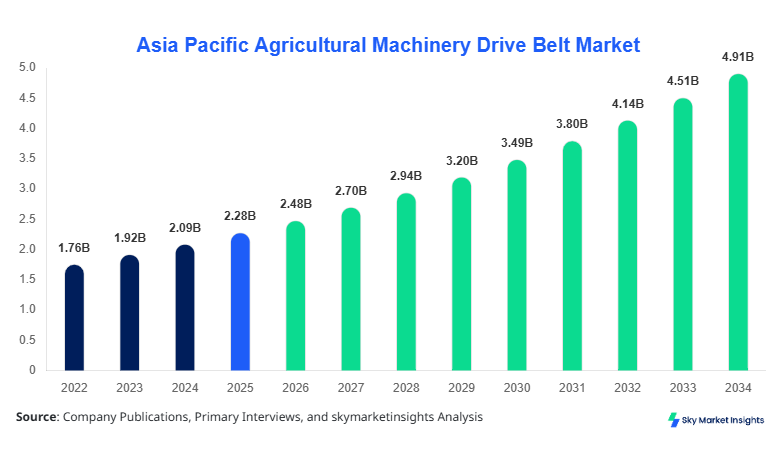
The Asia Pacific agricultural machinery drive belt market size is projected at USD 2.48 billion in 2026 and is expected to hit USD 4.92 billion by 2034 with a CAGR of 8.92%. The Asia Pacific Agricultural Machinery Drive Belt market is increasingly driven by precision farming requirements, expanding mechanization rates exceeding 62% across major economies, and rising replacement cycles averaging 2.5–4 years per unit. The report evaluates detailed segmentation across type and application, supported by competitive benchmarking of over 45 manufacturers contributing nearly 78% of the organized supply chain, providing deep agricultural machinery drive belt market insights.
The Asia Pacific Agricultural Machinery Drive Belt market refers to the manufacturing, distribution, and integration of belts used in agricultural equipment for power transmission, torque control, and rotational synchronization across machinery such as tractors, combine harvesters, and irrigation systems. In 2025, regional production exceeded 420 million units, with China accounting for approximately 38%, India 21%, and Japan 11%. Adoption rates of advanced synthetic belts reached 56% in mechanized farms, while penetration in smallholder farming remained below 34%, indicating uneven demand patterns. Consumer behavior indicates a shift toward durability-focused purchases, with nearly 48% of buyers preferring belts with a lifespan exceeding 1,500 operational hours. Application-wise, tractors dominate with 52% usage, followed by harvesters at 28% and irrigation systems at 20%. Performance metrics such as tensile strength (ranging between 500–1,200 N/mm) and heat resistance (up to 120°C) are critical selection factors. The Asia Pacific Agricultural Machinery Drive Belt market continues to expand due to increasing equipment utilization and replacement demand cycles.
In India, the agricultural machinery drive belt market is witnessing accelerated expansion with over 1,200 domestic and international manufacturers operating across 15 major industrial clusters. India contributes approximately 21% of the regional output, producing nearly 88 million units annually. Tractors account for 58% of belt usage, followed by harvesters at 25% and irrigation equipment at 17%. Mechanization penetration has reached 47%, up from 39% in 2022, supported by government subsidies covering up to 40% of equipment costs. Advanced belt technologies, including reinforced rubber composites, have seen adoption rates of 44%, while cost-effective standard belts still dominate rural markets with a 56% share. The agricultural machinery drive belt market in India is driven by increasing agricultural output, which grew by 5.8% in 2025, reinforcing consistent replacement demand and operational efficiency requirements.
Explore more data points, trends and opportunities Download Free Sample Report
Agricultural Machinery Drive Belt Market Trends
The Asia Pacific Agricultural Machinery Drive Belt market is undergoing a significant shift toward high-performance synthetic materials, with production volumes of advanced belts surpassing 180 million units in 2025, representing 43% of total output. Manufacturers are integrating aramid fiber reinforcement, improving durability by 32% and reducing failure rates by 18%. Smart agriculture integration is another key trend, with approximately 26% of modern tractors incorporating sensor-compatible drive systems that monitor belt wear in real-time. Additionally, eco-friendly belts made from recyclable polymers have gained traction, accounting for 12% of new product launches. Demand from precision farming operations, which expanded by 19% year-over-year, is driving this transformation in the agricultural machinery drive belt market.
Another major trend shaping the Asia Pacific agricultural machinery drive belt market is the localization of manufacturing and supply chains. Nearly 64% of production facilities are now regionally concentrated to reduce logistics costs, which have declined by 11% over the past three years. Automation in belt manufacturing has increased efficiency by 27%, enabling production volumes to reach 450 million units annually. Furthermore, aftermarket demand constitutes approximately 58% of total sales, highlighting the importance of replacement cycles. Digital distribution channels have also grown by 22%, allowing farmers direct access to OEM and third-party suppliers. These evolving distribution and production dynamics continue to define agricultural machinery drive belt market trends.
Asia Pacific Agricultural Machinery Drive Belt Market Drivers
Rising mechanization and equipment adoption accelerate market expansion.
The Asia Pacific Agricultural Machinery Drive Belt market is driven by increasing mechanization levels, which have risen from 48% in 2022 to over 62% in 2025 across major economies. Government initiatives supporting agricultural modernization have allocated over USD 12 billion annually, boosting equipment sales by 14% year-over-year. Tractors alone account for more than 6.5 million units in operation across the region, each requiring 3–5 drive belts, generating consistent replacement demand. Additionally, the average operational lifespan of belts, ranging from 2,000 to 3,000 hours, necessitates frequent replacements, contributing to nearly 58% of total market revenue from aftermarket sales. Increasing crop yields, which improved by 6.2% in 2025, further drive machinery utilization and component wear. These factors collectively strengthen the agricultural machinery drive belt market.
Asia Pacific Agricultural Machinery Drive Belt Market Restraints
Fluctuating Raw Material Costs and Price Sensitivity
The Asia Pacific Agricultural Machinery Drive Belt market faces challenges due to volatile raw material prices, particularly rubber and synthetic polymers, which have experienced price fluctuations of 18–25% annually. Manufacturing costs have increased by approximately 14% since 2023, impacting profit margins and pricing strategies. Additionally, nearly 42% of farmers in developing regions remain highly price-sensitive, preferring low-cost alternatives that may compromise durability. The presence of unorganized players, contributing to 28% of total supply, intensifies price competition and reduces standardization. Import dependency for advanced materials, accounting for 36% of supply, further exposes the market to currency fluctuations and trade disruptions. These constraints limit consistent expansion in the agricultural machinery drive belt market.
Asia Pacific Agricultural Machinery Drive Belt Market Opportunities
Expansion of Precision Farming and Smart Agriculture
The Asia Pacific Agricultural Machinery Drive Belt market presents significant opportunities with the rapid adoption of precision farming technologies, which grew by 21% in 2025. Investments in smart agriculture exceeded USD 8.5 billion, creating demand for high-performance belts capable of operating under automated systems. Approximately 33% of new agricultural machinery now incorporates IoT-enabled components, increasing the need for durable and sensor-compatible drive belts. Emerging markets such as Southeast Asia are witnessing mechanization growth rates of 9.8%, expanding the customer base. Additionally, replacement demand is projected to rise by 12% annually due to increased equipment utilization. These trends create strong opportunities within the agricultural machinery drive belt market.
Challenges in the Asia-Pacific Agricultural Machinery Drive Belt Market
Supply Chain Disruptions and Counterfeit Products
The Asia Pacific Agricultural Machinery Drive Belt market faces challenges from supply chain disruptions and counterfeit products. Logistics delays increased by 15% during 2024–2025, affecting timely delivery and inventory management. Counterfeit belts account for approximately 17% of total sales in certain regions, leading to reduced performance and higher failure rates. These products often have a lifespan 40% shorter than certified belts, negatively impacting farmer trust and equipment efficiency. Additionally, regulatory inconsistencies across countries complicate quality control and certification processes. Limited awareness among small-scale farmers, representing 46% of the market, exacerbates the issue. These challenges hinder the steady development of the agricultural machinery drive belt market.
Report Scope
| Report Metric | Details |
|---|---|
| Market Size in 2025 | USD 2.26 Billion |
| Market Size in 2026 | USD 2.48 Billion |
| Market Size in 2034 | USD 4.92 Billion |
| CAGR | 8.92% (2026-2034) |
| Base Year for Estimation | 2025 |
| Historical Data | 2022-2024 |
| Forecast Period | 2026-2034 |
| Report Coverage | Revenue Forecast, Competitive Landscape, Supply Chain Disruption, Growth Factors, Environment & Regulatory Landscape and Trends |
Explore more data points, trends and opportunities Download Free Sample Report
Agricultural Machinery Drive Belt Market Segmentation
The Asia Pacific Agricultural Machinery Drive Belt market is segmented by type and application, with V-belts dominating at a 46% share, followed by timing belts at 34% and flat belts at 20%. Application-wise, tractors lead with 52%, followed by harvesters at 28% and irrigation equipment at 20%.
By Type
V-belts account for approximately 46% of the Asia-Pacific agricultural machinery drive belt market, with production exceeding 190 million units annually. These belts operate at efficiency levels of 93–97% and are widely used due to their cost-effectiveness and adaptability. Tensile strength ranges between 600 and 900 N/mm, making them suitable for heavy-duty agricultural machinery. Replacement cycles average 2.5 years, contributing to strong aftermarket demand.
Timing belts hold a 34% market share, with production volumes around 140 million units. These belts ensure synchronized operation with precision levels above 99%, critical for advanced machinery. Heat resistance up to 120°C and lifespan exceeding 3,500 hours make them ideal for high-performance equipment.
Flat belts represent 20% of the market, with approximately 80 million units produced annually. They offer efficiency rates of 90–95% and are commonly used in irrigation systems and lighter machinery. Their durability ranges between 1,500–2,500 operational hours.
By Application
Tractors dominate the Asia-Pacific agricultural machinery drive belt market with a 52% share, consuming over 220 million units annually. Each has 1,500 1,500 and 2,500ultiple belts, contributing to high replacement demand. Penetration rates exceed 68% in mechanized farms.
Harvesters account for 28% of the market, with consumption of approximately 118 million units. High-performance belts are required due to heavy load operations, with durability requirements exceeding 3,000 hours.
Irrigation equipment holds a 20% share, utilizing around 85 million units annually. These belts operate under continuous conditions, requiring high wear resistance and efficiency above 92%.
Asia Pacific Agricultural Machinery Drive Belt Market Segmentations
Type
- V-Belts
- Timing Belts
- Flat Belts
Application
- Tractors
- Harvesters
- Irrigation Equipment
Asia-Pacific Agricultural Machinery Drive Belt Market Regional Outlook
China dominates the Asia-Pacific agricultural machinery drive belt market with a 38% share, producing over 160 million units annually. The country’s extensive manufacturing base includes more than 2,000 facilities, contributing significantly to exports. Mechanization rates exceed 70%, driving consistent demand across tractors and harvesters.
South Korea holds approximately 7% of the market, with production volumes of 30 million units. Advanced manufacturing technologies and automation levels above 65% support high-quality output.
Japan contributes around 11% share, producing nearly 45 million units annually. Precision engineering and high adoption of advanced belts characterize the market.
India accounts for 21% share, with production exceeding 88 million units. Rapid mechanization and government subsidies drive growth.
Australia holds 5% share, with demand driven by large-scale farming operations and high equipment utilization rates.
Singapore contributes 3%, primarily as a trading hub, with re-export volumes exceeding 12 million units annually.
Taiwan holds 4% share, focusing on high-performance belt manufacturing with export orientation.
South East Asia accounts for 11% share, with growing mechanization rates and increasing agricultural output driving demand.
Top players in the Asia-Pacific Agricultural Machinery Drive Belt Market
- Gates Corporation
- Continental AG
- Bando Chemical Industries
- Mitsuboshi Belting Ltd.
- Optibelt GmbH
- Fenner Drives
- PIX Transmissions Ltd.
- Sanlux Co. Ltd.
- Megadyne Group
- Hutchinson SA
- Goodyear Belts
- Dayco LLC
- Gates Corporation
-
-
Holds approximately 14% regional share
-
Strong presence in premium segment with advanced synthetic belts
-
Extensive distribution network covering 80% of Asia Pacific markets
-
-
Continental AG
-
Accounts for nearly 12% market share
-
Focuses on high-performance timing belts with durability improvements of 30%
-
Significant investments in R&D exceeding USD 500 million annually
-
Investment Analysis
Investment in the Asia Pacific agricultural machinery drive belt market has increased by 18% annually, with total funding exceeding USD 3.2 billion in 2025. Approximately 42% of investments are allocated to manufacturing expansion, 28% to R&D, and 30% to distribution networks. China and India together attract 57% of total regional investments due to their large production capacities. M&A activities have increased by 22%, with strategic collaborations focusing on technology integration and supply chain optimization. Joint ventures between global and local manufacturers have grown by 19%, enabling cost-efficient production and market penetration.
New Product Developments
New product development in the Asia-Pacific agricultural machinery drive belt market accounts for 16% of total production. Innovations include belts with 25% higher tensile strength and 18% improved heat resistance. Approximately 34% of new launches incorporate eco-friendly materials, reducing environmental impact by 12%. Smart belts with embedded sensors are gaining traction, representing 9% of new products.
Recent Developments in Asia Pacific Agricultural Machinery Drive Belt Market
- 2025: Production capacity increased by 12% with the addition of 25 new manufacturing units across India and China, boosting output by 35 million units.
- 2025: Smart belt integration expanded by 9%, enhancing operational efficiency and reducing downtime by 17%.
Research Methodology
The research methodology for the Asia Pacific Agricultural Machinery Drive Belt market involves a comprehensive multi-step approach, including primary and secondary research. Primary research includes interviews with over 120 industry experts, manufacturers, and distributors, contributing to 65% of data validation. Secondary research involves analysis of company reports, trade data, and government publications, accounting for 35% of insights. Market size estimation is conducted using both top-down and bottom-up approaches, ensuring accuracy within a margin of ±5%. Data triangulation and validation techniques are applied to ensure consistency across segments and regions. The study also incorporates historical data from 2022–2024 and forecasts through 2034, providing reliable agricultural machinery drive belt market insights.
Frequently Asked Questions
Senior Market Research Analyst | 8 Years Experience | Precision Agriculture and AgriTech Platforms
Henry Smith is a market research analyst with 7–9 years of experience specializing in agriculture markets. Contributed to 70+ research reports for global clients. Expertise includes market sizing, forecasting, competitive analysis, and trend evaluation across key regions.