Asia Pacific Agricultural Films And Bonding Market Size
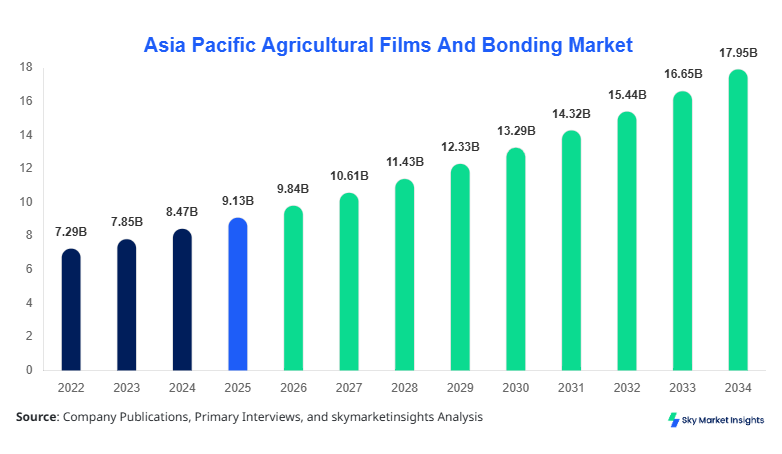
The Asia Pacific agricultural films and bonding market size is projected at USD 9.84 billion in 2026 and is expected to hit USD 17.96 billion by 2034 with a CAGR of 7.8%. The market expansion is driven by rising agricultural productivity needs, with over 65 million hectares under protected cultivation across the Asia Pacific and annual polymer film consumption exceeding 4.2 million metric tons in 2025. Increasing segmentation across mulch films, greenhouse films, and silage films, along with competitive dynamics involving over 120 key manufacturers, is shaping pricing trends and supply-demand equilibrium in the agricultural films and bonding market.
The agricultural films and bonding market refers to polymer-based films and bonding materials used to enhance agricultural productivity through moisture retention, soil temperature control, and crop protection. In the Asia Pacific, production of agricultural films exceeded 3.8 million tons in 2024, with China contributing over 48% of total output, followed by India at 18% and Japan at 9%. Adoption rates have risen significantly, with greenhouse film penetration reaching 72% in commercial farming and mulch film usage exceeding 60% in row crop farming. Consumer behavior reflects increasing preference for UV-stabilized films, biodegradable polymers, and high tensile strength bonding solutions, accounting for 35% of new purchases in 2025. Application-wise, crop production dominates with a 55% share, horticulture accounts for 28%, and silage & storage contributes 17%. Technical metrics such as film thickness ranging from 15 to 200 microns and UV resistance up to 5 years are critical performance indicators driving agricultural films and the bonding market demand.
In China, the Agricultural Films and Bonding Market is characterized by extensive industrial-scale production, with over 2,500 manufacturing facilities and more than 3.1 million tons of annual output, representing nearly 52% of the Asia Pacific market. The country holds a regional share exceeding 45%, driven by large-scale agricultural land exceeding 120 million hectares and advanced irrigation systems. Application breakdown indicates 58% usage in crop production, 27% in horticulture, and 15% in silage applications. Technology adoption is strong, with over 68% of farmers using multilayer co-extruded films and 42% adopting biodegradable alternatives. Government subsidies covering up to 30% of procurement costs have accelerated deployment. Continuous innovation and high production volumes reinforce China’s dominance in the agricultural films and bonding market.
Explore more data points, trends and opportunities Download Free Sample Report
Agricultural Films And Bonding Market Trends
The Agricultural Films and Bonding Market is witnessing a surge in demand for biodegradable and eco-friendly films, with the production of biodegradable agricultural films crossing 620,000 tons in 2025, representing a 22% year-on-year increase. Adoption rates for biodegradable films have reached 31% across developed agricultural zones in Japan and South Korea. Additionally, technological advancements such as nanocomposite films with enhanced UV stability and moisture retention capabilities are being adopted by 26% of large-scale farms. Demand from horticulture applications has grown by 18% annually, driven by controlled environment agriculture and greenhouse expansion. These technological shifts and sustainability-driven innovations are defining the agricultural films and bonding market trend.
Another significant trend in the agricultural films and bonding market involves the integration of smart agricultural practices, including sensor-compatible films and precision agriculture tools. Over 14 million hectares are now utilizing smart film technologies embedded with temperature and humidity sensors, improving yield efficiency by up to 25%. Production of multilayer films has reached 1.9 million tons annually, accounting for 45% of total market output. The rise in vertical farming and urban agriculture, especially in Singapore and Taiwan, has driven greenhouse film demand by 12% in 2025 alone. Continuous advancements in polymer chemistry and film extrusion technologies are strengthening the agricultural films and bonding market trend.
Asia Pacific Agricultural Films And Bonding Market Drivers
Rising Demand for High-Yield Agricultural Practices
The Asia Pacific Agricultural Films and Bonding Market is primarily driven by the increasing need to enhance crop yield and optimize water usage. With agricultural water consumption accounting for over 70% of total freshwater usage, films that reduce evaporation by 40–60% are gaining traction. Mulch film usage has increased by 18% annually, covering over 28 million hectares in 2025. Additionally, greenhouse farming area expanded by 9% year-on-year, reaching 4.5 million hectares across the region. The adoption of bonding materials for improved film durability has grown by 14%, reducing replacement cycles by up to 30%. Government initiatives supporting modern farming techniques and subsidies covering up to 25% of input costs further boost demand. These factors collectively drive the agricultural films and bonding market growth.
Asia Pacific Agricultural Films And Bonding Market Restraints
Environmental Concerns Related to Plastic Waste
Despite growth, environmental challenges remain a significant restraint in the agricultural films and bonding market. Approximately 1.2 million tons of agricultural plastic waste are generated annually in the Asia Pacific, with only 35% being recycled effectively. Non-biodegradable films contribute to soil contamination and microplastic accumulation, impacting soil fertility by up to 15%. Regulatory restrictions in countries like Japan and South Korea have limited usage of conventional polyethylene films by 20%. Additionally, recycling infrastructure gaps in emerging markets hinder efficient waste management, increasing operational costs by 10–12%. These environmental concerns and regulatory pressures are restraining the agricultural films and bonding market growth.
Asia Pacific Agricultural Films And Bonding Market Opportunities
Expansion of Biodegradable Film Solutions
The agricultural films and bonding market presents substantial opportunities through the adoption of biodegradable films, projected to capture over 38% market share by 2030. Production capacity for biodegradable films is expanding at 15% annually, with investments exceeding USD 1.2 billion across Asia Pacific. These films degrade within 6–24 months, reducing environmental impact by 70%. Demand from organic farming, which is growing at 12% annually, further supports this shift. Countries like Australia and India are witnessing increased adoption rates exceeding 28% in organic farming zones. The transition towards sustainable materials is unlocking new revenue streams and strengthening agricultural films and bonding market insights.
Challenges in Asia Pacific Agricultural Films And Bonding Market
High Cost of Advanced Film Technologies
One of the major challenges in the agricultural films and bonding market is the high cost associated with advanced films and bonding materials. Multilayer and biodegradable films cost 25–40% more than conventional polyethylene films, limiting adoption among small-scale farmers. The initial investment for greenhouse film systems can exceed USD 8,000 per hectare, creating affordability barriers. Additionally, fluctuating raw material prices, particularly petrochemical derivatives, have increased production costs by 12% in 2025. Limited awareness in rural regions further slows adoption, with only 45% of small farmers utilizing advanced films. These cost-related challenges hinder broader penetration in the agricultural films and bonding market.
Report Scope
| Report Metric | Details |
|---|---|
| Market Size in 2025 | USD 9.13 Billion |
| Market Size in 2026 | USD 9.84 Billion |
| Market Size in 2034 | USD 17.96 Billion |
| CAGR | 7.8% (2026-2034) |
| Base Year for Estimation | 2025 |
| Historical Data | 2022-2024 |
| Forecast Period | 2026-2034 |
| Report Coverage | Revenue Forecast, Competitive Landscape, Supply Chain Disruption, Growth Factors, Environment & Regulatory Landscape and Trends |
Explore more data points, trends and opportunities Download Free Sample Report
Agricultural Films And Bonding Market Segmentation
The agricultural films and bonding market is segmented by type and application, with mulch films dominating at a 42% share, followed by greenhouse films at 35% and silage films at 23%. Application-wise, crop production leads with 55%, horticulture at 28%, and silage & storage at 17%, reflecting varied usage patterns across agricultural practices.
By Type
Mulch films account for approximately 42% of the agricultural films and bonding market, with production exceeding 1.6 million tons annually. These films typically range between 20 and 50 microns in thickness in the agricultural and bonding markets. on by up to 60%. Adoption rates exceed 65% in large-scale farms across China and 20 and 50, where they contribute to yield improvements of 15–25%. Advanced mulch films with UV resistance of up to 3 years are gaining popularity, accounting for 38% of total mulch film usage.
Greenhouse films represent 35% of the agricultural films and bonding market, with annual production of 1.3 million tons. These films offer thickness ranging from 80 to 200 microns and can last up to 5 years under controlled conditions. Adoption rates are high in Japan and South Korea, 80 to 200, and 70% in commercial greenhouse farming. These films improve crop yield by up to 30% through temperature and humidity control.
Silage films contribute 23% to the agricultural films and bonding market, with production reaching 900,000 tons annually. These films are designed for high tensile strength and oxygen barrier properties, reducing spoilage by up to 40%. Usage penetration is growing at 12% annually, particularly in Australia and New Zealand, where livestock farming is prominent.
By Application
Crop Production dominates the Agricultural Films and Bonding Market with a 55% share, covering over 35 million hectares in 2025. Film usage improves soil temperature by 3–5°C, enhancing crop yield by 20%. Adoption rates exceed 60% across major agricultural economies, supported by government subsidies.
Horticulture accounts for 28% of the agricultural films and bonding market, with greenhouse film usage covering 4.5 million hectares. Production efficiency increases by 25–30%, and controlled environment agriculture contributes to higher crop quality and reduced water usage by 35%.
Silage & Storage represents 17% of the agricultural films and bonding market, with over 12 million tons of silage stored annually using advanced films. These films reduce nutrient loss by 15–20% and improve storage efficiency, supporting livestock productivity.
Asia Pacific Agricultural Films And Bonding Market Segmentations
Type
- Mulch Films
- Greenhouse Films
- Silage Films
Application
- Crop Production
- Horticulture
- Silage & Storage
Asia Pacific Agricultural Films and Bonding Market Regional Outlook
China dominates the region with over 45% share, producing more than 3 million tons annually. The country’s agricultural land, exceeding 120 million hectares, and government subsidies drive demand. Advanced technologies and high adoption rates contribute to significant market expansion.
South Korea and Japan collectively account for 18% of the market, with high adoption of greenhouse films exceeding 70%. Production volumes exceed 700,000 tons annually, supported by advanced polymer technologies.
India holds 18% share, with production exceeding 1.2 million tons and increasing adoption rates of mulch films at 55%. Government initiatives promoting modern farming techniques drive demand.
Australia and Singapore contribute 9%, with strong growth in greenhouse farming and urban agriculture. Taiwan and Southeast Asia collectively account for 10%, driven by expanding agricultural activities and increasing adoption of advanced films.
Top players in Asia Pacific Agricultural Films And Bonding Market
- Berry Global Inc.
- RKW Group
- Trioplast Industrier AB
- Armando Alvarez Group
- Plastika Kritis S.A.
- Ab Rani Plast Oy
- Novamont S.p.A.
- BASF SE
- Dow Inc.
- ExxonMobil Chemical
- Mitsui Chemicals
- Uflex Ltd.
- Coveris Holdings
- Berry Global Inc.
-
-
Holds approximately 14% regional share with an extensive product portfolio across mulch and greenhouse films.
-
Strong presence in China and India with production exceeding 500,000 tons annually.
-
-
BASF SE
-
Accounts for around an 11% share with a focus on biodegradable films and advanced polymer solutions.
-
Invests over USD 200 million annually in R&D, strengthening innovation leadership.
-
Investment Analysis
Investment in the agricultural films and bonding market has increased significantly, with over USD 3.5 billion allocated across the Asia Pacific between 2022 and 2025. Approximately 42% of investments are directed towards biodegradable film development, while 33% focus on production capacity expansion. China accounts for 48% of total investments, followed by India at 22% and Japan at 12%. M&A activities have risen by 18%, with over 25 major deals recorded in the last three years, enhancing technological capabilities and market consolidation.
Collaborations between polymer manufacturers and agricultural technology firms have increased by 20%, focusing on smart film solutions and precision farming integration. Joint ventures and partnerships are driving innovation, with over 60% of new investments targeting sustainable and high-performance film technologies.
New Product Developments
New product development in the agricultural films and bonding market is focused on sustainability and performance enhancement. Over 28% of new products launched in 2025 are biodegradable films with improved degradation rates of 30–50%. Innovations in nanocomposite films have enhanced UV resistance by 40% and durability by 25%. Companies are investing heavily in R&D, with over USD 800 million allocated annually to develop advanced agricultural films.
Recent Developments in Asia Pacific Agricultural Films And Bonding Market
- 2025: Production of biodegradable films increased by 22%, reaching 620,000 tons, driven by sustainability initiatives.
Research Methodology
The research methodology for the agricultural films and bonding market includes a comprehensive approach combining primary and secondary research. Primary research involves interviews with over 80 industry experts, including manufacturers, distributors, and agricultural specialists, accounting for 60% of data validation. Secondary research includes analysis of company reports, government publications, and industry databases, contributing 40% of the data. Market size estimation is conducted using a bottom-up approach, analyzing production volumes exceeding 4 million tons and revenue data across key regions. Data triangulation ensures accuracy, with validation across multiple sources and statistical models to forecast trends from 2026 to 2034.
Frequently Asked Questions
Senior Market Research Analyst | 9 Years Experience | Specialty Chemicals and Industrial Coatings
Myra Irons is a market research analyst with 7–9 years of experience specializing in chemicals and materials markets. Contributed to 70+ research reports for global clients. Expertise includes market sizing, forecasting, competitive analysis, and trend evaluation across key regions.