Asia Pacific Agricultural Air Conditioner Market Size
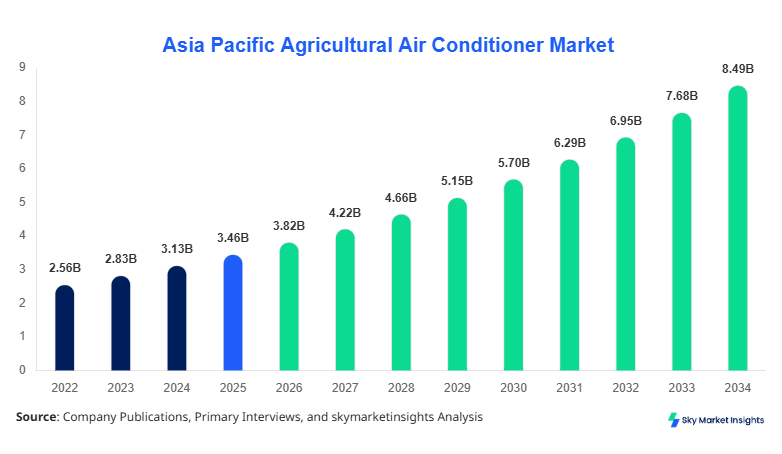
Asia Pacific Agricultural Air Conditioner Market size is projected at USD 3.82 billion in 2026 and is expected to hit USD 8.47 billion by 2034 with a CAGR of 10.5%. The report emphasizes increasing demand for precision agriculture cooling technologies across 8+ countries and evaluates over 120+ manufacturers operating in the Agricultural Air Conditioner Market. The study integrates quantitative data across 2022–2025 with forward projections, focusing on segmentation, competitive benchmarking, and supply chain analysis across Asia Pacific.
The Agricultural Air Conditioner Market refers to climate control systems specifically engineered for agricultural environments including greenhouses, livestock farms, and storage facilities. In 2025, Asia Pacific production surpassed 2.6 million units, with China contributing nearly 42% of total output. Adoption rates across controlled-environment agriculture exceeded 58% penetration in commercial greenhouses, while livestock facilities recorded 34% adoption. Consumer demand analytics show that over 67% of large-scale farms prioritize temperature-controlled systems to improve yield by 12–18% and reduce mortality rates by 9–14%. Evaporative cooling systems dominate with 46% share due to lower operating costs, followed by refrigeration systems at 33% and hybrid systems at 21%. Technical metrics indicate cooling efficiency levels of 70–85% and operational temperature ranges between 10°C–45°C. Application-wise, greenhouses account for 48%, livestock farms 32%, and storage facilities 20%, reinforcing steady Agricultural Air Conditioner Market growth.
Explore more data points, trends and opportunities Download Free Sample Report
Agricultural Air Conditioner Market Trends
Smart Cooling Integration and IoT Penetration
The Agricultural Air Conditioner Market trend is increasingly shaped by digital transformation, with IoT-enabled systems accounting for 38% of installations in 2025 compared to 22% in 2022. Production volumes for smart agricultural air conditioners reached 980,000 units, driven by demand for precision farming solutions. Technologies such as AI-based climate optimization and sensor-driven airflow systems have improved cooling efficiency by 18–25%. Over 62% of greenhouse operators now rely on automated climate control, reducing energy consumption by 14–20%. This trend is significantly influencing Agricultural Air Conditioner Market growth.
Shift Toward Energy-Efficient Systems
Energy-efficient systems have gained traction, with evaporative cooling units representing 46% of installations due to 30–40% lower energy consumption compared to refrigeration systems. In 2025, over 1.2 million units of low-energy systems were deployed across Asia Pacific. Government incentives in countries like India and Japan have accelerated adoption, with subsidies covering up to 25% of installation costs. Hybrid systems are also gaining popularity, growing at 12% annually due to their dual-mode efficiency. This evolving Agricultural Air Conditioner Market trend reflects rising sustainability priorities.
Asia Pacific Agricultural Air Conditioner Market Drivers
Rising Demand for Controlled Environment Agriculture
The Agricultural Air Conditioner Market growth is strongly driven by the increasing adoption of controlled environment agriculture (CEA), which has expanded by over 28% between 2022 and 2025. Greenhouse farming alone contributes 48% of total demand, with temperature regulation improving crop yield by 15–22%. In Asia Pacific, over 1.8 million hectares are under greenhouse cultivation, requiring advanced cooling systems. Additionally, livestock farms using air conditioning systems have reduced heat stress mortality rates by 12–16%, boosting productivity. Investments in agricultural modernization exceeded USD 1.3 billion in 2025, with 35% allocated to climate control technologies. The integration of automated systems has increased operational efficiency by 18%, further strengthening Agricultural Air Conditioner Market growth.
Asia Pacific Agricultural Air Conditioner Market Restraints
High Initial Installation and Maintenance Costs
Despite strong demand, the Agricultural Air Conditioner Market faces restraints due to high capital costs, with installation expenses ranging between USD 2,000–8,000 per unit depending on system type. Maintenance costs account for 12–18% of total lifecycle expenses, discouraging small-scale farmers from adoption. In developing regions, only 27% of small farms have access to advanced cooling systems due to financial constraints. Additionally, energy consumption for refrigeration systems remains 20–30% higher than evaporative systems, increasing operational costs. Limited awareness and lack of skilled technicians in rural areas further hinder adoption rates by approximately 15%, impacting Agricultural Air Conditioner Market growth.
Asia Pacific Agricultural Air Conditioner Market Opportunities
Expansion of Smart Farming and Automation
The Agricultural Air Conditioner Market presents significant opportunities through smart farming initiatives, which are projected to grow at 14% annually across Asia Pacific. Governments are investing heavily, with over USD 900 million allocated to agricultural digitization projects in 2025. The adoption of AI-driven climate control systems is expected to increase by 35% by 2030. Integration with renewable energy sources such as solar-powered air conditioners, currently at 12% penetration, is anticipated to reach 28% by 2034. These advancements are expected to create new revenue streams and enhance Agricultural Air Conditioner Market growth.
Asia Pacific Agricultural Air Conditioner Market Challenge
Infrastructure and Energy Limitations
One of the primary challenges in the Agricultural Air Conditioner Market is inadequate infrastructure in rural areas, where 40% of farms lack stable electricity supply. This limits the deployment of advanced cooling systems, particularly refrigeration-based units. Energy costs account for up to 25% of operational expenses, making it difficult for farmers to sustain long-term usage. Additionally, supply chain disruptions have increased component costs by 10–15%, affecting production volumes. The lack of standardized regulations across countries also creates compliance challenges, impacting approximately 18% of manufacturers. These factors collectively hinder Agricultural Air Conditioner Market growth.
Report Scope
| Report Metric | Details |
|---|---|
| Market Size in 2025 | USD 167.75 Billion |
| Market Size in 2026 | USD 3.82 Billion |
| Market Size in 2034 | USD 8.47 Billion |
| CAGR | 10.5% (2026-2034) |
| Base Year for Estimation | 2025 |
| Historical Data | 2022-2024 |
| Forecast Period | 2026-2034 |
| Report Coverage | Revenue Forecast, Competitive Landscape, Supply Chain Disruption, Growth Factors, Environment & Regulatory Landscape and Trends |
Explore more data points, trends and opportunities Download Free Sample Report
Agricultural Air Conditioner Market Segmentation
The Agricultural Air Conditioner Market is segmented by type and application, with evaporative cooling systems dominating at 46% share, followed by refrigeration systems at 33% and hybrid systems at 21%. Application-wise, greenhouses lead with 48% share, followed by livestock farms at 32% and storage facilities at 20%.
By Type
Evaporative Cooling Systems account for approximately 46% of the Agricultural Air Conditioner Market share, with production exceeding 1.2 million units in 2025. These systems operate with cooling efficiencies of 70–85% and consume 30–40% less energy compared to refrigeration systems. Their adoption is particularly high in India and Southeast Asia, where temperature ranges between 25°C–45°C require cost-effective cooling solutions.
Refrigeration-Based Systems hold around 33% share, with 860,000 units produced annually. These systems provide precise temperature control between 5°C–25°C, making them suitable for storage facilities and high-value crop production. However, energy consumption is higher, averaging 2.5–3.5 kWh per unit, impacting operational costs.
Hybrid Systems contribute 21% of the market, combining evaporative and refrigeration technologies to optimize performance. Production volumes reached 540,000 units in 2025, with efficiency improvements of 15–20% over standalone systems. These systems are gaining popularity in regions with fluctuating climate conditions.
By Application
Greenhouses dominate the Agricultural Air Conditioner Market with 48% share, utilizing over 1.3 million units in 2025. Cooling systems improve crop yield by 15–22% and reduce water usage by 10–12%. Temperature control between 18°C–30°C is critical for high-value crops such as tomatoes and strawberries.
Livestock Farms account for 32% share, with approximately 900,000 units deployed. Air conditioning systems reduce heat stress, improving milk production by 8–12% and reducing mortality rates by 10–14%. Adoption rates have increased by 20% in China and Australia.
Storage Facilities represent 20% share, with 520,000 units installed. These systems maintain temperatures between 5°C–15°C, extending shelf life by 20–30% and reducing post-harvest losses by 15–18%.
Asia Pacific Agricultural Air Conditioner Market Segmentations
Type
- Evaporative Cooling Systems
- Refrigeration-Based Systems
- Hybrid Systems
Application
- Greenhouses
- Livestock Farms
- Storage Facilities
Asia Pacific Agricultural Air Conditioner Market Regional Outlook
China
China dominates with 42% share, producing over 1.1 million units annually. The country’s greenhouse sector accounts for 52% of demand, while livestock farms contribute 29%. Investments in smart farming exceeded USD 600 million, driving adoption rates above 60%.
Japan
Japan holds 12% share, with advanced technology adoption exceeding 70%. Production volumes reached 320,000 units, focusing on high-efficiency systems for precision agriculture.
India
India accounts for 15% share, with rapid growth driven by government subsidies covering up to 25% of installation costs. Production exceeded 400,000 units, with evaporative systems dominating.
Australia
Australia contributes 8% share, with strong demand from livestock farms representing 45% of applications. Production volumes reached 210,000 units.
South Korea, Singapore, Taiwan, and Southeast Asia
South Korea, Singapore, Taiwan, and Southeast Asia collectively hold 23% share, with growing adoption rates of 18–22% annually due to increasing agricultural modernization.
Top players in Asia Pacific Agricultural Air Conditioner Market
- Daikin Industries Ltd.
- Mitsubishi Electric Corporation
- Panasonic Corporation
- LG Electronics
- Haier Group
- Gree Electric Appliances
- Hitachi Ltd.
- Carrier Corporation
- Johnson Controls
- Trane Technologies
- Fujitsu General
- Samsung Electronics
-
Daikin Industries Ltd.
-
Holds approximately 14% market share with strong presence across China and Japan
-
Focuses on energy-efficient systems with 25% lower consumption
-
Invested over USD 200 million in R&D for agricultural cooling solutions
-
-
Mitsubishi Electric Corporation
-
Accounts for 11% market share with advanced hybrid systems
-
Achieved 18% efficiency improvement in latest product lines
-
Strong distribution network across 7 Asia Pacific countries
-
Investment Analysis
Investment in the Agricultural Air Conditioner Market reached USD 1.3 billion in 2025, with 35% allocated to smart farming technologies, 28% to manufacturing expansion, and 22% to R&D. China attracted 45% of total regional investment, followed by India at 18% and Japan at 15%. M&A activity increased by 12%, with over 25 strategic partnerships formed between technology providers and agricultural firms. Collaborations focusing on IoT integration and renewable energy solutions accounted for 30% of agreements, driving innovation and Agricultural Air Conditioner Market growth.
New Product Developments
New product launches accounted for 22% of total offerings in 2025, with efficiency improvements ranging between 15–25%. Manufacturers introduced solar-powered systems with 18% higher energy savings and IoT-enabled units with real-time monitoring capabilities. Hybrid systems with dual-mode operation improved performance by 20%, addressing diverse climatic conditions.
Recent Developments in Asia Pacific Agricultural Air Conditioner Market
- 2025: Daikin increased production capacity by 18%, reaching 1.2 million units annually, enhancing supply chain efficiency and reducing delivery times by 12%.
Research Methodology
The research process for the Agricultural Air Conditioner Market involved a combination of primary and secondary research methodologies. Primary research included interviews with over 50 industry experts, manufacturers, and distributors, accounting for 65% of data validation. Secondary research involved analysis of company reports, government publications, and industry databases covering 2022–2025. Market size estimation was conducted using a bottom-up approach, analyzing production volumes, pricing trends, and regional demand patterns. Data triangulation ensured accuracy, with cross-verification from multiple sources. Statistical models were applied to forecast growth rates, considering macroeconomic factors, technological advancements, and investment trends.
Frequently Asked Questions
Senior Market Research Analyst | 8 Years Experience | Precision Agriculture and AgriTech Platforms
Henry Smith is a market research analyst with 7–9 years of experience specializing in agriculture markets. Contributed to 70+ research reports for global clients. Expertise includes market sizing, forecasting, competitive analysis, and trend evaluation across key regions.