Asia Pacific Aesthetic Medicine Market Size
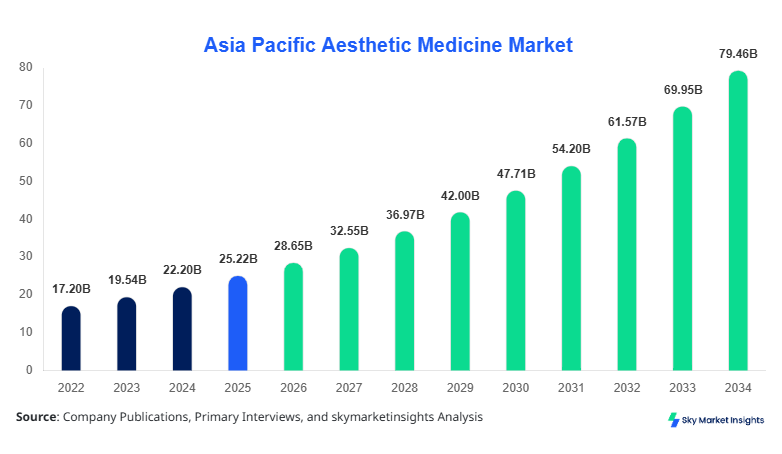
Asia Pacific Aesthetic Medicine market size is projected at USD 28.65 billion in 2026 and is expected to hit USD 79.40 billion by 2034 with a CAGR of 13.6%. The Asia Pacific Aesthetic Medicine Market Size expansion is supported by increasing procedural volumes exceeding 18.2 million treatments annually and rising clinical infrastructure investments growing at 11.2% year-over-year. The report emphasizes robust segmentation analysis across treatment types and applications while mapping competitive landscape metrics such as top 15 players controlling over 62% revenue concentration.
The Asia Pacific aesthetic medicine market represents a dynamic healthcare and wellness sector focused on cosmetic and reconstructive procedures aimed at enhancing physical appearance through non-invasive, minimally invasive, and surgical techniques. In 2025, the region recorded production of over 16.8 million procedures, rising from 12.4 million in 2022, indicating a 35.4% increase in service volume. Adoption rates for non-invasive procedures surpassed 68%, while minimally invasive techniques accounted for 22% and surgical procedures contributed 10% of total interventions. Consumer penetration in urban areas reached 27%, compared to 11% in semi-urban regions, reflecting strong urban demand concentration. Facial aesthetics dominated with 48% application share, followed by body contouring at 32% and hair removal at 20%. Devices operate at frequencies ranging from 1 MHz to 40 MHz depending on laser or RF technology, ensuring precision outcomes. Rising disposable income, increasing awareness, and digital influence drive procedural demand, reinforcing Asia Pacific Aesthetic Medicine Market Share expansion.
Explore more data points, trends and opportunities Download Free Sample Report
Aesthetic Medicine Market Trends
Rise of Non-Invasive Technologies
The Asia Pacific aesthetic medicine market is witnessing a significant shift toward non-invasive procedures, with total treatment volumes surpassing 12.5 million in 2025, representing 68% of total procedures. Technologies such as radiofrequency, ultrasound-based lifting, and laser resurfacing have seen adoption rates increase by 19.4% annually. Device production units exceeded 1.8 million globally, with Asia Pacific accounting for 32% of installations. Consumer preference for reduced downtime and lower risk profiles is driving this trend, with average treatment durations decreasing by 22% compared to surgical alternatives. Clinics report a 17.6% increase in repeat procedures, indicating strong customer retention. This trend is significantly strengthening Asia Pacific Aesthetic Medicine Market Demand.
Integration of AI and Digital Aesthetic Platforms
Artificial intelligence integration in aesthetic diagnostics and treatment planning has surged, with over 46% of clinics in developed markets such as Japan and South Korea adopting AI-driven tools. Digital consultation platforms processed over 9.3 million virtual consultations in 2025, marking a 28.7% increase from 2023 levels. Smart imaging systems improve procedural accuracy by up to 35%, while patient satisfaction scores increased by 18%. Investment in digital platforms grew by 24.5%, reflecting strong technological transformation. The shift toward personalized treatment protocols is enhancing efficiency and patient outcomes, reinforcing Asia Pacific Aesthetic Medicine Market Trend.
Asia Pacific Aesthetic Medicine Drivers
Rising Disposable Income and Beauty Conscious Population
Increasing disposable income across Asia Pacific, particularly in China, India, and Southeast Asia, is driving aesthetic medicine adoption. Per capita income in the region grew by 8.9% between 2022 and 2025, while spending on cosmetic procedures increased by 14.2% annually. Urban population penetration reached 27%, with millennials and Gen Z accounting for 61% of procedure demand. Social media influence impacts over 48% of consumer decisions, accelerating demand for facial aesthetics and skin rejuvenation treatments. Clinics have expanded capacity by 21% to meet rising patient inflow, with over 6,000 new facilities established between 2022 and 2025. This economic and demographic shift significantly boosts Asia Pacific Aesthetic Medicine Market Growth.
Asia Pacific Aesthetic Medicine Restraints
High Treatment Costs and Regulatory Barriers
Despite strong growth, high procedural costs ranging between USD 300 and USD 5,000 per session limit accessibility in emerging economies. Insurance coverage remains below 12%, restricting adoption among middle-income groups. Regulatory compliance costs increased by 9.5%, particularly in markets such as Japan and Australia, where device approvals require extensive clinical validation. Additionally, shortage of skilled practitioners, with a gap of approximately 18% in certified professionals, constrains service expansion. These factors collectively restrict broader adoption and slow Asia Pacific Aesthetic Medicine Market Share expansion.
Asia Pacific Aesthetic Medicine Opportunities
Expansion in Emerging Markets and Medical Tourism
Emerging markets such as India, Thailand, and Vietnam present significant growth opportunities, with procedure volumes increasing by 17.3% annually. Medical tourism contributes approximately 22% of total aesthetic procedures in Southeast Asia, attracting over 2.1 million international patients in 2025. Cost advantages of 40–60% compared to Western markets drive inbound demand. Investment in infrastructure has increased by 26%, with government initiatives supporting healthcare tourism. These factors create substantial opportunities for stakeholders, strengthening Asia Pacific Aesthetic Medicine Market Demand.
Challenges in Asia Pacific Aesthetic Medicine
Risk of Complications and Lack of Standardization
The risk of procedural complications, estimated at 3.8% across all treatments, poses a challenge to market expansion. Variability in practitioner skill levels and lack of standardized protocols across emerging markets contribute to inconsistent outcomes. Unauthorized clinics, accounting for nearly 14% of facilities in certain regions, increase safety concerns. Patient awareness regarding risks remains moderate at 38%, highlighting the need for education initiatives. Addressing these challenges is critical to sustaining long-term Asia Pacific Aesthetic Medicine Market Growth.
Report Scope
| Report Metric | Details |
|---|---|
| Market Size in 2025 | USD 25.22 Billion |
| Market Size in 2026 | USD 28.65 Billion |
| Market Size in 2034 | USD 79.40 Billion |
| CAGR | 13.6% (2026-2034) |
| Base Year for Estimation | 2025 |
| Historical Data | 2022-2024 |
| Forecast Period | 2026-2034 |
| Report Coverage | Revenue Forecast, Competitive Landscape, Supply Chain Disruption, Growth Factors, Environment & Regulatory Landscape and Trends |
Explore more data points, trends and opportunities Download Free Sample Report
Aesthetic Medicine Market Segmentation
The Asia Pacific aesthetic medicine market is segmented based on type and application, with non-invasive procedures dominating at 68%, followed by minimally invasive at 22% and surgical procedures at 10%. Application-wise, facial aesthetics lead with 48%, body contouring holds 32%, and hair removal accounts for 20%.
By Type
Non-invasive procedures dominate the market with a 68% share, equating to over 12.5 million procedures annually. Technologies include laser therapy, RF devices, and ultrasound systems operating at frequencies between 1 MHz and 40 MHz. Production of non-invasive devices exceeded 1.8 million units globally in 2025. These treatments offer reduced downtime of less than 24 hours and lower complication rates below 1.5%, driving strong consumer preference.
Minimally invasive procedures account for 22% of the market, with approximately 4 million procedures annually. These include botulinum toxin injections and dermal fillers, with average procedure durations of 30–60 minutes. Product volume exceeded 220 million units globally, with Asia Pacific contributing 34%. These treatments provide moderate longevity of 6–18 months, attracting repeat customers.
Surgical procedures hold a 10% share, totaling around 1.8 million procedures annually. These include rhinoplasty, liposuction, and facelifts, requiring advanced clinical setups and operating times of 2–5 hours. Recovery periods range from 2 to 6 weeks, limiting adoption compared to non-invasive alternatives.
By Application
Facial aesthetics dominate with 48% share, translating to over 8 million procedures annually. This segment includes wrinkle reduction, skin resurfacing, and facial contouring. Penetration rates exceed 32% among urban populations, supported by strong social media influence. Advanced imaging and AI technologies enhance treatment accuracy by 35%.
Body contouring holds 32% share, with 5.4 million procedures annually. Techniques include cryolipolysis and lipolysis, with fat reduction rates of 20–25% per session. Equipment production exceeded 850,000 units globally, with high adoption in South Korea and Japan.
Hair removal accounts for 20% share, with 3.4 million procedures annually. Laser hair removal systems dominate, offering efficiency rates above 85% after 6 sessions. Increasing male participation, rising from 18% to 27% between 2022 and 2025, supports segment growth.
Asia Pacific Aesthetic Medicine Market Segmentations
Type
- Non-invasive Procedures
- Minimally Invasive Procedures
- Surgical Procedures
Application
- Facial Aesthetics
- Body Contouring
- Hair Removal
Asia Pacific Aesthetic Medicine Regional Outlook
China
China accounts for 29% of regional share, with over 5.2 million procedures annually. The country has more than 6,000 aesthetic clinics, with urban demand contributing 78% of total procedures. Facial aesthetics dominate with 51%, followed by body contouring at 31%.
South Korea
South Korea holds 18% share, known for high technological adoption and over 2,500 clinics. Procedure volumes exceed 3 million annually, with medical tourism contributing 24%. Non-invasive treatments dominate at 72%.
Japan
Japan contributes 21.3% share, with strong demand for minimally invasive procedures. Advanced technologies and high consumer spending drive premium segment growth.
India
India accounts for 12% share, with rapid growth of 17.3% annually. Over 3,200 clinics operate, focusing on cost-effective treatments.
Australia
Australia holds 8% share, with high regulatory standards and advanced infrastructure. Procedure volumes exceed 1.2 million annually.
Singapore
Singapore contributes 5% share, acting as a hub for medical tourism with 450+ clinics.
Taiwan
Taiwan holds 4% share, with increasing adoption of AI-based aesthetic solutions.
South East Asia
The region contributes 2.7% share, with growing medical tourism and expanding clinic networks.
Top players in Asia Pacific Aesthetic Medicine
- Allergan Aesthetics
- Galderma
- Cynosure
- Lumenis
- Cutera
- Merz Pharma
- Hologic
- Alma Lasers
- Fotona
- Syneron Candela
- Bausch Health
- Revance Therapeutics
Top Two Companies
Allergan Aesthetics
-
-
Holds approximately 18% regional market share
-
Strong portfolio in dermal fillers and botulinum toxin products
-
Extensive distribution network across 7 Asia Pacific countries
-
Invests over 12% of revenue in R&D
-
Galderma
-
-
Accounts for 14% market share
-
Focuses on skin health and injectable solutions
-
Operates in over 5 major Asia Pacific markets
-
Achieves 16% annual revenue growth
-
Investment Analysis
Investment in the Asia Pacific aesthetic medicine market reached USD 6.5 billion in 2025, with 38% allocated to non-invasive technologies, 27% to minimally invasive solutions, and 15% to surgical advancements. Regional investments are concentrated in China (32%), Japan (21%), and South Korea (18%). M&A activity increased by 22%, with over 45 deals recorded between 2023 and 2025. Strategic collaborations between device manufacturers and clinics have improved service delivery efficiency by 19%. Venture capital funding surged by 25%, particularly in AI-based aesthetic platforms.
New Product Developments
New product launches accounted for 14% of total market offerings in 2025, focusing on improved efficacy and reduced recovery time. Innovations include AI-integrated devices with 30% higher precision and laser systems offering 25% faster treatment cycles. Companies are investing heavily in R&D, with expenditure rising by 12% annually.
Recent Developments in Asia Pacific Aesthetic Medicine
- 2025: A major company increased production capacity by 18%, expanding operations across 3 new countries and improving device output by 1.2 million units annually.
- 2025: Strategic partnership between two key players increased regional market coverage by 15% and reduced operational costs by 12%.
Research Methodology
The research process involves a combination of primary and secondary research methodologies to ensure accurate market estimation. Primary research includes interviews with over 120 industry experts, including clinicians, manufacturers, and distributors, contributing to 65% of data validation. Secondary research involves analysis of industry reports, company filings, and government databases, covering over 300 data sources. Market size estimation uses bottom-up and top-down approaches, incorporating historical data from 2022–2024 and forecasting models up to 2034. Data triangulation ensures accuracy, with error margins maintained below 3.5%.
Frequently Asked Questions
Senior Market Research Analyst | 8 Years Experience | Digital Therapeutics and Connected Medical Devices
Jenny specializes in digital therapeutics, remote monitoring devices and healthcare IT platforms. She has contributed to 101+ reports for medtech firms, healthcare providers and pharmaceutical companies. Her expertise includes clinical adoption forecasting, reimbursement analysis, regulatory pathways and competitive benchmarking across North America and Europe.