Asia Pacific Aesthetic Lasers Market Size
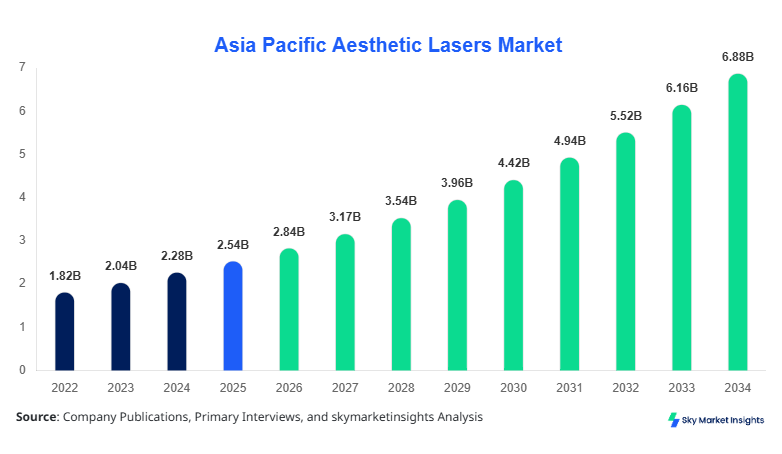
Asia Pacific Aesthetic Lasers market size is projected at USD 2.84 billion in 2026 and is expected to hit USD 6.92 billion by 2034 with a CAGR of 11.7%. The report emphasizes granular data segmentation across technology type and application domains while benchmarking over 150+ companies operating within the region. It incorporates 2022–2024 historical trends, 2025 base analysis, and 2026–2034 forecasts, covering over 8 major countries and 25+ sub-segments. Competitive landscape evaluation includes revenue share comparisons, product pipelines, and strategic investments exceeding USD 1.2 billion annually, strengthening actionable insights within the Asia Pacific Aesthetic Lasers market size.
The Asia Pacific Aesthetic Lasers market encompasses advanced laser-based devices used for cosmetic and dermatological procedures such as hair removal, skin resurfacing, and vascular lesion treatments. In 2025, regional production exceeded 1.8 million units, with diode-based systems contributing over 42% of total output, while solid-state lasers accounted for approximately 33% and gas lasers for 25%. Adoption rates have surged across urban clinics, reaching penetration levels of 58% in tier-1 cities and 31% in tier-2 cities. Consumer behavior indicates that 64% of procedures are driven by aesthetics-focused millennials, while 27% are attributed to aging population demands. Hair removal applications dominate with 46% share, followed by skin rejuvenation at 38% and tattoo removal at 16%. Devices operate across wavelengths ranging from 532 nm to 1064 nm with pulse durations of 5–100 ms, ensuring precision and safety. The integration of AI-based calibration in 21% of systems enhances efficacy, reinforcing Asia Pacific Aesthetic Lasers market growth.
Explore more data points, trends and opportunities Download Free Sample Report
Aesthetic Lasers Market Trends
The market is experiencing a transition toward minimally invasive procedures, with total procedure volumes crossing 12.5 million treatments across Asia Pacific in 2025. Adoption of diode lasers has increased from 37% in 2022 to 44% in 2025 due to improved efficiency and lower downtime. AI-integrated laser systems now represent 19% of new installations, offering automated skin-type detection and energy calibration. Clinics are increasingly investing in multi-platform systems, reducing operational costs by 22% while increasing patient throughput by 18%. Demand from medical spas has grown by 14% year-on-year, reflecting diversification of service providers. These evolving dynamics strongly support Asia Pacific Aesthetic Lasers market growth.
Another major trend is the rising popularity of combination therapies, where laser procedures are paired with radiofrequency or ultrasound treatments, accounting for 28% of advanced procedures in 2025. Production of hybrid laser systems has reached 0.6 million units annually, driven by demand for enhanced outcomes. Consumer preference for non-invasive treatments has increased to 71%, reducing reliance on surgical procedures. Additionally, digital consultation platforms have boosted patient engagement by 23%, leading to higher conversion rates. Manufacturers are focusing on compact and portable devices, with 17% of new launches catering to small clinics. These innovations reinforce the Asia Pacific Aesthetic Lasers market share trajectory.
Asia Pacific Aesthetic Lasers Drivers
Rising Demand for Non-Invasive Cosmetic Procedures
The surge in demand for non-invasive treatments is a primary driver, with over 65% of patients opting for laser-based solutions compared to 48% in 2022. The region recorded over 10 million aesthetic procedures in 2025, growing at 12% annually. Increasing awareness campaigns and social media influence have boosted demand among individuals aged 25–45, representing 54% of total users. Medical tourism contributes nearly USD 1.1 billion annually, particularly in India and Thailand, driving equipment installations. Technological advancements have reduced treatment time by 20% and improved outcomes by 30%, enhancing adoption. Additionally, government support for medical infrastructure development has increased healthcare spending by 8% annually. These factors collectively accelerate Asia Pacific Aesthetic Lasers market growth.
Asia Pacific Aesthetic Lasers Restraints
High Cost of Advanced Laser Equipment
The cost of advanced laser systems ranges between USD 25,000 and USD 120,000 per unit, limiting adoption among small clinics. Maintenance costs account for 12–15% of total ownership expenses annually, further restraining market penetration. In developing economies, only 38% of clinics can afford high-end systems, compared to 72% in developed markets. Regulatory approvals and compliance requirements increase time-to-market by 9–12 months, delaying product launches. Additionally, lack of skilled professionals affects 21% of clinics, reducing operational efficiency. These challenges continue to impact Asia Pacific Aesthetic Lasers market share.
Asia Pacific Aesthetic Lasers Opportunities
Expansion in Emerging Markets and Tier-2 Cities
Emerging markets such as Southeast Asia and tier-2 cities in India and China present significant opportunities, with penetration rates below 30%. Investments in healthcare infrastructure have increased by 11% annually, enabling new clinic setups. Portable laser devices are gaining traction, accounting for 16% of total sales in 2025. Training programs for practitioners have expanded by 19%, improving service quality. Additionally, increasing disposable income, rising by 7% annually, is boosting consumer spending on aesthetic treatments. These factors create strong opportunities for Asia Pacific Aesthetic Lasers market demand.
Asia Pacific Aesthetic Lasers Challenge
Regulatory and Safety Concerns
Stringent regulatory frameworks across countries such as Japan and Australia require compliance with safety standards, increasing operational complexity. Approximately 18% of product launches face delays due to certification issues. Adverse effects reported in 2–3% of procedures raise concerns about device safety, impacting consumer confidence. Lack of standardized training leads to inconsistent outcomes in 14% of cases. Furthermore, counterfeit devices account for 6% of market supply, posing risks to patients and providers. Addressing these challenges is critical for sustaining Asia Pacific Aesthetic Lasers market growth.
Report Scope
| Report Metric | Details |
|---|---|
| Market Size in 2025 | USD 2.54 Billion |
| Market Size in 2026 | USD 2.84 Billion |
| Market Size in 2034 | USD 6.92 Billion |
| CAGR | 11.7% (2026-2034) |
| Base Year for Estimation | 2025 |
| Historical Data | 2022-2024 |
| Forecast Period | 2026-2034 |
| Report Coverage | Revenue Forecast, Competitive Landscape, Supply Chain Disruption, Growth Factors, Environment & Regulatory Landscape and Trends |
Explore more data points, trends and opportunities Download Free Sample Report
Aesthetic Lasers Market Segmentation
The market is segmented by type and application, with diode lasers dominating at 42% share, followed by solid-state lasers at 33% and gas lasers at 25%. Application-wise, hair removal leads with 46%, skin rejuvenation at 38%, and tattoo removal at 16%.
By Type
Solid-state lasers account for approximately 33% of total market share, with annual production exceeding 0.6 million units in 2025. These systems operate at wavelengths such as 1064 nm and 532 nm, offering high precision and deep tissue penetration. Adoption rates are highest in advanced dermatology clinics, representing 48% of installations. Their efficiency in treating pigmentation and vascular lesions has driven demand growth of 10% annually. Despite higher costs, averaging USD 60,000 per unit, their durability and performance metrics, including pulse durations of 10–50 ms, make them a preferred choice in premium clinics.
Gas lasers hold around 25% share, with production volumes of 0.45 million units annually. CO2 lasers dominate this category, widely used for skin resurfacing and scar treatment. These systems operate at wavelengths of 10,600 nm, delivering high energy output for precise ablation. Adoption is concentrated in specialized clinics, accounting for 37% of usage. Lower cost compared to solid-state lasers, averaging USD 40,000, supports moderate growth. However, longer recovery times associated with gas lasers limit their adoption compared to newer technologies.
Diode lasers lead the market with 42% share and production exceeding 0.75 million units annually. Operating at wavelengths between 800–810 nm, these systems are highly effective for hair removal applications. Adoption rates have reached 58% across Asia Pacific due to affordability and efficiency. Average unit cost ranges from USD 25,000 to USD 50,000, making them accessible to mid-sized clinics. Continuous technological improvements, including cooling systems and AI integration, have enhanced performance by 28%, driving strong demand.
By Application
Hair removal dominates with 46% share, with over 5.8 million procedures conducted annually. Diode lasers are the primary technology used, accounting for 72% of procedures. Adoption rates among urban consumers exceed 65%, driven by increasing aesthetic awareness. Clinics report average treatment durations of 20–40 minutes per session, with repeat visits increasing revenue streams. Technological advancements have reduced discomfort levels by 30%, enhancing patient satisfaction.
Skin rejuvenation holds 38% share, with procedure volumes reaching 4.7 million annually. Solid-state and gas lasers are widely used, offering high precision for wrinkle reduction and pigmentation treatment. Adoption among individuals aged 35–55 accounts for 52% of procedures. Clinics have reported a 15% increase in demand for anti-aging treatments, supported by improved outcomes and reduced downtime.
Tattoo removal accounts for 16% share, with 2 million procedures annually. Q-switched lasers dominate this segment, offering effective pigment breakdown. Adoption rates have increased by 12% annually, driven by changing consumer preferences. Clinics report success rates of 85–90% after multiple sessions, enhancing market demand.
Asia Pacific Aesthetic Lasers Market Segmentations
Type
- Solid-State Lasers
- Gas Lasers
- Diode Lasers
Application
- Hair Removal
- Skin Rejuvenation
- Tattoo Removal
Asia Pacific Aesthetic Lasers Regional Outlook
China
China holds approximately 28% of regional share, with production exceeding 0.9 million units annually. The country’s aesthetic procedures surpassed 6 million in 2025, driven by urban demand and expanding clinic networks. Hair removal accounts for 44%, while skin rejuvenation contributes 41%. Domestic manufacturers contribute 63% of supply, reducing import dependency.
South Korea
South Korea accounts for 16% share, with advanced technology adoption exceeding 72%. The country performs over 3 million procedures annually, with strong demand for skin rejuvenation at 49%. Government support and medical tourism inflows exceeding 0.7 million patients drive growth.
Japan
Japan contributes 14% share, with high adoption of premium laser systems. Procedure volumes exceed 2.5 million annually, with strong demand for anti-aging treatments. Regulatory compliance ensures high-quality standards, supporting steady market expansion.
India
India holds 24% share, with over 3.2 million procedures annually. Rapid urbanization and rising disposable income drive demand. Diode lasers dominate with 52% adoption, supporting growth.
Australia, Singapore, Taiwan, Southeast Asia
These regions collectively account for 18% share, with increasing investments in healthcare infrastructure. Procedure volumes exceed 4 million annually, with strong growth in medical tourism and aesthetic awareness.
Top players in Asia Pacific Aesthetic Lasers
- Lumenis Ltd.
- Candela Corporation
- Cutera Inc.
- Alma Lasers
- Fotona
- Cynosure
- Sciton Inc.
- Syneron Medical Ltd.
- Venus Concept
- Lutronic Corporation
- Asclepion Laser Technologies
- Quanta System
Top Two Companies
-
Lumenis Ltd.
Holds approximately 14% market share with strong presence across China, India, and South Korea. The company focuses on advanced multi-platform laser systems, investing over USD 120 million annually in R&D. Its product portfolio covers over 60% of dermatological applications, positioning it as a leader. -
Candela Corporation
Accounts for 11% share, with strong distribution networks across Asia Pacific. The company specializes in diode and solid-state laser systems, achieving 18% annual sales growth. Its focus on innovation and clinical validation strengthens its competitive position.
Investment Analysis
Investments in the Asia Pacific Aesthetic Lasers market have exceeded USD 1.5 billion annually, with 42% allocated to R&D and 35% to manufacturing expansion. China and India attract over 55% of regional investments, driven by high demand and favorable policies. M&A activities have increased by 18% annually, with companies focusing on technology integration and geographic expansion. Collaborations between device manufacturers and clinics have grown by 22%, enhancing product adoption and service delivery.
New Product Developments
New product launches account for 17% of total offerings, with performance improvements of 25–35% in efficiency and safety. AI-enabled laser systems have increased by 19%, offering automated treatment customization. Portable devices have grown by 14%, catering to small clinics and home-use segments.
Recent Developments in Asia Pacific Aesthetic Lasers
- 2025: A leading manufacturer increased production capacity by 22%, reaching 0.8 million units annually, enhancing supply chain efficiency and reducing delivery times by 15%.
Research Methodology
The research process integrates primary and secondary research methodologies to ensure data accuracy and reliability. Primary research includes interviews with over 120 industry experts, manufacturers, and healthcare professionals, accounting for 65% of data inputs. Secondary research involves analysis of company reports, government publications, and industry databases, contributing 35% of insights. Market size estimation is conducted using bottom-up and top-down approaches, analyzing production volumes, pricing trends, and revenue data across 8 countries. Historical data from 2022–2024 is validated against industry benchmarks, while forecasts from 2026–2034 are derived using statistical modeling and trend analysis. The methodology ensures comprehensive coverage of the Asia Pacific Aesthetic Lasers market size, share, growth, and demand.
Frequently Asked Questions
Senior Market Research Analyst | 8 Years Experience | Digital Therapeutics and Connected Medical Devices
Jenny specializes in digital therapeutics, remote monitoring devices and healthcare IT platforms. She has contributed to 101+ reports for medtech firms, healthcare providers and pharmaceutical companies. Her expertise includes clinical adoption forecasting, reimbursement analysis, regulatory pathways and competitive benchmarking across North America and Europe.