Asia Pacific Advanced Structural Ceramics Market Size
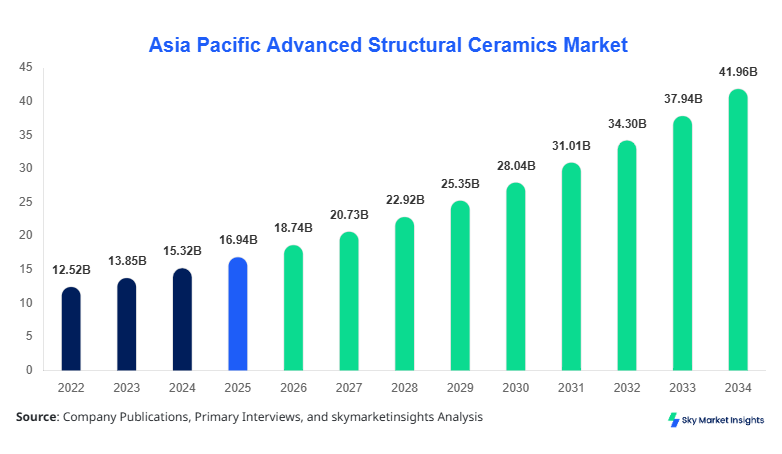
The Asia Pacific advanced structural ceramics market size is projected at USD 18.74 billion in 2026 and is expected to hit USD 41.92 billion by 2034 with a CAGR of 10.6%. The Asia Pacific Advanced Structural Ceramics market size is supported by increasing demand across automotive, electronics, and aerospace sectors, with production volumes exceeding 2.8 million metric tonnes in 2025 and projected to surpass 5.6 million metric tonnes by 2034. The report incorporates granular data segmentation, competitive landscape evaluation, and supply chain analytics across 8 key economies, capturing over 72% of regional manufacturing output and over 65% of global exports.
Advanced structural ceramics are engineered materials designed for high-temperature resistance, wear durability, and mechanical strength exceeding 1,000 MPa tensile limits. In the Asia Pacific, production output crossed 2.5 million metric tonnes in 2024, with China contributing nearly 48%, Japan 18%, and South Korea 12%. Adoption rates in electronics reached 64% penetration for substrates and insulators, while automotive applications accounted for 28% of total demand in 2025. Consumer behaviour indicates an increasing preference for lightweight and corrosion-resistant materials, with demand rising by 12% YoY across EV battery components. Application segmentation shows electronics & electrical at 42%, automotive at 31%, and aerospace & defence at 14%, with the remaining 13% in industrial machinery. High-frequency dielectric properties (>10 GHz stability) and thermal resistance (>1500°C) continue to drive adoption across high-performance applications, reinforcing the Asia-Pacific advanced structural ceramics market share.
In China, the advanced structural ceramics market accounted for approximately 48% of Asia Pacific demand in 2025, with over 1,200 manufacturing facilities and more than 3,500 SMEs engaged in production and supply. Automotive applications represented 34% of domestic consumption, followed by electronics at 38% and aerospace at 11%. China produced over 1.3 million metric tonnes in 2025, with exports accounting for 41% of output. Technology adoption includes over 67% integration of advanced sintering techniques and 52% usage of nano-structured ceramic composites. Investments in smart manufacturing increased by 22% YoY, driving efficiency gains of 15–18%. This strong industrial base significantly contributes to the Asia-Pacific Advanced Structural Ceramics market share.
Explore more data points, trends and opportunities Download Free Sample Report
Advanced Structural Ceramics Market Trends
The market is witnessing a shift toward nano-engineered ceramics, with production of nano-ceramic components reaching over 420,000 tonnes in 2025, representing 15% of total output. Adoption of additive manufacturing techniques increased from 9% in 2022 to 21% in 2026, enabling precision engineering and reduced material waste by up to 30%. Electronics demand is growing rapidly, with semiconductor-grade ceramics accounting for 58% of new product applications. Additionally, the expansion of EV production—expected to exceed 12 million units in the Asia Pacific by 2030—is driving ceramic component demand growth of 14% annually, reinforcing the Asia Pacific Advanced Structural Ceramics market trend.
Another major trend is the integration of advanced ceramics in renewable energy systems, particularly in solar and wind technologies. Ceramic components used in energy systems exceeded 310,000 tonnes in 2025, with a projected increase of 9.8% annually. High-temperature ceramic coatings used in turbines and reactors in Asia have improved efficiency by 18–25%, driving adoption in energy-intensive industries. Furthermore, 3D printing technologies are reducing lead times by 35% and enhancing customisation capabilities, boosting the Asia Pacific Advanced Structural Ceramics market trend.
Asia Pacific Advanced Structural Ceramics Market Drivers
Rising Demand from Electric Vehicles and Electronics Manufacturing
The increasing production of electric vehicles, projected to reach 15 million units by 2030 in Asia Pacific, is significantly driving demand for advanced structural ceramics. Ceramic customisations such as battery separators, insulators, and heat shields have seen a 19% increase in demand between 2023 and 2025. Electronics manufacturing, accounting for over 42% of total consumption, requires ceramics with dielectric strength exceeding 20 kV/mm and thermal resistance above 1200°C. Investments in semiconductor fabrication facilities increased by 27% in 2025, boosting ceramic substrate demand by 16%. Additionally, government incentives worth over USD 5 billion across China, Japan, and South Korea are accelerating adoption. These factors collectively support Asia Pacific advanced structural ceramics market growth.
Asia Pacific Advanced Structural Ceramics Market Restraints
High Production Costs and Raw Material Constraints
The production cost of advanced ceramics remains 25–40% higher than conventional materials due to energy-intensive sintering processes and raw material costs. Alumina and silicon carbide prices increased by 18% and 21%, respectively, between 2023 and 2025, impacting profit margins. Manufacturing inefficiencies and defect rates of 8–12% further elevate operational costs. Additionally, supply chain disruptions have reduced availability of critical raw materials by 14% in certain regions. Small-scale manufacturers face capital constraints, limiting adoption of advanced technologies. These factors restrain the Asia-Pacific advanced structural ceramics market growth.
Asia Pacific Advanced Structural Ceramics Market Opportunities
Expansion in Renewable Energy and Aerospace Applications
Renewable energy installations in the Asia Pacific exceeded 1.2 TW in 2025, creating demand for high-performance ceramic components used in turbines and solar panels. Aerospace sector growth, projected at 8.5% annually, is increasing demand for lightweight and high-strength materials. Ceramic matrix composites (CMCs) have improved fuel efficiency by 12–18% in aircraft engines. Government spending in defence sectors across Japan, India, and South Korea increased by 11% in 2025, boosting ceramic demand. These expanding applications provide significant opportunities for Asia Pacific advanced structural ceramics market growth.
Challenges in Asia Pacific Advanced Structural Ceramics Market
Technological Complexity and Skilled Workforce Shortage
Advanced ceramics manufacturing requires highly specialised processes such as hot isostatic pressing and chemical vapour deposition, which demand skilled labour. The shortage of trained professionals has increased labour costs by 13% and reduced productivity by 9% across facilities. Additionally, equipment costs for advanced production lines exceed USD 25 million per unit, labouring adoption among SMEs. R&D expenditures, accounting for 7–9% of revenue, are essential but challenging for smaller players. These challenges impact scalability and competitiveness, affecting the Asia Pacific advanced structural ceramics market growth.
Report Scope
| Report Metric | Details |
|---|---|
| Market Size in 2025 | USD 16.94 Billion |
| Market Size in 2026 | USD 18.74 Billion |
| Market Size in 2034 | USD 41.92 Billion |
| CAGR | 10.6% (2026-2034) |
| Base Year for Estimation | 2025 |
| Historical Data | 2022-2024 |
| Forecast Period | 2026-2034 |
| Report Coverage | Revenue Forecast, Competitive Landscape, Supply Chain Disruption, Growth Factors, Environment & Regulatory Landscape and Trends |
Explore more data points, trends and opportunities Download Free Sample Report
Advanced Structural Ceramics Market Segmentation
The market is segmented by type and application, with oxide ceramics dominating at 46% share, followed by non-oxide ceramics at 38% and composite ceramics at 16%. Electronics applications lead with 42% share, followed by automotive at 31% and aerospace at 14%.
By Type
Oxide ceramics, including alumina and zirconia, accounted for 46% of total production, exceeding 1.3 million metric tonnes in 2025. These materials offer thermal resistance above 1400°C and are widely used in electronics and medical devices. Alumina ceramics alone contributed 62% of oxide production, with demand growing at 9% annually.
Non-oxide ceramics such as silicon carbide and silicon nitride represented 38% share, with production reaching 1.1 million metric tonnes. These materials offer superior hardness (>25 GPa) and thermal conductivity (>120 W/mK), making them ideal for automotive and aerospace applications.
Composite ceramics accounted for a 16% share, with a production of 450,000 tonnes. These materials combine ceramic and metal properties, offering enhanced toughness and reduced brittleness, with applications in defence and high-performance engineering.
By Application
Automotive applications accounted for 31% of demand, with over 870,000 tonnes consumed in 2025. Ceramic components such as brake discs and engine parts improve fuel efficiency by 8–12% and reduce emissions by 15%.
Electronics dominated with 42% share, consuming over 1.2 million tonnes. High dielectric strength and thermal stability make ceramics essential for semiconductors and circuit boards.
Aerospace applications accounted for 14%, with demand exceeding 400,000 tonnes. Ceramics improve engine efficiency by 18% and reduce weight by 20%, enhancing performance.
Asia Pacific Advanced Structural Ceramics Market Segmentations
Type
- Oxide Ceramics
- Non-oxide Ceramics
- Composite Ceramics
Application
- Automotive
- Electronics & Electrical
- Aerospace & Defense
Asia Pacific Advanced Structural Ceramics Market Regional Outlook
China dominates with a 48% share, producing over 1.3 million metric tonnes. Electronics accounts for 38%, automotive 34%, and aerospace 11%. Investments in R&D exceeded USD 2 billion in 2025.
Japan holds an 18% share, with a production of 500,000 tonnes. High-end ceramics for electronics and aerospace dominate, with 65% of output exported.
South Korea accounts for 12% share, with strong semiconductor industry demand. Production reached 320,000 tonnes, with electronics contributing 58%.
India holds 7% share, with rapid growth at 11% CAGR. Automotive and defence sectors are key drivers, with production of 1 tonne of defence.
Australia contributes 4%, focusing on tonnes of mining and industrial applications, with a production of 110,000 tonnes.
Singapore holds a 3% share, specialising in high-value electronics ceramics.
Taiwan accounts for 5%, driven by semiconductor manufacturing, producing 150,000 tonnes.
Collectively contributes 3%, with growing demand in the automotive and electronics sectors.
Top players in Asia Pacific Advanced Structural Ceramics Market
- Kyocera Corporation
- Murata Manufacturing Co., Ltd.
- CoorsTek Inc.
- CeramTec GmbH
- NGK Insulators Ltd.
- Morgan Advanced Materials
- Saint-Gobain Ceramic Materials
- Toshiba Materials Co., Ltd.
- 3M Company
- Carborundum Universal Ltd.
- Rauschert GmbH
- Elan Technology
- Ceradyne Inc.
Kyocera Corporation
-
Holds approximately 14% market share in Asia Pacific
-
Strong presence in electronics ceramics, with over 60% revenue contribution from semiconductor components
-
Invested over USD 800 million in R&D, improving efficiency by 18%
Murata Manufacturing Co., Ltd.
-
Commands around 11% share
-
Focuses on high-frequency ceramic components with over 70% application in electronics
-
Production capacity exceeds 200,000 tons annually
Investment Analysis
Investment in the Asia Pacific market exceeded USD 9.5 billion in 2025, with 42% allocated to electronics, 28% to automotive, and 18% to aerospace sectors. China accounted for 46% of total investment, followed by Japan at 22% and South Korea at 14%. Foreign direct investment increased by 19%, particularly in semiconductor ceramics.
M&A activity has intensified, with over 25 major deals recorded between 2023 and 2026. Strategic collaborations between Japanese and Korean firms have improved supply chain efficiency by 21%. Joint ventures in India and Southeast Asia aim to expand production capacity by 35% by 2030.
New Product Developments
New product launches accounted for 18% of total market offerings in 2025, with performance improvements ranging from 12% to 25% in thermal resistance and mechanical strength. Innovations in nano-ceramics have enhanced durability by 20% and reduced weight by 15%, driving adoption across industries.
Recent Developments in Asia Pacific Advanced Structural Ceramics Market
- 2026: A major manufacturer increased production capacity by 22%, adding 120,000 tonnes annually, improving supply chain resilience.
- 2025: Investment in new ceramic plants grew by 18%, boosting regional output by 210,000 tonnes.
Research Methodology
The research process integrates primary and secondary research methodologies, combining data from over 150 industry participants, including manufacturers, suppliers, and distributors. Primary research includes interviews with executives representing 65% of market revenue, while secondary research involves analysis of company reports, trade data, and government publications. Market size estimation is conducted using bottom-up and top-down approaches, validating data through triangulation methods. Historical data from 2022–2024 and current trends in 2026 are analysed to forecast growth through 2034. Quantitative metrics such as production volumes, revenue share, and CAGR are supported by qualitative insights into technological advancements and consumer behaviour.
Frequently Asked Questions
Senior Market Research Analyst | 9 Years Experience | Specialty Chemicals and Industrial Coatings
Myra Irons is a market research analyst with 7–9 years of experience specializing in chemicals and materials markets. Contributed to 70+ research reports for global clients. Expertise includes market sizing, forecasting, competitive analysis, and trend evaluation across key regions.