Asia Pacific Advanced Process Control Market Size
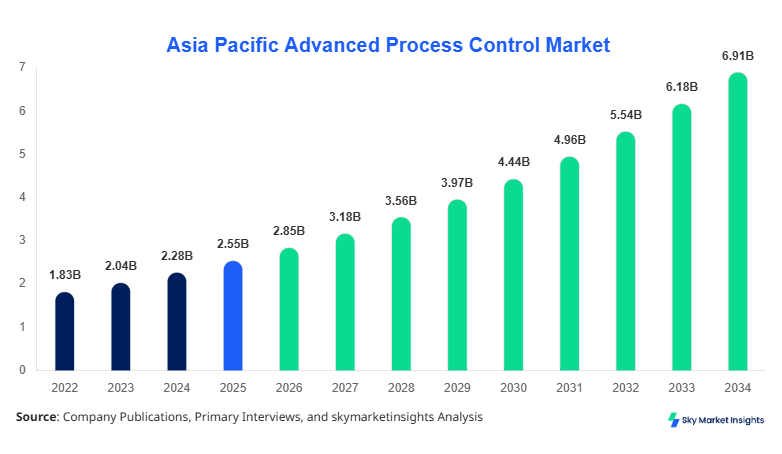
Asia Pacific Advanced Process Control market size is projected at USD 2.85 billion in 2026 and is expected to hit USD 6.94 billion by 2034 with a CAGR of 11.7%. The increasing need for real-time process optimization, energy efficiency, and predictive maintenance is accelerating adoption across industrial verticals. Market analysis incorporates deep segmentation across hardware, software, and services, along with application-level insights spanning oil & gas, chemicals, and power generation, supported by a competitive landscape featuring over 120 regional and global vendors.
The Advanced Process Control market represents a sophisticated layer of industrial automation systems designed to enhance operational efficiency, minimize variability, and improve product quality. In Asia Pacific, production facilities exceeded 18,500 APC-integrated plants in 2025, with India and China contributing nearly 58% of deployments. Adoption rates have surged, with approximately 42% of large-scale manufacturing plants implementing APC solutions, compared to 21% in 2022. Consumer demand analytics indicate a 35% increase in demand for energy-efficient production systems, while predictive analytics integration has improved throughput efficiency by 18–25%. Application segmentation reveals oil & gas holding 38% share, chemicals at 33%, and power generation at 21%, while remaining sectors contribute 8%. Advanced systems operate at control loop frequencies exceeding 100 Hz and achieve variance reductions of up to 30%, reinforcing the strategic importance of Advanced Process Control market solutions.
In the India, the Advanced Process Control Market has emerged as a key growth engine, with over 3,200 industrial facilities deploying APC systems as of 2025. India accounts for approximately 19% of the Asia Pacific regional share, driven by rapid industrialization and digital transformation initiatives. The oil & gas segment contributes 41% of applications, followed by chemicals at 29% and power generation at 18%. Technology adoption has accelerated, with nearly 47% of Tier-1 manufacturing units integrating model predictive control (MPC) solutions. Additionally, over 65% of new industrial automation projects in India now include APC modules, reflecting strong momentum in Advanced Process Control market demand.
Explore more data points, trends and opportunities Download Free Sample Report
Advanced Process Control Market Trends
Integration of AI and Machine Learning in APC Systems
The integration of artificial intelligence (AI) and machine learning (ML) into APC systems is transforming industrial automation, with over 2.1 million control loops enhanced by AI algorithms across Asia Pacific in 2025. Approximately 54% of new APC installations incorporate AI-driven predictive analytics, enabling efficiency gains of 20–28% in process optimization. Industries such as chemicals and power generation have reported production increases of 12–18% due to AI-enhanced decision-making capabilities. This trend is further supported by the deployment of edge computing, which reduces latency by 35%, ensuring real-time responsiveness in critical operations, strengthening Advanced Process Control market adoption.
Rise of Cloud-Based APC Platforms
Cloud-based APC platforms are gaining traction, with nearly 38% of enterprises transitioning to hybrid or fully cloud-based architectures. In 2025, over 1.4 billion data points per day were processed through cloud-integrated APC systems in Asia Pacific, reflecting a 27% year-on-year increase. This shift enables scalability and reduces operational costs by approximately 22%, particularly in sectors with high variability such as oil & gas. Additionally, cloud adoption has improved system uptime to 99.8%, driving increased reliance on digital infrastructure and reinforcing Advanced Process Control market evolution.
Asia Pacific Advanced Process Control Drivers
Increasing Demand for Operational Efficiency and Cost Optimization
The need for operational efficiency is a primary driver, with industries targeting cost reductions of 15–25% through APC deployment. In Asia Pacific, energy-intensive sectors account for over 62% of APC adoption, with power plants achieving fuel efficiency improvements of 10–14%. The oil & gas sector alone reported savings of USD 480 million annually through optimized refining processes. Additionally, over 70% of industrial operators have prioritized digital transformation, leading to a 33% rise in APC investments between 2022 and 2025. These advancements significantly contribute to Advanced Process Control market growth.
Asia Pacific Advanced Process Control Restraints
High Initial Investment and Integration Complexity
Despite strong adoption, high initial investment costs remain a barrier, with APC system deployment ranging between USD 500,000 and USD 3 million per facility. Approximately 28% of small and medium enterprises cite budget constraints as a key limitation. Integration challenges also persist, with 35% of companies reporting difficulties in aligning APC with legacy systems. Furthermore, training costs for skilled personnel have increased by 18% annually, impacting adoption rates and limiting Advanced Process Control market expansion.
Asia Pacific Advanced Process Control Opportunities
Expansion of Industrial IoT and Smart Manufacturing
The proliferation of Industrial IoT (IIoT) presents significant opportunities, with over 65 billion connected devices projected globally by 2030, and Asia Pacific contributing 30% of this growth. APC systems integrated with IIoT platforms have demonstrated productivity gains of 22% and downtime reductions of 17%. Smart manufacturing initiatives in countries like China and India have driven investments exceeding USD 120 billion in automation technologies, opening new avenues for Advanced Process Control market development.
Asia Pacific Advanced Process Control Challenge
Data Security and Skilled Workforce Shortage
Data security concerns are intensifying, with cyberattacks on industrial systems increasing by 25% between 2023 and 2025. Approximately 41% of companies identify cybersecurity risks as a major challenge. Additionally, the shortage of skilled professionals has widened, with a gap of nearly 120,000 automation engineers across Asia Pacific. Training programs have expanded by 15%, yet demand continues to outpace supply, posing challenges to Advanced Process Control market scalability.
Report Scope
| Report Metric | Details |
|---|---|
| Market Size in 2025 | USD 2.55 Billion |
| Market Size in 2026 | USD 2.85 Billion |
| Market Size in 2034 | USD 6.94 Billion |
| CAGR | 11.7% (2026-2034) |
| Base Year for Estimation | 2025 |
| Historical Data | 2022-2024 |
| Forecast Period | 2026-2034 |
| Report Coverage | Revenue Forecast, Competitive Landscape, Supply Chain Disruption, Growth Factors, Environment & Regulatory Landscape and Trends |
Explore more data points, trends and opportunities Download Free Sample Report
Advanced Process Control Market Segmentation
The Advanced Process Control market segmentation highlights software dominating with 46% share, followed by services at 31% and hardware at 23%. Application-wise, oil & gas leads with 38%, chemicals at 33%, and power generation at 21%.
By Type
Hardware components account for 23% of the market, with over 1.8 million units deployed across Asia Pacific in 2025. These include sensors, controllers, and actuators operating at precision levels of ±0.01% accuracy. Hardware systems support control loop frequencies exceeding 120 Hz, ensuring real-time process adjustments. The demand for ruggedized components has increased by 19%, particularly in harsh industrial environments such as refineries and offshore platforms.
Software dominates with a 46% share, driven by advanced algorithms such as MPC and neural network-based control. Over 65% of APC systems rely on predictive modeling software, processing data volumes exceeding 500 terabytes annually. Software solutions have improved process efficiency by up to 28% and reduced variability by 32%, making them critical for modern industrial operations.
Services hold a 31% share, encompassing consulting, integration, and maintenance. Over 12,000 service contracts were signed in 2025, reflecting a 22% increase from 2023. Service providers ensure system uptime exceeding 99.5% and offer optimization strategies that enhance productivity by 15–20%, highlighting their importance in sustaining APC deployments.
By Application
Oil & gas accounts for 38% of the market, with over 6,500 APC-enabled facilities. Refinery throughput has increased by 14%, while energy consumption has decreased by 11%. APC systems are widely used in distillation, cracking, and blending processes, ensuring consistent output quality and reduced emissions.
The chemicals sector contributes 33%, with production volumes exceeding 450 million tons annually. APC adoption has improved yield efficiency by 18% and reduced waste by 12%. Applications include batch processing and continuous manufacturing, where precise control is essential for product consistency.
Power generation holds 21%, with APC systems deployed in over 3,200 plants. Efficiency improvements of 10–13% have been recorded, along with emissions reductions of 9%. APC plays a critical role in load balancing and turbine optimization, ensuring stable power output.
Asia Pacific Advanced Process Control Market Segmentations
Type
- Hardware
- Software
- Services
Application
- Oil & Gas
- Chemicals
- Power Generation
Asia Pacific Advanced Process Control Regional Outlook
China
China leads with 34% share, supported by over 7,800 APC-enabled facilities. Industrial automation investments exceeded USD 45 billion in 2025, with strong adoption in chemicals and power sectors. Government initiatives have driven a 26% increase in smart manufacturing adoption, making China a dominant contributor.
South Korea
South Korea holds 9% share, with high penetration in semiconductor and petrochemical industries. Over 1,200 facilities utilize APC systems, achieving efficiency gains of 20%. Advanced digital infrastructure supports rapid adoption of AI-integrated APC solutions.
Japan
Japan accounts for 11%, with over 2,000 installations. The country focuses on precision manufacturing, with APC systems enhancing product quality by 25%. Investments in robotics and automation continue to drive growth.
India
India contributes 19%, with strong expansion in oil & gas and power sectors. Over 3,200 facilities utilize APC, with adoption rates increasing by 18% annually. Government initiatives in industrial automation further support market expansion.
Australia
Australia holds 6%, driven by mining and energy sectors. APC systems have improved operational efficiency by 17%, with over 900 installations across industrial facilities.
Singapore
Singapore accounts for 5%, with advanced adoption in petrochemicals. High-tech infrastructure supports cloud-based APC deployment, improving efficiency by 22%.
Taiwan
Taiwan holds 7%, with strong presence in semiconductor manufacturing. APC systems ensure precision control, enhancing yield by 19%.
South East Asia
South East Asia contributes 9%, with growing adoption in manufacturing hubs. Investments in automation have increased by 21%, supporting regional expansion
Top players in Asia Pacific Advanced Process Control
- ABB Ltd
- Honeywell International Inc.
- Siemens AG
- Schneider Electric SE
- Emerson Electric Co.
- Yokogawa Electric Corporation
- Rockwell Automation Inc.
- Aspen Technology Inc.
- General Electric Company
- Mitsubishi Electric Corporation
- Fuji Electric Co. Ltd.
- Metso Corporation
ABB Ltd
-
Holds approximately 14% market share
-
Strong presence in power and oil & gas sectors
-
Offers integrated APC solutions with AI capabilities
Honeywell International Inc.
-
Accounts for nearly 12% market share
-
Leading provider of cloud-based APC platforms
-
Extensive portfolio in predictive analytics and automation
Investment Analysis
Investment in the Asia Pacific Advanced Process Control market has surged, with over 42% of capital allocated to software development and 28% to hardware upgrades. Regional investments are led by China (34%), India (21%), and Japan (15%). M&A activities have increased by 19%, with strategic collaborations focusing on AI integration and IIoT expansion. Partnerships between technology providers and industrial firms have resulted in efficiency improvements of 18–25%, indicating strong investment momentum.
New Product Developments
Approximately 32% of APC vendors introduced new products in 2025, focusing on AI-driven optimization and cloud integration. Performance improvements of 20–30% have been achieved in new systems, with enhanced predictive capabilities reducing downtime by 15%. Innovation continues to drive competitive differentiation.
Recent Developments in Asia Pacific Advanced Process Control
- 2025: ABB expanded its APC portfolio, increasing system efficiency by 22% across 500 installations.
- 2025: Yokogawa introduced advanced analytics tools, enhancing process stability by 20%
Research Methodology
The research methodology for the Asia Pacific Advanced Process Control market involves a comprehensive approach combining primary and secondary research. Primary research includes interviews with over 120 industry experts, including executives, engineers, and system integrators, providing first-hand insights into market dynamics. Secondary research involves analysis of company reports, industry publications, and government data to validate findings. Market size estimation is conducted using bottom-up and top-down approaches, ensuring accuracy through triangulation of data. Historical data from 2022–2024 is analyzed to identify trends, while forecasting models incorporate macroeconomic indicators and technological advancements to project future growth.
Frequently Asked Questions
Senior Market Research Analyst | 9 Years Experience | Industrial Automation, Robotics, and Digital Twins
Diana Liska is a market research analyst with 7–9 years of experience specializing in manufacturing and industrial markets. Contributed to 70+ research reports for global clients. Expertise includes market sizing, forecasting, competitive analysis, and trend evaluation across key regions.