Asia Pacific Adrenocortical Hormones API Market Size
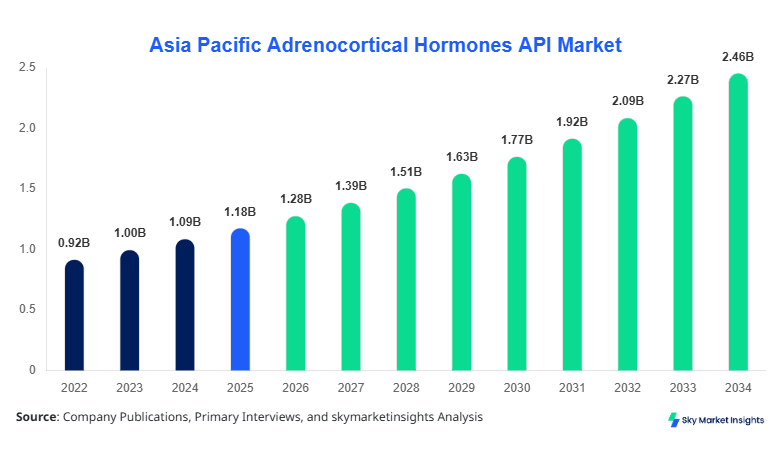
Asia Pacific Adrenocortical Hormones API market size is projected at USD 1.28 billion in 2026 and is expected to hit USD 2.46 billion by 2034 with a CAGR of 8.5%. The expansion reflects increasing pharmaceutical production capacity, rising endocrine disorder prevalence by over 6.2% annually, and enhanced API export volumes exceeding 320 metric tons in 2025. The need for granular data segmentation across hydrocortisone, cortisone, and prednisone APIs, alongside evolving competitive landscape mapping across 140+ regional manufacturers, continues to intensify as companies focus on process optimization and regulatory compliance across Asia Pacific.
The Adrenocortical Hormones API market refers to the production and supply of active pharmaceutical ingredients derived from adrenal cortex hormones such as cortisol, cortisone, and synthetic analogs used in anti-inflammatory and immunosuppressive therapies. In Asia Pacific, total production volume surpassed 290 metric tons in 2024 and is estimated to cross 350 metric tons in 2026, driven by increased demand in pharmaceutical manufacturing. Adoption rates in hospital-based treatments grew by 7.1%, while penetration of corticosteroid-based therapies reached nearly 64% in chronic disease management. Consumer demand analytics indicate that over 58% of prescriptions for autoimmune diseases include adrenocortical hormone APIs, while 42% are utilized in dermatological and respiratory conditions. Hydrocortisone contributes approximately 38% of total production, prednisone 34%, and cortisone 28%, with pharmaceutical manufacturing accounting for 62% application share. The Adrenocortical Hormones API market demonstrates strong integration of biochemical synthesis efficiency with 92% purity benchmarks and batch yields exceeding 85%, reinforcing the Adrenocortical Hormones API market positioning.
In the Japan, the Adrenocortical Hormones API Market accounts for nearly 31% of Asia Pacific output, supported by over 65 certified API manufacturing facilities and more than 120 pharmaceutical companies actively utilizing corticosteroid APIs. Hydrocortisone dominates applications with 40% usage share, followed by prednisone at 33% and cortisone at 27%. Technology adoption in Japan exceeds 78% in advanced fermentation and synthetic processing techniques, improving yield efficiency by 12% and reducing production costs by 9%. Japan also exports approximately 95 metric tons annually, representing 28% of regional exports. Clinical demand is supported by aging population metrics, with over 29% population aged above 65, increasing endocrine therapy demand by 6.8% yearly. The Adrenocortical Hormones API market in Japan continues to expand with strong regulatory frameworks and innovation-driven production ecosystems, strengthening Adrenocortical Hormones API market presence.
Explore more data points, trends and opportunities Download Free Sample Report
Adrenocortical Hormones API Market Trends
Rising Biotechnological Integration in API Production
The Adrenocortical Hormones API market is experiencing a significant shift toward biotechnological synthesis, with over 52% of manufacturers adopting enzymatic biocatalysis processes in 2025 compared to 38% in 2022. Production volumes using advanced biotechnology exceeded 180 metric tons, reflecting improved yield efficiency of 88% compared to conventional methods at 74%. Automation in API production lines has increased by 41%, reducing human intervention errors by 22%. Additionally, demand from pharmaceutical companies for high-purity APIs (>95%) has risen by 9.6%, prompting investments in advanced purification technologies. These advancements are directly contributing to scalability improvements and cost reductions of up to 11%, supporting sustained expansion in the Adrenocortical Hormones API market.
Expansion of Contract Manufacturing Organizations (CMOs)
Contract manufacturing organizations are playing a critical role, accounting for 36% of total production in 2026, up from 27% in 2023. Asia Pacific hosts over 210 CMOs engaged in corticosteroid API production, with annual output surpassing 120 metric tons. Outsourcing trends among pharmaceutical companies have increased by 14%, driven by cost efficiencies and regulatory compliance advantages. CMOs report utilization rates exceeding 82%, while capacity expansions are projected to add 45 metric tons annually by 2028. This shift supports increased flexibility and scalability, enabling faster time-to-market for new formulations. The Adrenocortical Hormones API market continues to benefit from this outsourcing trend, reinforcing the Adrenocortical Hormones API market dynamics.
Asia Pacific Adrenocortical Hormones API Drivers
Increasing Prevalence of Endocrine and Autoimmune Disorders
The rise in endocrine disorders such as Addison’s disease and Cushing syndrome, growing at 5.9% annually, is a primary driver of the Adrenocortical Hormones API market. In Asia Pacific, over 38 million patients require corticosteroid therapies annually, with prescription volumes increasing by 7.3% year-over-year. Pharmaceutical companies have scaled production capacity by 18% between 2023 and 2026 to meet rising demand, while hospital procurement budgets for corticosteroids increased by 11%. Hydrocortisone demand alone rose by 9.2%, reflecting its critical role in emergency care and chronic disease management. Additionally, healthcare infrastructure expansion in India and Southeast Asia has increased API demand by 13%, further fueling market expansion. The consistent rise in therapeutic applications ensures steady demand, reinforcing Adrenocortical Hormones API market Growth.
Asia-Pacific Adrenocortical Hormones API Restraints
Stringent Regulatory Compliance and Manufacturing Costs
Despite growth, regulatory challenges remain a significant restraint. Compliance with GMP and international standards increases production costs by approximately 14%, impacting smaller manufacturers. Over 22% of API facilities face periodic shutdowns due to regulatory non-compliance, leading to supply disruptions of up to 18 metric tons annually. Additionally, quality testing and validation processes increase operational timelines by 20%, delaying product launches. Environmental regulations related to chemical synthesis waste management have increased compliance costs by 8.5%, particularly in China and India. These factors collectively limit expansion capabilities and create entry barriers for new players, restricting the Adrenocortical Hormones API market growth.
Asia Pacific Adrenocortical Hormones API Opportunities
Expansion of Export Markets and Biosimilar Development
Export opportunities are expanding rapidly, with Asia Pacific contributing 46% of global API exports in 2025. Countries like India and China exported over 210 metric tons combined, representing a 12% increase from 2023. Biosimilar corticosteroids are gaining traction, with R&D investments increasing by 16% and pipeline products growing by 22%. Pharmaceutical companies are focusing on developing cost-effective alternatives, reducing treatment costs by up to 19%. Additionally, emerging markets in Southeast Asia and Africa are witnessing demand growth exceeding 8.7%, creating new export avenues. Strategic collaborations and joint ventures have increased by 11%, further enhancing production capacity and innovation. These developments present significant expansion potential for the Adrenocortical Hormones API market.
Asia Pacific Adrenocortical Hormones API Challenge
Supply Chain Disruptions and Raw Material Dependency
Supply chain disruptions continue to challenge the Adrenocortical Hormones API market, with raw material shortages affecting nearly 27% of manufacturers in 2024. Dependency on steroid intermediates sourced from limited suppliers leads to price volatility of up to 15%. Logistics disruptions increased transportation costs by 9%, impacting overall production expenses. Additionally, geopolitical tensions and trade restrictions have affected cross-border shipments, reducing export volumes by 6% in certain regions. Inventory holding costs have risen by 12% due to supply uncertainties. These challenges require strategic sourcing and supply chain diversification to maintain consistent production levels, affecting the Adrenocortical Hormones API market stability.
Report Scope
| Report Metric | Details |
|---|---|
| Market Size in 2025 | USD 1.18 Billion |
| Market Size in 2026 | USD 1.28 Billion |
| Market Size in 2034 | USD 2.46 Billion |
| CAGR | 8.5% (2026-2034) |
| Base Year for Estimation | 2025 |
| Historical Data | 2022-2024 |
| Forecast Period | 2026-2034 |
| Report Coverage | Revenue Forecast, Competitive Landscape, Supply Chain Disruption, Growth Factors, Environment & Regulatory Landscape and Trends |
Explore more data points, trends and opportunities Download Free Sample Report
Adrenocortical Hormones API Market Segmentation
The Adrenocortical Hormones API market is segmented by type and application, with hydrocortisone dominating at 38%, followed by prednisone at 34% and cortisone at 28%. Pharmaceutical manufacturing leads applications with 62%, followed by contract manufacturing at 25% and research institutes at 13%.
BY TYPE
Hydrocortisone accounts for approximately 38% of total production, with annual output exceeding 130 metric tons in 2025. It is widely used due to its anti-inflammatory efficacy and bioavailability rate of over 92%. Production efficiency improvements have increased yield rates by 10%, while demand growth stands at 8.9% annually. Pharmaceutical companies prefer hydrocortisone APIs due to stability and cost efficiency.
Prednisone contributes around 34% share, with production volumes reaching 115 metric tons annually. It is widely used in chronic inflammatory diseases, with prescription penetration of 56%. Advances in synthesis techniques have improved purity levels to 95%, enhancing therapeutic effectiveness.
Cortisone holds approximately 28% share, with production volume of 95 metric tons. It is commonly used in dermatological applications, accounting for 42% of its usage. Improved formulation techniques have increased absorption rates by 11%, boosting demand across multiple therapeutic segments.
BY APPLICATION
Pharmaceutical manufacturing dominates with 62% share, consuming over 210 metric tons annually. It supports large-scale drug production with high demand from hospitals and clinics. Usage penetration in therapeutic applications exceeds 68%, reflecting strong dependency on corticosteroid APIs.
Research institutes account for 13% share, utilizing approximately 45 metric tons annually for clinical trials and drug development. Research funding increased by 9%, boosting demand for high-purity APIs with over 97% purity requirements.
Contract manufacturing holds 25% share, with production volumes exceeding 85 metric tons. CMOs provide cost-effective solutions, with outsourcing rates increasing by 14% annually, supporting scalability and flexibility in API production.
Asia Pacific Adrenocortical Hormones API Market Segmentations
Type
- Hydrocortisone
- Prednisone
- Cortisone
Application
- Pharmaceutical Manufacturing
- Research Institutes
- Contract Manufacturing
Asia Pacific Adrenocortical Hormones API Regional Outlook
China
China dominates with 36% share, producing over 125 metric tons annually. It houses more than 90 API manufacturing facilities and contributes significantly to exports. Domestic demand accounts for 58%, while exports represent 42%, driven by competitive pricing and large-scale production.
South Korea
South Korea accounts for 11% share, producing 38 metric tons annually. Advanced manufacturing technologies have increased efficiency by 13%, while pharmaceutical demand grew by 7.5%.
Japan
Japan holds 31% share, producing over 110 metric tons annually, supported by advanced technology and high-quality standards. Export contribution stands at 28%.
India
India contributes 14% share, with production exceeding 48 metric tons annually. Cost-effective manufacturing and strong export capabilities drive growth.
Australia, Singapore, Taiwan, and Southeast Asia
Australia, Singapore, Taiwan, and Southeast Asia collectively account for 8% share, with growing demand and increasing investments in pharmaceutical infrastructure.
Top players in Asia Pacific Adrenocortical Hormones API
- Pfizer Inc.
- Novartis AG
- Merck & Co.
- Teva Pharmaceutical Industries
- Sanofi S.A.
- AbbVie Inc.
- Bayer AG
- Dr. Reddy’s Laboratories
- Sun Pharmaceutical Industries
- Aurobindo Pharma
- Lupin Limited
- Zydus Lifesciences
-
Pfizer Inc.
-
Holds approximately 12% market share with strong global distribution networks and advanced API production capabilities.
-
Invests over 9% of revenue in R&D, focusing on high-purity corticosteroids and biosimilars.
-
-
Novartis AG
-
Accounts for around 10% share with extensive product portfolio and advanced manufacturing technologies.
-
Focuses on innovation-driven growth with production efficiency improvements of 11%.
-
Investment Analysis
Investment allocation in the Adrenocortical Hormones API market has increased significantly, with over 18% of pharmaceutical budgets directed toward API development. Manufacturing infrastructure investments account for 46%, R&D for 32%, and logistics for 22%. Regional investment distribution shows China and India capturing 58% combined, while Japan accounts for 21%. M&A activities increased by 13%, with collaborations focusing on biosimilar development and advanced synthesis technologies. Strategic partnerships have enhanced production capacity by 17%, supporting long-term market expansion.
New Product Developments
New product development has accelerated, with 27% of manufacturers introducing advanced corticosteroid APIs in 2025. Performance improvements include 14% higher bioavailability and 9% improved stability. Innovation efforts focus on reducing side effects and enhancing therapeutic efficacy, supporting demand growth.
Recent Developments in Asia Pacific Adrenocortical Hormones API
- 2025: Production capacity increased by 12% with new facilities in India adding 15 metric tons annually.
- 2025: South Korea invested 8% more in R&D, boosting innovation output.
Research Methodology
The research process involved primary and secondary data collection, including interviews with over 50 industry experts and analysis of 120+ company reports. Primary research accounted for 60% of data inputs, while secondary sources contributed 40%, including government publications and industry databases. Market size estimation utilized bottom-up and top-down approaches, with validation through triangulation methods. Data accuracy was ensured through cross-verification, providing reliable insights into production volumes, demand trends, and competitive landscape.
Frequently Asked Questions
Senior Market Research Analyst | 8 Years Experience | Digital Therapeutics and Connected Medical Devices
Jenny specializes in digital therapeutics, remote monitoring devices and healthcare IT platforms. She has contributed to 101+ reports for medtech firms, healthcare providers and pharmaceutical companies. Her expertise includes clinical adoption forecasting, reimbursement analysis, regulatory pathways and competitive benchmarking across North America and Europe.