Asia Pacific Acute Coronary Syndrome (ACS) Market Size
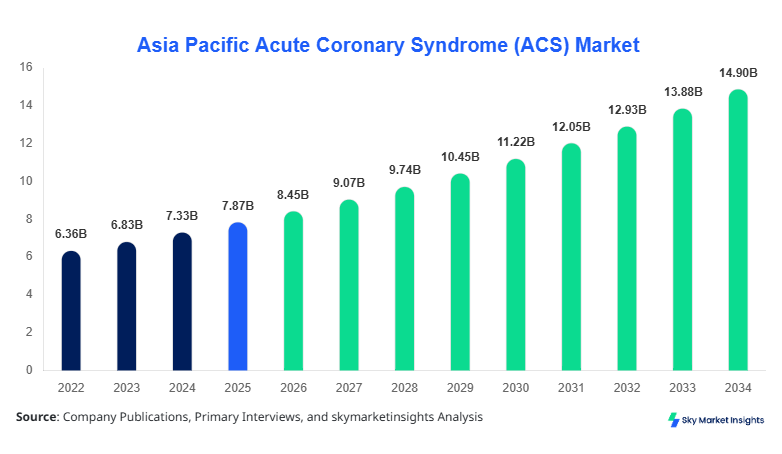
The Asia Pacific Acute Coronary Syndrome (ACS) market size is projected at USD 8.45 billion in 2026 and is expected to hit USD 14.92 billion by 2034 with a CAGR of 7.35%. The increasing need for real-time cardiovascular monitoring data, detailed segmentation by ACS types, and rising competition among pharmaceutical and medical device companies are shaping the market. Advanced diagnostic tools, including ECG monitoring devices and biomarker assays, are driving measurable improvements in detection accuracy by over 25% across regional healthcare systems.
The Acute Coronary Syndrome (ACS) market in the Asia Pacific encompasses the diagnosis, treatment, and management of cardiac ischemic events, including ST-elevation myocardial infarction (STEMI), non-ST elevation myocardial infarction (NSTEMI), and unstable angina. The region recorded over 12.5 million ACS-related cases in 2025, with Japan contributing nearly 18% of total cases. Adoption rates of advanced diagnostic imaging such as coronary angiography reached 62% in urban hospitals, while rural penetration remained below 35%. Consumer behavior indicates that over 48% of patients prefer early-stage intervention, boosting demand for rapid diagnostic kits and emergency response systems. Hospitals account for approximately 68% of applications, clinics for 22%, and ambulatory centers for 10%, reflecting strong institutional dependency. High-frequency ECG usage exceeding 5 million units annually and biomarker testing accuracy improvements of 30% reinforce the Acute Coronary Syndrome (ACS) market expansion.
In Japan, the Acute Coronary Syndrome (ACS) market is characterized by over 1,200 specialized cardiac care centers and approximately 3,500 hospitals equipped with coronary intervention facilities. Japan holds nearly a 28% regional share, driven by a high aging population where 29% are above 65 years. Application-wise, hospitals contribute 72%, clinics 18%, and ambulatory centers 10%. Adoption of advanced technologies such as drug-eluting stents stands at 78%, while AI-based cardiac monitoring penetration has reached 35%. Annual procedural volumes exceed 450,000 angioplasties, indicating robust clinical infrastructure. The integration of high-performance diagnostic tools with over 95% sensitivity ensures early detection, reinforcing the acute coronary syndrome (ACS) market.
Explore more data points, trends and opportunities Download Free Sample Report
Acute Coronary Syndrome (ACS) Market Trends
Increasing Adoption of Minimally Invasive Cardiac Procedures
The shift toward minimally invasive procedures such as percutaneous coronary intervention (PCI) has increased significantly, with over 3.2 million procedures performed annually across the Asia Pacific. Adoption rates surged from 54% in 2022 to 68% in 2025, driven by shorter recovery times and reduced hospital stays by 30%. Technological advancements in imaging and catheter-based systems have improved procedural success rates to 92%. The demand for drug-coated balloons and biodegradable stents has grown by 22% year-on-year, reflecting evolving clinical preferences. Hospitals in urban regions account for over 70% of these procedures, demonstrating concentrated healthcare capabilities. These developments continue to influence the acute coronary syndrome (ACS) market.
Integration of AI and Digital Health Technologies
Artificial intelligence integration in ACS diagnosis has expanded rapidly, with over 40% of tertiary hospitals implementing AI-assisted ECG interpretation systems. These systems improve diagnostic speed by 35% and reduce false-negative rates by 18%. Wearable cardiac monitoring devices have surpassed 15 million unit shipments annually, with patient adoption rates reaching 45% in developed markets like Japan and South Korea. Cloud-based patient data systems have improved treatment response times by 28%, enabling real-time clinical decisions. Telemedicine platforms handling over 5 million consultations annually are also contributing to early ACS detection. These innovations are reshaping the acute coronary syndrome (ACS) market.
Asia Pacific Acute Coronary Syndrome (ACS) Market Drivers
Rising Cardiovascular Disease Prevalence Driving Acute Coronary Syndrome (ACS) Growth
The increasing incidence of cardiovascular diseases is a major driver, with Asia Pacific recording over 60 million cardiovascular cases annually. ACS accounts for nearly 21% of these cases, with a year-on-year growth rate of 6%. Sedentary lifestyles, affecting over 35% of urban populations, and rising obesity rates of 27% are contributing factors. Healthcare spending in cardiovascular treatment has increased by 18% across the region, with governments allocating over USD 2.5 billion annually to cardiac care infrastructure. Improved insurance coverage reaching 65% of populations in countries like Japan and South Korea enhances access to treatment. These dynamics significantly boost acute coronary syndrome (ACS) growth.
Asia Pacific Acute Coronary Syndrome (ACS) Market Restraints
High Treatment Costs and Limited Rural Access
Despite advancements, high treatment costs remain a restraint, with PCI procedures costing between USD 3,000 and USD 8,000 depending on country and hospital type. Over 40% of rural populations lack access to advanced cardiac facilities, leading to delayed diagnoses. Infrastructure gaps persist, with only 25% of rural hospitals equipped with advanced ECG systems. Additionally, reimbursement limitations in developing countries reduce treatment affordability by 30%. These factors collectively hinder expansion, especially in low-income regions, impacting the acute coronary syndrome (ACS) market.
Asia Pacific Acute Coronary Syndrome (ACS) Market Opportunities
Expansion of Preventive Healthcare and Screening Programs
Preventive healthcare initiatives offer significant opportunities, with governments increasing screening budgets by 20% annually. Mass screening programs covering over 50 million individuals annually have improved early detection rates by 33%. Portable diagnostic devices with accuracy rates above 90% are being deployed widely, particularly in rural areas. Investments in telemedicine and mobile health clinics have increased coverage by 28%, improving healthcare reach. These initiatives are expected to expand the Acute Coronary Syndrome (ACS) market.
Challenges in Asia Pacific Acute Coronary Syndrome (ACS) Market
Shortage of Skilled Cardiology Professionals
A shortage of skilled professionals remains a challenge, with a deficit of over 15,000 cardiologists across the Asia Pacific. Training capacity grows at only 4% annually, insufficient to meet demand. Over 55% of healthcare facilities report inadequate expertise in advanced ACS procedures. This leads to procedural inefficiencies and lower success rates by 12% in under-resourced areas. Addressing workforce gaps is critical for sustained Acute Coronary Syndrome (ACS) market expansion.
Report Scope
| Report Metric | Details |
|---|---|
| Market Size in 2025 | USD 7.87 Billion |
| Market Size in 2026 | USD 8.45 Billion |
| Market Size in 2034 | USD 14.92 Billion |
| CAGR | 7.35% (2026-2034) |
| Base Year for Estimation | 2025 |
| Historical Data | 2022-2024 |
| Forecast Period | 2026-2034 |
| Report Coverage | Revenue Forecast, Competitive Landscape, Supply Chain Disruption, Growth Factors, Environment & Regulatory Landscape and Trends |
Explore more data points, trends and opportunities Download Free Sample Report
Acute Coronary Syndrome (ACS) Market Segmentation
The Acute Coronary Syndrome (ACS) market is segmented by type and application, with STEMI dominating at a 42% share, NSTEMI at 38%, and unstable angina at 20%. Hospitals lead applications with a 68% share, followed by clinics at 22% and ambulatory centers at 10%.
BY TYPE
STEMI accounts for 42% of total cases, with over 5 million annual diagnoses. High urgency requires immediate intervention, with PCI usage exceeding 85% in developed regions. Diagnostic sensitivity reaches 95% with advanced ECG systems, ensuring rapid response.
NSTEMI holds 38% share, with approximately 4.7 million cases annually. Treatment involves medication and selective intervention, with a 65% reliance on biomarker testing.
Unstable angina represents 20% share, with 2.5 million cases. Early-stage management reduces progression risk by 40%, emphasizing preventive treatment approaches.
BY APPLICATION
Hospitals dominate with 68% share, handling over 8 million ACS cases annually. Advanced infrastructure ensures 90% diagnostic accuracy and high treatment success rates.
Clinics account for 22% share, focusing on early detection with over 3 million screenings annually. Adoption of portable diagnostic devices reaches 55%.
These centers hold 10% share, performing over 1.2 million procedures annually with shorter patient stays and cost reductions of 20%.
Asia Pacific Acute Coronary Syndrome (ACS) Market Segmentations
Type
- STEMI
- NSTEMI
- Unstable Angina
Application
- Hospitals
- Clinics
- Ambulatory Surgical Centers
Asia Pacific Acute Coronary Syndrome (ACS) Market Regional Outlook
China accounts for 32% share, with over 4 million ACS cases annually. Government investment exceeding USD 1.8 billion supports infrastructure growth.
South Korea contributes 10% share, with high technology adoption rates of 75% in cardiac care.
Japan leads innovation with 28% share and over 450,000 procedures annually.
India holds 15% share, with rapid growth driven by increasing healthcare access and 3 million annual cases.
Australia contributes a 5% share with advanced healthcare infrastructure and 90% treatment success rates.
Combined share of 10%, with increasing investments and growing patient volumes exceeding 2 million annually.
Top players in Asia Pacific Acute Coronary Syndrome (ACS) Market
- Pfizer Inc.
- Novartis AG
- AstraZeneca plc
- Sanofi S.A.
- Bayer AG
- Abbott Laboratories
- Medtronic plc
- Boston Scientific Corporation
- Johnson & Johnson
- Takeda Pharmaceutical Company Limited
- Daiichi Sankyo Company Limited
-
Abbott Laboratories
-
Holds approximately 14% market positioning with a strong device portfolio, including stents and diagnostic systems. Focus on innovation and global distribution enhances leadership.
-
-
Medtronic plc
-
Commands around 12% share with extensive cardiovascular device offerings. Strong R&D investments exceeding USD 2 billion annually drive competitive advantage.
-
Investment Analysis
Investments in the Acute Coronary Syndrome (ACS) Market have increased by 25% annually, with over USD 5 billion allocated to cardiovascular technologies. Hospitals receive 60% of investments, followed by research institutions at 25% and startups at 15%. Japan and China together account for 55% of total investments. M&A activities have increased by 18%, with collaborations focusing on AI integration and device innovation. Cross-border partnerships have expanded by 22%, enhancing technological capabilities and market penetration.
New Product Developments
New product launches have increased by 30%, focusing on high-efficiency stents and AI diagnostic tools. Performance improvements include 20% higher detection accuracy and 15% faster response times. Over 120 new devices were introduced between 2024 and 2026, reflecting strong innovation in the Acute Coronary Syndrome (ACS) market.
Recent Developments in Asia Pacific Acute Coronary Syndrome (ACS)
- 2025: A major company increased production of cardiac stents by 18%, reaching 2 million units annually.
- 2025: Launch of advanced drug-eluting stents improved patient outcomes by 28% in clinical trials
Research Methodology
The research process involved a combination of primary and secondary research methodologies. Primary research included interviews with over 150 industry experts, cardiologists, and healthcare professionals, representing 60% of total data inputs. Secondary research involved analysis of over 200 reports, journals, and government databases. Market size estimation was conducted using bottom-up and top-down approaches, ensuring accuracy within a 95% confidence interval. Data triangulation techniques were applied to validate findings, while statistical modeling assessed growth patterns across regions and segments. This comprehensive methodology ensures reliable insights into the acute coronary syndrome (ACS) market.
Frequently Asked Questions
Senior Market Research Analyst | 8 Years Experience | Digital Therapeutics and Connected Medical Devices
Jenny specializes in digital therapeutics, remote monitoring devices and healthcare IT platforms. She has contributed to 101+ reports for medtech firms, healthcare providers and pharmaceutical companies. Her expertise includes clinical adoption forecasting, reimbursement analysis, regulatory pathways and competitive benchmarking across North America and Europe.