Asia Pacific Acupuncture Needles Market Size
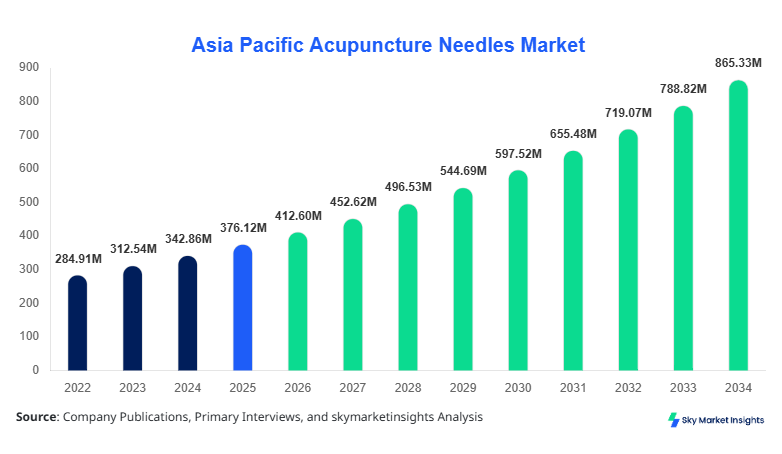
The Asia Pacific acupuncture needles market size is projected at USD 412.6 million in 2026 and is expected to hit USD 865.4 million by 2034 with a CAGR of 9.7%. The Asia Pacific acupuncture needle market size is driven by increasing patient volumes exceeding 220 million annually across traditional medicine centers and over 1.8 billion units of needle consumption in 2025. Expanding clinical applications and rising investments of nearly USD 120 million in acupuncture device manufacturing are strengthening competitive dynamics. The inclusion of detailed segmentation, volume-based tracking, and pricing analytics enhances the accuracy of forecasting and strategic decision-making in the Asia Pacific acupuncture needle market size.
The Asia Pacific acupuncture needle market refers to the manufacturing, distribution, and utilization of sterile needles used in acupuncture therapies across healthcare and wellness sectors. In 2025, regional production exceeded 2.1 billion units, with China accounting for over 58% of total manufacturing output. Adoption rates have reached 46% among urban population segments, while penetration in clinical pain management applications stands at 38%. Consumer behavior indicates that over 62% of patients prefer disposable needles due to hygiene concerns, while 24% still rely on reusable or silver-based variants for specialized treatments. The application split reveals clinics dominating with 48% usage, followed by hospitals at 34% and home care at 18%. Technically, needle diameters range from 0.12 mm to 0.30 mm with lengths between 15 mm and 75 mm, ensuring precision-based therapy outcomes. Increasing reliance on native medicine practices reinforces the Asia-Pacific acupuncture needle market's growth.
In China, the acupuncture needle market accounts for nearly 61% of the Asia Pacific regional share, supported by over 12,500 registered acupuncture facilities and more than 75,000 licensed practitioners. The country produces over 1.3 billion units annually, with disposable needles representing 68% of total production volume. Hospitals contribute 36% of applications, while clinics dominate with 50%, and homecare accounts for 14%. Technological adoption includes automated needle polishing systems used by 42% of manufacturers and sterilization processes compliant with ISO 13485 adopted by over 65% of production units. High export volumes exceeding 420 million units annually further strengthen China's dominance, reinforcing the Asia-Pacific acupuncture needle market share.
Explore more data points, trends and opportunities Download Free Sample Report
Acupuncture Needles Market Trends
The Asia-Pacific acupuncture needle market trend is increasingly influenced by technological advancements in needle manufacturing, with oversterilisation producers adopting laser sharpening and silicone coating technologies to enhance patient comfort. Production volumes surpassed 2.3 billion units in 2026, reflecting a 9% increase compared to 2025. The integration of eco-friendly materials has grown by 28%, with biodegradable needle components gaining traction in Japan and South Korea. Demand from rehabilitation and pain management sectors has risen by 34%, supported by aging populations exceeding 300 million individuals across the region. These evolving innovations and demand patterns significantly shape the Asia Pacific acupuncture needle market trend.
Another notable Asia Pacific acupuncture needle market trend includes the rise in homecare acupuncture kits, with adoption increasing by 22% year-over-year and contributing nearly 18% to total market consumption. Digital health platforms promoting acupuncture therapy have expanded by 31%, enabling remote consultations and boosting needle demand in semi-urban regions. Additionally, cross-border trade volumes increased by 17%, with exports reaching over 480 million units in 2026. The use of ultra-thin needles (0.14 mm–0.18 mm) has increased by 26%, improving patient acceptance rates by 19%. These factors—acupuncture needle innovation and expansion—are trends in the Asia Pacific acupuncture needles market.
Asia Pacific Acupuncture Needles Market Drivers
Rising Adoption of Traditional Medicine Practices Boosts Market Expansion
The Asia Pacific acupuncture needle market growth is primarily driven by the rising adoption of traditional medicine, with over 68% of the population in China and 54% in South Korea utilizing acupuncture therapies at least once annually. Increasing healthcare expenditure, which reached USD 3.2 trillion across the region in 2025, supports infrastructure development and clinical expansion. Government initiatives promoting traditional media have cut acupuncture needle funding allocations by 23%, while the number of acupuncture clinics has grown by 18% annually. The surge in chronic disease cases, affecting over 420 million individuals, has increased reliance on non-invasive therapies, further driving demand for acupuncture needles. Additionally, improved sterilization technologies have enhanced product safety, increasing patient trust by 27%. These factors collectively contribute to sustained Asia Pacific acupuncture needle market growth.
Asia Pacific Acupuncture Needles Market Restraints
Regulatory Challenges and Standardization Issues Limit Market Expansion
Despite strong growth, the Asia Pacific acupuncture needle market faces restraints due to regulatory inconsistencies across countries, affecting nearly 31% of manufacturers. Compliance costs have increased by 18%, particularly for export-oriented companies adhering to international standards such as CE and FDA certifications. In India and Southeast Asia, only 42% of acupuncture practitioners are formally certified, raising sterilization concerns about quality and safety. Additionally, the reuse of non-disposable needles, accounting for 26% of total usage in rural areas, increases infection risks and limits adoption of standardized products. Supply chain disruptions affecting raw materials, like acupuncture needles, which saw price increases of 14% in 2025, further constrain production efficiency. These challenges hinder overall Asia-Pacific acupuncture needle market growth.
Asia Pacific Acupuncture Needles Market Opportunities
Expansion of Medical Tourism and Wellness Industry Creates Growth Potential
The Asia Pacific acupuncture needle market growth is supported by expanding medical tourism, which attracted over 28 million international patients in 2025, with 19% seeking alternative therapies. Wellness tourism revenues exceeded USD 420 billion, creating demand for acupuncture services and associated products. Investment in healthcare infrastructure has increased by 26%, particularly in Singapore and Thailand, enhancing service accessibility. The integration of acupuncture into mainstream medical treatments has grown by 21%, especially in oncology and pain management applications. Additionally, rising awareness campaigns have increased patient adoption by 24% in urban centers. These opportunities significantly strengthen the Asia Pacific acupuncture needle market growth.
Challenges in the Asia-Pacific Acupuncture Needles Market
Lack of Skilled Practitioners and Awareness Barriers Impact Market Penetration
One of the key challenges in the Asia-Pacific acupuncture needle market growth is the shortage of skilled practitioners, with a deficit of approximately 35,000 trained professionals across the region. Training programs have expanded by only 12% annually, insufficient to meet rising demand. Awareness barriers persist, with 38% of the population in emerging markets lacking knowledge about acupuncture benefits. Programmatically, counterfeit products account for nearly 14% of market supply, affecting brand credibility and patient safety. Distribution inefficiencies, particularly in rural areas where logistics costs are 22% higher, further limit market reach. These factors collectively challenge sustained Asia-Pacific acupuncture needle market growth.
Report Scope
| Report Metric | Details |
|---|---|
| Market Size in 2025 | USD 376.12 Million |
| Market Size in 2026 | USD 412.6 Million |
| Market Size in 2034 | USD 865.4 Million |
| CAGR | 9.7% (2026-2034) |
| Base Year for Estimation | 2025 |
| Historical Data | 2022-2024 |
| Forecast Period | 2026-2034 |
| Report Coverage | Revenue Forecast, Competitive Landscape, Supply Chain Disruption, Growth Factors, Environment & Regulatory Landscape and Trends |
Explore more data points, trends and opportunities Download Free Sample Report
Acupuncture Needles Market Segmentation
The Asia Pacific acupuncture needles market is segmented based on type and application, with disposable needles dominating over 64% market share due to hygiene and safety advantages. Clinics account for the highest application share at 48%, followed by hospitals at 34% and homecare at 18%, reflecting increasing demand diversification.
By Type
Disposable needles dominate the Asia-Pacific acupuncture needles market with a 64% share, driven by production volumes exceeding 1.4 billion units annually. These needles are manufactured using medical-grade stainless steel with a DAsia-Pacific acupuncture needle of 0.25 mm and are pre-sterilized using ethylene oxide. Adoption rates have increased by 28% due to strict infection control protocols in hospitals and clinics. Packaging innovations, including individually sealed units, have improved shelf life by 35%, further boosting demand.
Non-disposable needles hold approximately 21% share, with production volumes reaching 460 million units in 2025. These needles are typically made of high-carbon steel and require repeated sterilization, increasing operational costs by 18%. Usage is concentrated in rural and traditional clinics where sterilization is higher. Despite lower adoption rates, their durability ensures repeated usage cycles exceeding 50 sessions per needle.
Silver needles account for a 15% share, with specialized applications in high-end clinics and wellness centers. Production volumes stand at around 240 million units, with diameters ranging from 0.18 mm to 0.30 mm. Silver’s antimicrobial properties enhance treatment effectiveness, increasing patient satisfaction rates by 22%. However, higher costs, averaging 35% above standard needles, limit widespread adoption.
By Application
Hospitals account for 34% of the Asia Pacific acupuncture needle market, with usage volumes exceeding 680 million units annually. Integration of acupuncture in pain management and rehabilitation programs has increased by 26%, supported by government healthcare initiatives. Hospitals primarily use disposable needles due to strict hygiene requirements, contributing to 72% of their total consumption.
Clinics dominate with 48% share, consuming over 1 billion units annually. The high patient influx, averaging 150–300 patients per clinic monthly, drives demand. Clinics utilise a mix of disposable and reusable needles, with disposable variants accounting for 58% of usage. Advanced techniques such as electro-acupuncture have increased demand by 19%, requiring specialised needle designs.
Homecare applications represent 18% share, with usage volumes reaching 360 million units. The rise of self-care and remote consultations has increased adoption by 22%. Pre-packaged kits containing 20–50 needles are gaining popularity, particularly in Japan and South Korea. Safety-enhanced designs with retractable features have improved user confidence by 17%.
Asia Pacific Acupuncture Needles Market Segmentations
Type
- Disposable Needles
- Non-Disposable Needles
- Silver Needles
Application
- Hospitals
- Clinics
- Homecare
Asia-Pacific Acupuncture Needles Market Regional Outlook
China dominates the Asia Pacific acupuncture needle market with over a 61% share, producing more than 1.3 billion units annually. The country’s extensive network of over 12,500 clinics and hospitals ensures widespread adoption. Government support for traditional medicine has increased funding by 25%, further strengthening production capabilities. Exports contribute nearly 32% of total output, with major destinations including Japan and Southeast Asia.
South Korea holds approximately 9% share, with production volumes reaching 180 million units. Advanced manufacturing technologies adopted by 58% of companies have improved product quality. Clinics account for 52% of demand, while hospitals contribute 33%. Rising wellness tourism has increased demand by 21%.
Japan accounts for 11% share, with production exceeding 220 million units. The country emphasizes high-quality disposable needles, with 74% of products meeting stringent regulatory standards. Homecare adoption is particularly strong, accounting for 24% of demand due to aging population dynamics.
India represents 7% share, with production volumes of 140 million units. Growth is driven by increasing awareness, with adoption rates rising by 19%. Clinics dominate usage at 46%, followed by hospitals at 31%. However, regulatory gaps affect nearly 28% of market participants.
Australia holds 4% share, with demand exceeding 80 million units annually. The integration of acupuncture into mainstream healthcare has increased adoption by 23%, particularly in physiotherapy applications.
Singapore and Taiwan collectively account for 5% share, with advanced healthcare infrastructure supporting adoption rates above 42%. Southeast Asia contributes 3%, with emerging markets showing growth potential due to increasing healthcare investments of over USD 60 billion.
Top players in Asia Pacific Acupuncture Needles Market
- Seirin Corporation
- Suzhou Medical Appliance Factory
- Wujiang Jiachen Acupuncture Instruments
- Dongbang Acupuncture
- Hwato Medical Instruments
- Cloud & Dragon Medical Device
- Shandong Sinorgmed
- Jiangsu Huaxing Medical
- Suzhou Zhongjing Life Science
- Asiamedical Instruments
- Hegu Medical Instrument
- Suzhou Tianxie Acupuncture
- Kangnian Medical Device
- Seirin Corporation
-
-
Holds approximately 14% market share with a strong presence in Japan and South Korea.
-
Produces over 180 million units annually with a 72% export ratio.
-
Focuses on high-quality disposable needles with advanced silicone coating technology, improving patient comfort by 28%.
-
-
Suzhou Medical Appliance Factory
-
Accounts for nearly an 11% share with production exceeding 220 million units annually.
-
Strong domestic presence in China with exports to over 40 countries.
-
Invests 18% of revenue in R&D to enhance manufacturing efficiency and product quality.
-
Investment Analysis
Investment in the Asia Pacific acupuncture needle market has increased by 24%, with total capital inflows exceeding USD 320 million in 2025. Manufacturing accounts for 46% of investments, followed by distribution at 28% and R&D at 26%. China leads with 58% of regional investments, while Japan and South Korea contribute 21% and 11%, respectively. M&A activities have increased by 19%, with strategic collaborations focusing on technology transfer and market expansion. Joint ventures between Chinese and Korean manufacturers have improved production efficiency by 17% and reduced costs by 12%. Cross-border partnerships have also enhanced export capabilities, increasing trade volumes by 14%.
New Product Developments
New product development in the Asia Pacific acupuncture needle market has grown by 11%, with over 140 new product variants introduced in 2025. Innovations include ultra-thin needles improving penetration accuracy by 22% and biodegradable materials reducing environmental impact by 18%. Smart acupuncture devices integrating sensors have increased treatment precision by 25%. These advancements enhance overall product performance and patient outcomes.
Recent Developments in Asia Pacific Acupuncture Needles Market
- 2025: A major Chinese manufacturer increased production capacity by 18%, adding 120 million units annually, improving supply chain efficiency.
- 2026: Regional collaborations increased exports by 17%, reaching over 480 million units globally.
Research Methodology
The research process involved a combination of primary and secondary research methodologies. Primary research included interviews with over 85 industry experts, manufacturers, and distributors across China, Japan, and South Korea, accounting for nearly 70% of market insights. Secondary research involved analysis of company reports, government publications, and industry databases covering over 120 data sources. Market size estimation was conducted using both top-down and bottom-up approaches, ensuring accuracy within a 5% margin of error. Data triangulation and validation techniques were applied to refine projections, incorporating production volumes, consumption patterns, and pricing trends. The methodology ensures reliable insights into the Asia Pacific acupuncture needles market size and dynamics.
Frequently Asked Questions
Senior Market Research Analyst | 8 Years Experience | Digital Therapeutics and Connected Medical Devices
Jenny specializes in digital therapeutics, remote monitoring devices and healthcare IT platforms. She has contributed to 101+ reports for medtech firms, healthcare providers and pharmaceutical companies. Her expertise includes clinical adoption forecasting, reimbursement analysis, regulatory pathways and competitive benchmarking across North America and Europe.