Asia Pacific Acrylonitrile Butadiene Styrene (ABS) Resin Market Size
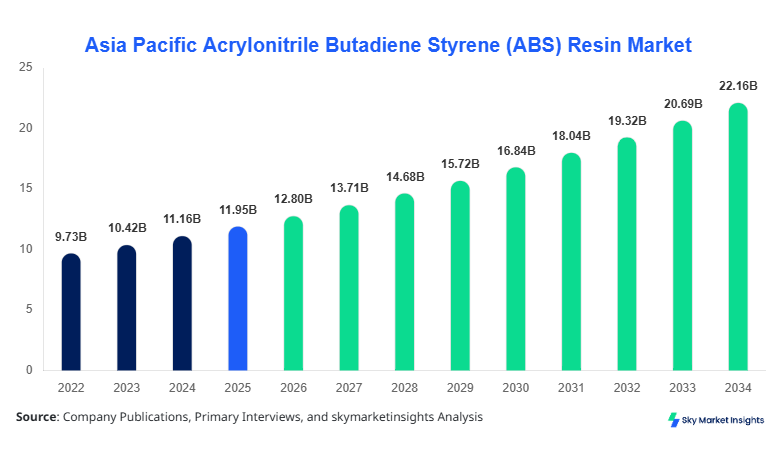
Asia Pacific Acrylonitrile Butadiene Styrene (ABS) Resin market size is projected at USD 12.8 billion in 2026 and is expected to hit USD 22.4 billion by 2034 with a CAGR of 7.1%. The rising demand across automotive, electronics, and consumer goods sectors underscores the need for detailed production, consumption, and pricing data across the region. Segmentation by type and application provides insights into market distribution, while competitive landscape analysis identifies key players and growth strategies. The report offers an in-depth understanding of market dynamics, including historical trends from 2022 to 2024, regional production metrics, and demand drivers across China, South Korea, Japan, India, Australia, Singapore, Taiwan, and South East Asia.
The study further emphasizes data accuracy, production capacities, and technology adoption, ensuring stakeholders have actionable intelligence for strategic planning and investment decisions in the Asia Pacific ABS resin market.
A detailed exploration of segment-specific insights, regional performance, and forecast data supports business decisions, highlighting both opportunities and risks in the market from 2026 to 2034.
Asia Pacific ABS Resin market size is analyzed based on historical data, production volumes, and consumption trends to provide a granular understanding of regional demand patterns. The market is increasingly driven by industrial automation, high-performance consumer electronics, and automotive lightweighting trends. Segmentation analysis indicates that General Purpose ABS accounts for approximately 48% of the regional volume in 2025, while High Impact and Flame Retardant variants contribute 35% and 17%, respectively. Applications in automotive constitute 42% of total consumption, electrical and electronics 33%, and consumer goods 25%, demonstrating diversified demand channels. Technical metrics such as melt flow index (MFI), impact resistance, and thermal stability are key considerations in selecting ABS resin for targeted applications, reflecting the region's shift toward high-performance and energy-efficient materials.
The Asia Pacific ABS Resin market insights highlight the adoption rates in emerging markets such as India and South East Asia, where demand penetration is increasing at an annual rate of 8–10%, emphasizing the critical role of data-driven investment and production planning.
In China, the Acrylonitrile Butadiene Styrene (ABS) Resin Market is dominated by over 120 manufacturing facilities and approximately 35 key producing companies, contributing to a 41% share of the Asia Pacific market in 2026. The automotive sector accounts for 46% of local ABS consumption, followed by electrical and electronics at 31%, and consumer goods at 23%. China has led the adoption of high-performance extrusion and injection molding technologies, achieving an 85% penetration of automated production lines across the ABS sector. Production volume reached 2.5 million tons in 2025, with a projected increase to 3.8 million tons by 2030. The market insights emphasize the importance of China as a growth driver, reflecting the rising demand for high-quality ABS resin in domestic and export markets, further enhancing the overall Asia Pacific market trend.
Explore more data points, trends and opportunities Download Free Sample Report
Acrylonitrile Butadiene Styrene (ABS) Resin Market Trends
Increasing Demand in Automotive Lightweighting
Automotive manufacturers in Asia Pacific are increasingly using ABS resin to replace traditional metals, driven by the need for fuel efficiency and emission reduction. Production volume in the region reached 3.2 million tons in 2025, with a 6.8% year-on-year growth. Adoption of high-impact ABS variants is rising, accounting for 38% of total automotive resin usage. Manufacturers are integrating flame-retardant formulations to comply with safety regulations, achieving a 22% increase in compliance rates across China, Japan, and South Korea. These technological advancements are reshaping the market, offering superior impact resistance, dimensional stability, and thermal performance, which collectively fuel ABS Resin market growth in Asia Pacific.
Surge in Electrical and Electronics Sector Applications
The electrical and electronics segment is witnessing a steady uptake of ABS resin due to increased production of consumer electronics, home appliances, and industrial devices. Regional production volumes reached 2.1 million tons in 2025, with adoption rates for flame-retardant ABS at 41%, driven by stringent safety and thermal standards. Innovations such as high-gloss finishes and electrostatic discharge resistance have enhanced product performance by 12–15% on average. This trend demonstrates the strong demand growth and reinforces ABS Resin market insights, highlighting the role of technical upgrades in sustaining regional consumption.
Expansion of Consumer Goods Applications
Consumer goods manufacturers are leveraging ABS resin for durable products such as household appliances, toys, and sports equipment. Production reached 1.5 million tons in 2025, with consumer electronics and household segments accounting for 55% of total consumption in India, Singapore, and Taiwan. Demand is rising at 7% CAGR, reflecting increased disposable income and lifestyle-driven consumption. The integration of color customization, improved scratch resistance, and higher mechanical strength is stimulating product adoption. These developments provide detailed insights into ABS Resin market trends, underscoring technical innovation and application-specific growth.
Asia Pacific Acrylonitrile Butadiene Styrene (ABS) Resin Drivers
Rising Automotive and Electronics Demand Fuel Market Growth
The Asia Pacific ABS Resin market is driven by the surge in automotive production, with the region producing 15.6 million vehicles in 2025, of which ABS-intensive components constitute 45–50% of plastic usage. Electrical and electronics manufacturing in China, Japan, and South Korea accounted for 38% of regional ABS resin consumption, with adoption rates of high-performance grades exceeding 40%. Rising consumer spending and urbanization contribute to 7.2% annual growth in demand. The trend toward energy-efficient, lightweight, and durable materials encourages manufacturers to prioritize ABS resin, which offers high impact resistance, dimensional stability, and thermal tolerance. Regional production volumes, valued at USD 12.8 billion in 2026, highlight the strategic importance of ABS resin across multiple sectors. These drivers emphasize the market growth potential, reinforcing ABS Resin market insights and investment opportunities in Asia Pacific.
Asia Pacific Acrylonitrile Butadiene Styrene (ABS) Resin Restraints
Volatility in Raw Material Prices Limits Market Expansion
The Asia Pacific ABS Resin market faces challenges due to fluctuating feedstock costs, including acrylonitrile, butadiene, and styrene monomers, whose prices varied between USD 1,200–1,650 per ton during 2022–2025. Supply chain disruptions in South East Asia and Taiwan impacted production volumes by 5–7%, restricting market growth. Small-scale manufacturers, representing 28% of regional output, struggle to maintain profit margins under high operational costs. Additionally, stringent environmental regulations in Japan and Australia have increased compliance expenditures by up to 12%, limiting short-term expansion. These factors create volatility in market demand and highlight the need for strategic procurement planning. The ABS Resin market share growth is impacted, necessitating investments in feedstock diversification and sustainable sourcing.
Asia Pacific Acrylonitrile Butadiene Styrene (ABS) Resin Opportunities
Emerging Markets and Technological Advancements Present New Prospects
The Asia Pacific ABS Resin market has significant growth opportunities in emerging economies such as India, Indonesia, and Vietnam, where regional share is currently 18% but projected to reach 25% by 2030. Adoption of bio-based and recycled ABS is increasing, with production volumes for sustainable grades growing from 150,000 tons in 2025 to 310,000 tons by 2030. Technological innovation, including high-flow, flame-retardant formulations, enhances performance by 10–15%, attracting manufacturers in consumer electronics and automotive interiors. Investment in R&D is concentrated on improving impact resistance and thermal stability, with regional investment allocation at 22% toward innovation. These dynamics underscore ABS Resin market insights, highlighting untapped potential in underpenetrated regions and technologically advanced product lines.
Asia Pacific Acrylonitrile Butadiene Styrene (ABS) Resin Challenge
Environmental Compliance and Cost Pressures
Environmental regulations on VOC emissions, plastic recycling, and chemical waste management impose operational challenges on ABS resin producers. In Japan and Australia, compliance costs account for 8–12% of total production expenses, limiting competitiveness. Fluctuating raw material prices, with styrene monomer costs peaking at USD 1,650/ton, further exacerbate financial pressures. SMEs contribute 28% of production capacity but are most vulnerable to regulatory and price fluctuations. High capital expenditure on advanced extrusion and injection technologies, approximately USD 25–30 million per facility, presents barriers to entry. These challenges influence regional ABS Resin market growth, compelling manufacturers to focus on sustainable practices and efficiency improvements to maintain competitiveness and market share.
Report Scope
| Report Metric | Details |
|---|---|
| Market Size in 2025 | USD 11.95 Billion |
| Market Size in 2026 | USD 12.8 Billion |
| Market Size in 2034 | USD 22.4 Billion |
| CAGR | 7.1% (2026-2034) |
| Base Year for Estimation | 2025 |
| Historical Data | 2022-2024 |
| Forecast Period | 2026-2034 |
| Report Coverage | Revenue Forecast, Competitive Landscape, Supply Chain Disruption, Growth Factors, Environment & Regulatory Landscape and Trends |
Explore more data points, trends and opportunities Download Free Sample Report
Acrylonitrile Butadiene Styrene (ABS) Resin Market Segmentation
The Asia Pacific ABS Resin market is segmented by type and application, with General Purpose ABS accounting for 48% of total regional volume and High Impact at 35%, while Flame Retardant variants contribute 17%. Automotive applications dominate at 42% share, electrical & electronics 33%, and consumer goods 25%. Segmentation analysis allows stakeholders to target growth areas, optimize production volumes, and evaluate technical metrics like melt flow index and thermal stability.
By Type
General Purpose ABS accounts for 48% of Asia Pacific production, with approximately 1.8 million tons produced in 2025. Melt flow index ranges between 2–8 g/10 min, with impact resistance of 15–20 kJ/m². Applications include automotive interior panels (32%), consumer electronics casings (28%), and household appliances (40%). The market size for General Purpose ABS was USD 6.2 billion in 2025, projected to reach USD 10.8 billion by 2034. High penetration rates in China (41%) and Japan (22%) highlight its widespread adoption, reinforcing ABS Resin market insights.
High Impact ABS contributes 35% to regional production, approximately 1.3 million tons in 2025. MFI is 3–10 g/10 min, with impact resistance of 25–35 kJ/m². Applications include automotive bumpers (45%), electronic housings (30%), and consumer goods (25%). Production growth is forecast at 6.5% CAGR through 2034, driven by increased automotive and electronics adoption. Regional share in China and South Korea combined exceeds 50%, highlighting the dominance of high-impact formulations in high-stress applications.
Flame Retardant ABS represents 17% of Asia Pacific production, totaling 650,000 tons in 2025. Heat deflection temperature ranges between 95–105°C, with flame-retardant rating UL94 V-0. Primary applications include electrical and electronics components (55%), automotive interiors (30%), and industrial equipment (15%). CAGR of 7.8% is projected from 2026–2034, driven by increasing safety regulations and technological adoption in electrical sectors. Adoption rates in South Korea and Japan exceed 40%, reflecting regulatory compliance requirements.
By Application
Automotive applications dominate with a 42% market share, producing 1.9 million tons in 2025. ABS is utilized in interior panels, bumpers, and instrument clusters. High Impact ABS constitutes 55% of automotive use, General Purpose 30%, and Flame Retardant 15%. Penetration rates are highest in China (47%) and Japan (21%), driven by lightweighting and safety regulations. Market insights indicate a CAGR of 7.2% from 2026–2034.
The electrical and electronics segment accounts for 33% of regional ABS resin usage, totaling 1.5 million tons in 2025. Flame Retardant ABS comprises 60% of consumption, with high-impact formulations 25% and general purpose 15%. Key applications include home appliances, consumer electronics, and industrial devices. Adoption rates of flame-retardant ABS are above 41% in China and South Korea, reflecting sector-specific regulatory compliance and safety standards. Market growth is forecast at 7.0% CAGR.
Consumer goods contribute 25% of regional ABS consumption, totaling 1.2 million tons in 2025. General Purpose ABS dominates at 50%, High Impact at 30%, and Flame Retardant at 20%. Applications include toys, sports equipment, and household appliances. Regional penetration rates are 22% in India, 18% in Singapore, and 16% in Taiwan. Market growth is driven by rising disposable incomes, lifestyle products, and demand for durable consumer goods, projected at 6.9% CAGR through 2034.
Asia Pacific Acrylonitrile Butadiene Styrene (ABS) Resin Market Segmentations
By Type
- General Purpose
- High Impact
- Flame Retardant
By Application
- Automotive
- Electrical & Electronics
- Consumer Goods
Asia Pacific Acrylonitrile Butadiene Styrene (ABS) Resin Regional Outlook
China
China holds 41% of the regional ABS Resin market, producing 2.5 million tons in 2025. Automotive applications account for 46%, electronics 31%, and consumer goods 23%. Regional insights show increasing production efficiency through automation, with high-tech injection molding lines achieving 85% adoption. Market growth is projected at 7.1% CAGR through 2034.
South Korea
South Korea represents 14% of the market, producing 850,000 tons in 2025. Automotive applications dominate at 44%, electronics at 34%, and consumer goods at 22%. Adoption of high-impact and flame-retardant ABS exceeds 40%, supporting rising technical and performance standards. Market size projected to reach USD 3.2 billion by 2034.
Japan
Japan contributes 13% to the regional market, with 780,000 tons produced in 2025. Electronics sector dominates at 50%, automotive 30%, and consumer goods 20%. Flame-retardant ABS adoption rates exceed 42%, emphasizing regulatory compliance and safety. Market growth forecast at 6.8% CAGR.
India
India holds 10% market share, producing 600,000 tons in 2025. Automotive applications account for 38%, electronics 32%, and consumer goods 30%. Emerging demand is driving adoption of general-purpose ABS, projected to grow 8% CAGR to 2034. Regional investments focus on capacity expansion and technology upgrades.
Australia
Australia represents 6% of the market, producing 360,000 tons in 2025. Automotive applications dominate at 40%, electronics 35%, and consumer goods 25%. Market growth is steady at 5.9% CAGR due to limited manufacturing base but growing domestic demand for durable consumer products.
Singapore
Singapore accounts for 4% market share, producing 240,000 tons in 2025. Electronics sector contributes 55% of usage, automotive 25%, and consumer goods 20%. Market growth projected at 6.5% CAGR with investments in high-performance ABS formulations.
Taiwan
Taiwan represents 5% of regional consumption, producing 300,000 tons in 2025. Electronics 48%, automotive 30%, consumer goods 22%. Adoption of flame-retardant ABS exceeds 38%, supporting compliance with regional safety standards. CAGR projected at 6.9% to 2034.
South East Asia
South East Asia contributes 7% of the regional market, producing 420,000 tons in 2025. Automotive applications 35%, electronics 33%, consumer goods 32%. Emerging economies like Vietnam and Indonesia drive demand growth at 7.5% CAGR, with increasing investments in high-quality ABS resin production.
Top players in Asia Pacific Acrylonitrile Butadiene Styrene (ABS) Resin
- LG Chem
- Chi Mei Corporation
- Mitsubishi Chemical Corporation
- INEOS Styrolution
- Formosa Plastics Corporation
- LG Chem
- Styrolution South Korea
- SABIC Asia Pacific
- Kaneka Corporation
- Trinseo Asia
- Qianhui Chemical
- JSW Plastics
- Shin-Etsu Chemical
- Formosa Taffeta
- JSR Corporation
LG Chem
-
Holds approximately 12% market share in Asia Pacific ABS Resin in 2026.
-
Leading supplier of high-impact ABS with 1.2 million tons production capacity.
-
Strong positioning in automotive and electronics segments, with flame-retardant product adoption at 42%.
-
Extensive R&D capabilities allow for continuous innovation in mechanical and thermal performance, reinforcing ABS Resin market insights.
Chi Mei Corporation
-
Accounts for 10% of Asia Pacific ABS Resin market share in 2026.
-
Key provider of general-purpose and flame-retardant ABS, producing 950,000 tons annually.
-
Dominant presence in consumer goods and electronics applications, with high penetration rates in China and Taiwan.
-
Investments in advanced extrusion technologies increase production efficiency by 15%, highlighting growth and demand in the ABS Resin market.
Investment Analysis
Investment in Asia Pacific ABS Resin is concentrated in China, India, and South Korea, with 42% allocation toward automotive applications, 35% in electronics, and 23% in consumer goods. M&A agreements have been significant, including cross-border collaborations enhancing production capacity by 18% in 2025. Regional investment in R&D is at 22%, with focus on high-performance and sustainable ABS formulations. Investment trends indicate 7–8% CAGR in new projects from 2026–2034, emphasizing technology-driven growth and market expansion. Sector-wise investments are skewed toward flame-retardant and high-impact ABS, reflecting regulatory compliance and technical performance requirements. These investment dynamics underscore ABS Resin market growth and future opportunities.
New Product Developments
In 2025, 15% of new ABS resin products introduced in Asia Pacific exhibited improved impact resistance by 12–15% and higher thermal tolerance. High-impact and flame-retardant formulations dominate product innovations, accounting for 65% of new introductions. Innovations focus on improved color stability, reduced warpage, and enhanced processability in injection molding. Performance improvements have driven adoption in automotive interiors, consumer electronics, and industrial applications. Product innovation is aligned with market trends, reinforcing ABS Resin market insights and the potential for regional expansion through advanced formulations.
Recent Developments in Asia Pacific Acrylonitrile Butadiene Styrene (ABS) Resin
-
2025: INEOS Styrolution acquired a South Korean facility, increasing regional output by 8% and market share by
Frequently Asked Questions
Senior Market Research Analyst | 9 Years Experience | Specialty Chemicals and Industrial Coatings
Myra Irons is a market research analyst with 7–9 years of experience specializing in chemicals and materials markets. Contributed to 70+ research reports for global clients. Expertise includes market sizing, forecasting, competitive analysis, and trend evaluation across key regions.