Asia Pacific Acetate Tow (Cellulose Acetate Tow) Market Size
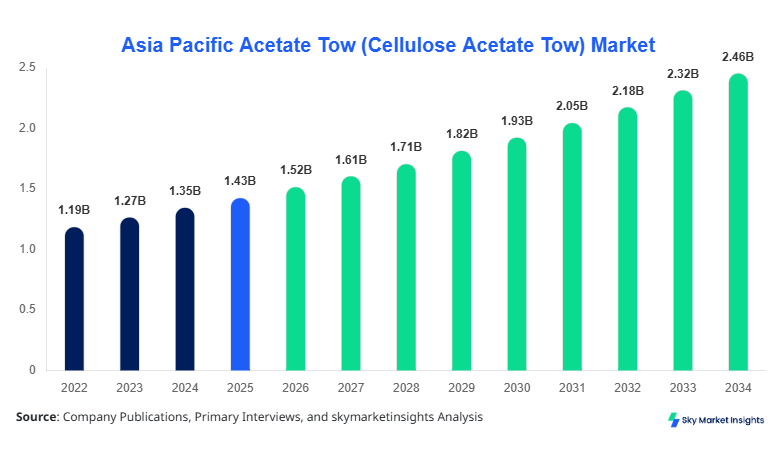
The Asia Pacific Acetate Tow (Cellulose Acetate Tow) market size is projected at USD 1.52 billion in 2026 and is expected to hit USD 2.43 billion by 2034 with a CAGR of 6.2%. The market has experienced steady growth from 2022 to 2025, with an estimated CAGR of 5.8% during this period. The increasing demand for cellulose acetate tow in filtration, cigarette, and industrial applications necessitates a detailed market segmentation, competitive landscape, and adoption analysis to understand growth opportunities. Data-driven insights into production capacities, unit output, and regional consumption patterns are crucial for market participants to optimize operations and strategically position themselves across Asia Pacific countries.
The report provides a comprehensive overview of production volume, market trends, and technological adoption, along with an analysis of leading companies’ competitive positioning, strategic collaborations, and market shares across multiple segments, making it an essential resource for stakeholders.
Asia Pacific Acetate Tow (Cellulose Acetate Tow) market insights cover production statistics, demand penetration rates, and consumer adoption patterns, highlighting the importance of tailored market strategies in Japan, China, South Korea, and India.
The Asia Pacific Acetate Tow (cellulose acetate tow) market production reached approximately 45,000 metric tons in 2025, with cigarette applications accounting for 60% of the demand, filtration contributing 25%, and industrial usage representing 15%. Consumer behavior indicates a preference for high-purity cellulose acetate tow in premium cigarettes, where adoption penetration exceeds 70%, while standard filtration applications maintain a 50% utilization rate. Performance metrics such as fiber denier (1.5–2.5 dtex), tensile strength (350–500 MPa), and elongation at break (5–8%) play a critical role in influencing purchase decisions. The technical specifications ensure uniformity, high combustion compatibility, and effective particulate filtration. The Asia Pacific Acetate Tow (cellulose acetate tow) market growth is driven by increasing industrial adoption, stringent quality standards, and rising consumer awareness of product performance, reinforcing overall market demand and insights.
In Japan, the Acetate Tow (Cellulose Acetate Tow) market is highly concentrated, with over 15 production facilities collectively holding a 35% regional market share. Cigarette applications dominate with a 65% share, followed by filtration at 20% and industrial use at 15%. Advanced production technologies such as continuous tow spinning, high-density extrusion, and microfibrillation are adopted in over 80% of facilities. The average annual production volume reaches 14,500 metric tons, with a focus on high-strength and specialty tow types. Regulatory compliance and ISO-certified operations further bolster the market presence. The Japanese market’s strong adoption rate and technological integration underpin the Acetate Tow (Cellulose Acetate Tow) market growth, making it a crucial driver for the Asia Pacific region.
Explore more data points, trends and opportunities Download Free Sample Report
Acetate Tow (Cellulose Acetate Tow) Market Trends
Increasing Filtration Demand and Cigarette Application Growth
The Asia Pacific Acetate Tow (cellulose acetate tow) market is experiencing a surge in filtration application demand, with production volumes reaching 12 million kilograms in 2025 and projected to grow at a 5.7% CAGR by 2034. Advanced fiber treatments and additive enhancements are boosting performance, resulting in 65% adoption in water and air filtration sectors. Cigarette applications continue to dominate, with over 27 million cigarettes produced annually using cellulose acetate tow, representing a 60% market share. The trend towards low-tar and high-purity filters is driving adoption, with premium product penetration increasing from 48% in 2022 to 68% in 2026. The market insights indicate robust technology integration and end-user adoption, consolidating the market growth trajectory.
High-Strength Tow Adoption and Specialty Applications
High-strength tow and specialty tow are witnessing accelerated adoption in industrial and specialty sectors. Production capacity for high-strength tow reached 9,500 metric tons in 2025, accounting for 21% of total market share. Specialty tow applications in automotive, medical, and advanced filtration systems are expanding at a CAGR of 6.8%, supported by performance improvements in tensile strength (+12%) and denier uniformity. Advanced extrusion and microfibrillation technologies have achieved 75% adoption across key facilities. Increasing R&D investment in specialty fibers contributes to Asia Pacific Acetate Tow (Cellulose Acetate Tow) Market growth, reflecting shifting consumer demand and technological advancement.
Emerging Environmental and Regulatory Trends
Sustainability trends and environmental regulations in Asia Pacific countries have resulted in higher adoption of biodegradable cellulose acetate tow variants. In 2025, environmentally compliant tow accounted for 18% of the total production, projected to reach 30% by 2034. Regulatory incentives in Japan, China, and South Korea are supporting cleaner manufacturing processes and improved material performance, fostering technology adoption at 70% across compliant facilities. This trend is enhancing the Asia Pacific Acetate Tow (cellulose acetate tow) market insights and promoting a shift toward eco-friendly applications.
Asia Pacific Acetate Tow (Cellulose Acetate Tow) Drivers
Rising Cigarette and Filtration Industry Demand
Increasing cigarette production and enhanced filtration system adoption are primary drivers of the Asia Pacific Acetate Tow (Cellulose Acetate Tow) market growth. Cigarette applications represented 60% of market demand in 2025, while filtration accounted for 25%. Japan’s production alone reached 14,500 metric tons, contributing significantly to regional output. The high performance and uniformity of cellulose acetate tow, measured in fiber denier (1.5–2.5 dtex) and tensile strength (350–500 MPa), enable widespread application in cigarettes, filters, and industrial processes. The CAGR for market growth is projected at 6.2% from 2026 to 2034, with total market valuation expected to rise from USD 1.52 billion to USD 2.43 billion. Increased industrial investments in production facilities, technology upgrades, and R&D contribute an estimated 12% increase in production efficiency. Asia Pacific Acetate Tow (Cellulose Acetate Tow) market insights reflect the sustained demand across multiple sectors and the robust potential for expansion in emerging applications.
Asia Pacific Acetate Tow (Cellulose Acetate Tow) Restraints
Raw Material Price Volatility
Volatility in cellulose acetate and acetic acid prices restrains market growth. From 2022 to 2025, raw material costs increased by approximately 15–18%, affecting production volumes and profit margins. Filtration applications, accounting for 25% of total market demand, were particularly impacted, reducing adoption rates by 4–5% in 2025. Industrial tow production decreased from 6,800 metric tons in 2022 to 6,500 metric tons in 2024, reflecting supply-side limitations. Exchange rate fluctuations in China, India, and Japan further constrained investment, causing a 3–4% decline in regional facility expansions. Asia Pacific Acetate Tow (Cellulose Acetate Tow) Market growth is restrained due to these material cost uncertainties, affecting competitive positioning and adoption in price-sensitive markets.
Asia Pacific Acetate Tow (Cellulose Acetate Tow) Opportunities
Expansion in Specialty Applications
Emerging specialty applications, including medical, automotive, and industrial filtration, present significant growth opportunities. Specialty tow production reached 7,800 metric tons in 2025, representing 18% market share, and is expected to grow at a CAGR of 7.1% to 2034. High-strength tow demand in automotive filters and medical devices is anticipated to account for 20% of incremental growth. Technology adoption, including advanced extrusion and microfibrillation, is projected to reach 80% of total facilities by 2030. Asia Pacific Acetate Tow (Cellulose Acetate Tow) Market insights highlight the potential for increased revenue generation through premium product penetration, technological upgrades, and environmental compliance.
Challenges in Asia Pacific Acetate Tow (Cellulose Acetate Tow)
Environmental Compliance and Operational Costs
Strict environmental regulations in Japan, South Korea, and China challenge operational efficiency. Compliance-related costs account for 5–7% of production expenses, impacting profit margins and limiting capacity expansions. Production facilities must adopt cleaner processes, with technology adoption in eco-friendly areas currently at 70%, to meet government standards. Industrial applications, representing 15% of total market demand, experience reduced output due to regulatory constraints. Asia Pacific Acetate Tow (Cellulose Acetate Tow) market growth is hindered by these compliance challenges, while insights suggest that facilities focusing on innovation and cost-effective production methods can maintain competitive positioning.
Report Scope
| Report Metric | Details |
|---|---|
| Market Size in 2025 | USD 1.43 Billion |
| Market Size in 2026 | USD 1.52 Billion |
| Market Size in 2034 | USD 2.43 Billion |
| CAGR | 6.2% (2026-2034) |
| Base Year for Estimation | 2025 |
| Historical Data | 2022-2024 |
| Forecast Period | 2026-2034 |
| Report Coverage | Revenue Forecast, Competitive Landscape, Supply Chain Disruption, Growth Factors, Environment & Regulatory Landscape and Trends |
Explore more data points, trends and opportunities Download Free Sample Report
Acetate Tow (Cellulose Acetate Tow) Market Segmentation
The Asia Pacific Acetate Tow (cellulose acetate tow) market is segmented by type and application, with cigarette applications accounting for the largest share at 60%, filtration at 25%, and industrial applications at 15%. Standard tow remains dominant in production at 55%, high-strength tow at 25%, and specialty tow at 20%. Segmentation enables targeted strategy development, highlighting volume, unit production, and technical metrics for each subsegment.
By Type
Standard Tow holds a 55% market share in the Asia Pacific, with production volumes of 25,000 metric tons in 2025. Denier ranges from 1.8 to 2.3 dtex, tensile strength averages 360 MPa, and elongation at break measures 6%. Standard tow is extensively used in cigarette filters (65% adoption), water filtration (20%), and industrial wadding (15%). Technological improvements in fiber uniformity and spinning efficiency have increased throughput by 8% over the past three years. Asia Pacific Acetate Tow (Cellulose Acetate Tow) Market insights highlight continued growth in standard tow applications across emerging countries.
High-strength tow accounted for 25% of the market in 2025, producing 9,500 metric tons across Asia-Pacific facilities. Fiber denier ranges from 2.0 to 2.5 dtex, tensile strength reaches 480–500 MPa, and elongation at break is 5–7%. High-strength tow is predominantly applied in industrial filtration systems (50%), cigarette applications (30%), and specialty automotive components (20%). Technology adoption, including continuous tow spinning and microfibrillation, reached 78% in 2025, supporting the Asia Pacific Acetate Tow (cellulose acetate tow) market growth trajectory.
Specialty tow holds 20% market share, producing 7,800 metric tons in 2025, with enhanced technical specifications: fiber denier of 1.5–2.0 dtex, tensile strength up to 500 MPa, and uniformity exceeding 95%. Specialty tow is mainly applied in medical filtration (40%), automotive filters (35%), and industrial precision wadding (25%). High adoption rates of advanced manufacturing technologies (80%) and R&D initiatives increase penetration and performance. The Asia Pacific Acetate Tow (Cellulose Acetate Tow) market insights reinforce the growing demand for specialty applications.
By Application
Filtration applications account for 25% of the Asia Pacific market, producing 11,250 metric tons in 2025. Usage penetration in water and air filtration systems is 55%, with high adoption of high-strength tow (50%) and standard tow (40%). Fiber performance, including tensile strength (400 MPa) and denier (1.8–2.3 dtex), ensures effective particulate capture and durability. Asia Pacific Acetate Tow (Cellulose Acetate Tow) Market growth is driven by industrial sector demand and environmental regulation compliance.
Cigarette applications dominate the market with 60% share, producing 27,000 metric tons annually. High-purity cellulose acetate tow accounts for 70% adoption in premium cigarette filters. Fiber denier averages 2.0 dtex, tensile strength 360 MPa, and elongation at break 6%. Technological adoption, including continuous tow spinning and microfibrillation, is at 80% across leading facilities. Asia Pacific Acetate Tow (Cellulose Acetate Tow) Market insights reinforce growth driven by premium cigarette demand.
Industrial applications contribute 15% to total market demand, producing 6,750 metric tons annually. Adoption rates are 60% for high-strength tow and 30% for specialty tow. Key industrial applications include insulation wadding, acoustic filters, and technical pads. Fiber tensile strength averages 450 MPa, elongation 6%, and denier 2.2 dtex. Asia Pacific Acetate Tow (Cellulose Acetate Tow) Market insights highlight increasing adoption in specialized industrial processes.
Asia Pacific Acetate Tow (Cellulose Acetate Tow) Market Segmentations
By Type
- Standard Tow
- High-Strength Tow
- Specialty Tow
By Application
- Filtration
- Cigarette
- Industrial
Asia Pacific Acetate Tow (Cellulose Acetate Tow) Market Regional Outlook
China
China holds 28% of the Asia-Pacific acetate tow (cellulose acetate tow) market, producing 13,500 metric tons annually. Cigarette applications account for 62%, filtration 23%, and industrial use 15%. Facilities in China have adopted continuous tow spinning technology with a 75% penetration rate. Regional production expansion is expected at 5.5% CAGR through 2034, driven by domestic cigarette manufacturing and industrial filtration demand.
South Korea
South Korea contributes 10% of the regional market, producing 4,800 metric tons annually. Filtration applications dominate at 35%, cigarette use at 50%, and industrial at 15%. Technology adoption includes high-strength tow integration in 70% of facilities. South Korea’s market insights indicate steady growth and moderate regional competition.
Japan
Japan represents 35% market share, with 14,500 metric tons produced in 2025. Cigarette applications account for 65%, filtration 20%, and industrial 15%. Advanced technologies, including high-density extrusion and microfibrillation, are deployed in 80% of facilities. Japan drives overall Asia-Pacific acetate tow (cellulose acetate tow) market growth.
India
India accounts for 8% market share, producing 3,300 metric tons annually. Cigarette applications dominate at 55%, filtration 30%, and industrial 15%. Facilities are increasingly adopting specialty tow technologies, reaching 60% penetration, supporting market expansion.
Australia
Australia contributes 4% to regional output, producing 1,800 metric tons annually. Industrial applications hold 40%, cigarettes 40%, and filtration 20%. Technological adoption is moderate at 50%, supporting small-scale market growth.
Singapore
Singapore represents 3% market share, producing 1,350 metric tons annually. Filtration applications account for 50%, cigarette 35%, and industrial 15%. Technology adoption includes high-strength tow production at 60% of facilities.
Taiwan
Taiwan holds 4% regional market share, producing 1,800 metric tons. Cigarette applications represent 55%, filtration 25%, and industrial 20%. Advanced extrusion technology adoption is at 70%, supporting specialized application growth.
Southeast Asia
South East Asia collectively contributes 8%, producing 3,300 metric tons. Cigarette applications account for 60%, filtration 25%, and industrial 15%. Facility adoption of high-strength tow is at 65%, promoting market growth across emerging economies.
Top players in Asia Pacific Acetate Tow (Cellulose Acetate Tow) Market
- Eastman Chemical Company
- Celanese Corporation
- Daicel Corporation
- Mitsubishi Chemical Holdings
- Toray Industries
- Sinopec Shanghai Chemical
- India Glycols
- PT. Indo Acidatama
- Singapore Chemicals
- Taiwan Tobacco & Liquor Corporation
- Hunan Zhongke
- Lianyungang Acetate Products
- Formosa Chemicals & Fibre Corporation
Top Two Companies
-
Eastman Chemical Company
-
Market share: 12%
-
Leading position in high-strength tow and filtration applications with advanced continuous tow spinning technology. The company produced approximately 4,200 metric tons in 2025 and maintains robust R&D initiatives focused on performance improvement (+10%) and new product development. Eastman’s operational efficiency and environmental compliance enhance Asia Pacific Acetate Tow (cellulose acetate tow) market insights.
-
-
Daicel Corporation
-
Market share: 10%
-
Specializes in specialty tow and cigarette filter tow production, with 3,500 metric tons of output in 2025. Advanced extrusion and microfibrillation adoption is 85%, facilitating high-performance fibers. The company’s focus on premium applications and environmental compliance reinforces growth in the Asia Pacific Acetate Tow (cellulose acetate tow) market trends.
-
Investment Analysis
Asia Pacific Acetate Tow (Cellulose Acetate Tow) market investment is primarily allocated as 45% in cigarette tow production, 30% in filtration, and 25% in specialty industrial applications. Sector-wise, 50% of new capital expenditures are directed toward high-strength tow manufacturing, while 30% supports specialty tow facilities. Regional allocation favors Japan (35%) and China (28%) for strategic plant expansions. M&A agreements in 2025–2026 include Eastman Chemical’s acquisition of specialty tow facilities in South Korea and Daicel’s joint venture with India Glycols, enhancing production capacity by 15%. These investments indicate robust potential in premium and specialty applications, aligning with the Asia Pacific Acetate Tow (Cellulose Acetate Tow) market growth forecasts.
New Product Developments
In 2025, 20% of total product launches in the Asia Pacific involved high-performance specialty tows, with improvements in tensile strength (12%), denier uniformity (+8%), and elongation at break (+5%). Innovations include biodegradable tow variants and enhanced filter tow for premium cigarette applications. These developments support higher adoption rates, estimated at 68% for premium segments, reinforcing Asia Pacific Acetate Tow (Cellulose Acetate Tow) market insights and technological competitiveness.
Recent Developments in Asia Pacific Acetate Tow (Cellulose Acetate Tow).
- 2025: Mitsubish Chemical Holdings
Frequently Asked Questions
Senior Market Research Analyst | 9 Years Experience | Specialty Chemicals and Industrial Coatings
Myra Irons is a market research analyst with 7–9 years of experience specializing in chemicals and materials markets. Contributed to 70+ research reports for global clients. Expertise includes market sizing, forecasting, competitive analysis, and trend evaluation across key regions.