Asia Pacific Acetaldehyde Market Size
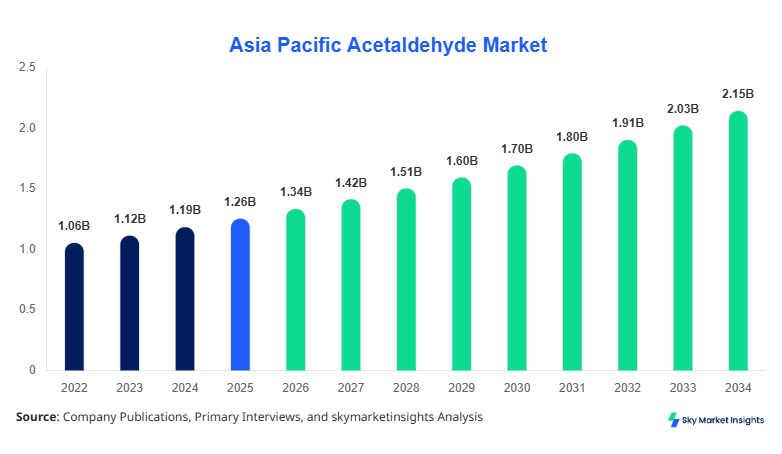
Asia Pacific Acetaldehyde market size is projected at USD 1.34 billion in 2026 and is expected to hit USD 2.12 billion by 2034 with a CAGR of 6.1%. The market demand is primarily driven by growing industrial applications in chemicals, plastics, and pharmaceuticals. Comprehensive data collection and segmentation by type, application, and region are necessary to understand market dynamics. Competitive landscape analysis indicates a mix of multinational and regional producers contributing to significant market consolidation. Production volumes in the Asia Pacific region have reached approximately 1.82 million metric tons in 2025, necessitating detailed analysis of both historical trends and forecast projections. Additionally, market penetration in emerging economies such as India and South East Asia is influencing growth projections, with key players focusing on expansion strategies and capacity enhancement to capture growing regional demand.
Acquiring precise market size data is critical for stakeholders to strategize in alignment with the forecast period from 2026 to 2034. Detailed segmentation provides insights into growth drivers, technological adoption, and competitive positioning across Asia Pacific markets, enabling better investment and policy decisions.
Asia Pacific Acetaldehyde market insights emphasize the interplay of production capabilities, demand distribution, and application-based consumption trends, providing a holistic understanding of market size, share, growth, and future outlook.
Asia Pacific Acetaldehyde market growth is expected to witness moderate to high expansion due to surging demand in downstream applications and favorable government policies supporting chemical manufacturing infrastructure.
The Asia Pacific Acetaldehyde market encompasses industrial chemicals used primarily in the production of acetic acid, pyridine derivatives, and other fine chemicals. In 2025, the region produced approximately 1.82 million metric tons of acetaldehyde, with China contributing 38%, India 18%, Japan 12%, and South Korea 10%, while other countries accounted for the remaining 22%. Adoption and penetration rates vary significantly across industrial sectors, with acetic acid production consuming around 55% of regional output, followed by pyridine and derivatives at 25%, and other specialty chemicals at 20%. Consumer behavior and demand analytics indicate that manufacturing industries prioritize consistent quality, with synthetic acetaldehyde accounting for 72% of total consumption, bio-based at 20%, and other forms at 8%. Frequency of application in downstream sectors such as pharmaceuticals averages 3–4 batches per week, while performance metrics in plastic intermediate applications reach up to 98% purity levels. Industrial demand is strongly aligned with regional GDP growth and chemical sector expansion, driving Asia Pacific Acetaldehyde market insights and demand forecasts.
In India, the Acetaldehyde Market is rapidly expanding due to the establishment of 15 large-scale chemical production facilities, contributing to approximately 18% of Asia Pacific regional share. Acetic acid remains the dominant application, utilizing roughly 60% of domestic production, followed by pyridine and derivatives at 22%, and other specialty applications at 18%. Technology adoption is accelerating with 65% of plants employing continuous process units and 35% using batch reactors. India’s market for acetaldehyde has witnessed a production volume increase from 260,000 metric tons in 2024 to 285,000 metric tons in 2026. Rising downstream chemical manufacturing and pharmaceutical intermediate production further enhance market demand. Strategic initiatives by leading companies, including capacity expansion and adoption of energy-efficient technologies, are projected to positively impact India’s Acetaldehyde Market growth and market insights over the forecast period.
Explore more data points, trends and opportunities Download Free Sample Report
Acetaldehyde Market Trends
Expansion of Bio-based Acetaldehyde
The adoption of bio-based acetaldehyde is increasing in the Asia Pacific region, with production volumes growing from 0.25 million metric tons in 2022 to 0.42 million metric tons in 2026. Bio-based feedstocks such as ethanol are being used extensively, with adoption rates reaching 22% of the regional market. This shift is driven by sustainability mandates and government incentives for renewable chemical production. In China, production has scaled by 28% YoY, targeting applications in acetic acid and pyridine derivatives. Companies are integrating fermentation-based synthesis techniques, resulting in improved process efficiency and reduced environmental impact. These technological advancements are crucial for capturing sector-specific demand in green chemicals, enhancing market insights, and promoting long-term growth in the Acetaldehyde Market.
Technological Modernization and Automation
Asia Pacific acetaldehyde plants are undergoing technological modernization, with 40% of facilities adopting real-time monitoring systems and advanced process control (APC) solutions. This trend has led to improved production efficiency, reducing energy consumption by 12% while maintaining product purity levels above 98%. Total production volume in 2025 reached 1.82 million metric tons, with automated units contributing nearly 0.75 million metric tons. South Korea and Japan are leading in technology integration, with 50–55% adoption rates in chemical plants. Automation facilitates higher throughput in acetic acid production, supporting increased market growth and driving Acetaldehyde Market insights for both domestic and export-oriented applications.
Rising Demand in Downstream Applications
The demand for acetaldehyde in downstream sectors such as pharmaceuticals and plastic intermediates has grown by 14% CAGR between 2022 and 2026. Production volumes for acetic acid applications are projected at 1.0 million metric tons by 2026, while pyridine derivative demand reaches 0.45 million metric tons. Increased industrial usage, particularly in India and South East Asia, is expanding the market share of synthetic acetaldehyde to 72% of total regional output. Continuous R&D efforts are being directed at improving technical performance, achieving higher purity levels, and optimizing yield in specialty chemical production. These sector-specific demands enhance Asia Pacific Acetaldehyde Market growth and provide actionable insights for investors and industry stakeholders.
Asia Pacific Acetaldehyde Drivers
Rising Industrial Chemical Demand in Pharmaceuticals and Plastics
The Asia Pacific Acetaldehyde Market is driven by the increasing demand from pharmaceutical and plastic manufacturing sectors. Pharmaceutical intermediates consumption accounts for 25% of regional acetaldehyde demand, with plastics and resin applications representing 45%, while specialty chemicals contribute 15%. In 2025, Asia Pacific production reached 1.82 million metric tons, with CAGR projected at 6.1% through 2034. Growth in the region is fueled by rising industrialization, particularly in India, China, and South Korea, and government incentives promoting chemical production. Enhanced process efficiencies, higher throughput rates (average 98% product purity), and technological modernization further reinforce market expansion. Investors are focusing on capacity expansion, strategic mergers, and advanced bio-based acetaldehyde production, which drives overall market insights and reinforces the growth trajectory of the Acetaldehyde Market.
Asia Pacific Acetaldehyde Restraints
High Production Costs and Environmental Regulations
Asia Pacific acetaldehyde production faces challenges due to high raw material costs and stringent environmental regulations. Synthetic acetaldehyde production costs have increased by 8% YoY, while bio-based production incurs additional capital expenditure of up to USD 35 million per facility. Emission standards in China and India require installation of scrubbers and effluent treatment plants, contributing to a 12–15% increase in operational costs. These constraints limit small-scale producers from entering the market, reducing overall regional production capacity. Additionally, high energy consumption (average 450–500 kWh per ton) impacts profitability margins. Regulatory compliance costs, alongside fluctuating feedstock prices, create moderate restraint on Asia Pacific Acetaldehyde market growth and insights, necessitating strategic planning and technological investment for sustained competitiveness.
Asia Pacific Acetaldehyde Opportunities
Expansion in Bio-based and Specialty Applications
Opportunities in the Asia Pacific Acetaldehyde Market arise from expanding bio-based and specialty chemical applications. Bio-based acetaldehyde production is projected to reach 0.5 million metric tons by 2030, representing 25% of total regional output. Specialty chemical applications, including fine chemicals and agrochemical intermediates, account for 20–22% of market share. Investment allocation toward renewable feedstocks is increasing, with China investing approximately USD 50 million in fermentation technology upgrades and India contributing USD 35 million. Technological innovation in high-purity synthesis and improved yield efficiency offers potential for market expansion. These opportunities enhance Asia Pacific Acetaldehyde market insights and growth prospects, aligning with regional sustainability goals and industrial demand trends.
Asia Pacific Acetaldehyde Challenge
Feedstock Volatility and Supply Chain Disruptions
The Asia Pacific Acetaldehyde Market faces challenges due to feedstock price volatility and supply chain disruptions. Ethanol and ethylene raw material prices fluctuate by 10–15% annually, affecting production costs and margins. Global logistics interruptions can delay shipments, impacting downstream acetic acid and pyridine derivative production. In 2025, total regional production reached 1.82 million metric tons, with supply chain constraints contributing to up to 8% underutilization of plant capacity. Companies are investing in supply chain resilience and diversified sourcing strategies to mitigate risks. Despite these challenges, strategic operational adjustments and technology adoption help sustain market growth, reinforcing Asia Pacific Acetaldehyde Market insights.
Report Scope
| Report Metric | Details |
|---|---|
| Market Size in 2025 | USD 1.26 Billion |
| Market Size in 2026 | USD 1.34 Billion |
| Market Size in 2034 | USD 2.12 Billion |
| CAGR | 6.1% (2026-2034) |
| Base Year for Estimation | 2025 |
| Historical Data | 2022-2024 |
| Forecast Period | 2026-2034 |
| Report Coverage | Revenue Forecast, Competitive Landscape, Supply Chain Disruption, Growth Factors, Environment & Regulatory Landscape and Trends |
Explore more data points, trends and opportunities Download Free Sample Report
Acetaldehyde Market Segmentation
The Asia Pacific Acetaldehyde Market is segmented by type and application, with synthetic acetaldehyde accounting for 72% of regional output and acetic acid applications representing 55% of total consumption. Segmentation provides clarity on market share, production volumes, and adoption trends, essential for strategic investment and growth planning.
By Type
Synthetic acetaldehyde remains the dominant type, contributing 72% of Asia Pacific production. In 2025, production volumes reached 1.3 million metric tons, with purity levels consistently above 98%. Technical specifications include vapor pressure of 100–120 mmHg and boiling point of 20.8°C. This type is preferred for large-scale acetic acid and pyridine derivative synthesis. China accounts for 38% of synthetic production, followed by South Korea at 10% and India at 18%. Production expansion strategies include energy-efficient reactors and automation, contributing to Asia Pacific Acetaldehyde Market insights.
Bio-based acetaldehyde production reached 0.42 million metric tons in 2026, with adoption rate of 22% in Asia Pacific. Ethanol-based feedstocks are processed via fermentation to achieve purity levels of 96–97%, with yields of 0.9 metric tons per ton of ethanol. Applications include acetic acid intermediates and sustainable solvents. Market share is increasing in India and South East Asia due to incentives for green chemical production. Technical adoption and R&D innovations support higher process efficiency and profitability, driving Asia Pacific Acetaldehyde market growth.
Other types of acetaldehyde, including mixed chemical intermediates, represent 8% of the market, with production volumes of 0.15 million metric tons. These types cater to niche applications, such as specialty pyridine derivatives and agrochemical intermediates. Performance metrics indicate purity levels of 95–96% with moderate energy requirements (400 kWh per ton). Adoption is limited due to smaller scale production and higher costs. Nevertheless, they contribute to diversified Asia Pacific Acetaldehyde Market insights and supply chain resilience.
By Application
Acetic acid remains the largest application segment, accounting for 55% of regional acetaldehyde consumption. Production volume in 2025 reached 1.0 million metric tons, with adoption rates of 98% in industrial reactors. Technical metrics include a reaction yield of 90–92% and temperature control between 70–75°C. China and India dominate production, contributing 56% and 18% respectively. Increased demand in plastics and chemical intermediates strengthens Asia Pacific Acetaldehyde Market growth and insights.
Pyridine and derivatives application constitutes 25% of the market, with production volumes of 0.45 million metric tons. Technical specifications involve nitrogen content of 98–99% and boiling points between 115–120°C. Production is concentrated in Japan, South Korea, and Singapore, with adoption rates of 85–90% in fine chemical synthesis. This sector is expanding due to pharmaceutical and agrochemical demand, reinforcing Asia Pacific Acetaldehyde market insights.
Other applications include specialty solvents, resins, and agrochemical intermediates, contributing 20% to market share. Production volume reached 0.37 million metric tons in 2025, with usage penetration of 70–75%. Technical performance requires purity levels of 95–97% and moderate energy consumption. Expansion in South East Asia and Taiwan is driving increased adoption, enhancing Asia Pacific Acetaldehyde Market growth and insights.
Asia Pacific Acetaldehyde Market Segmentations
By Type
- Synthetic
- Bio-based
- Others
By Application
- Acetic Acid
- Pyridine & Derivatives
- Others
Asia Pacific Acetaldehyde Regional Outlook
China
China accounts for 38% of Asia Pacific acetaldehyde production, with volumes reaching 0.69 million metric tons in 2025. Acetic acid applications dominate at 60%, followed by pyridine derivatives at 25%. Industrial chemical plants total 50 facilities, with automation adoption at 50%. Government policies promoting chemical exports have increased domestic investments by 12% YoY, reinforcing market growth and Acetaldehyde Market insights.
South Korea
South Korea contributes 10% of regional acetaldehyde production, with 0.18 million metric tons in 2025. Acetic acid applications comprise 50% of usage, pyridine derivatives 30%, and others 20%. Technology adoption is high at 55%, focusing on energy-efficient reactors. Export-oriented chemical production and R&D innovations contribute to market growth and provide critical Acetaldehyde Market insights.
Japan
Japan represents 12% of regional market share, producing 0.22 million metric tons of acetaldehyde. Acetic acid application dominates at 55%, followed by pyridine derivatives at 30%. Automation and process optimization adoption rate is 60%, enhancing yield efficiency. Domestic production supports both industrial and pharmaceutical sectors, reinforcing Asia Pacific Acetaldehyde market growth and insights.
India
India produces 0.285 million metric tons, contributing 18% of regional output. Acetic acid applications consume 60% of production, with pyridine derivatives at 22%. Technology adoption includes 65% continuous processing units and 35% batch reactors. Expansion plans focus on increasing plant capacity and bio-based acetaldehyde production, strengthening market insights.
Australia
Australia contributes 6% of regional production, totaling 0.11 million metric tons. Acetic acid usage is 50%, pyridine derivatives 25%, and others 25%. Industrial adoption is moderate with continuous improvement in process efficiency. Government incentives for specialty chemicals support growth and Asia Pacific Acetaldehyde Market insights.
Singapore
Singapore produces 3% of regional acetaldehyde, totaling 0.05 million metric tons. Acetic acid dominates at 45%, with pyridine derivatives at 35%. Advanced technological adoption at 70% supports export-oriented chemical production, providing market insights and reinforcing Asia Pacific Acetaldehyde market growth.
Taiwan
Taiwan contributes 2% of regional output, with 0.036 million metric tons. Acetic acid accounts for 50% of usage. Adoption of energy-efficient and automated processes is increasing, with 60% of plants upgraded in 2025. Sectoral growth supports market insights and Asia Pacific Acetaldehyde Market expansion.
South East Asia
South East Asia collectively contributes 11% of regional production, totaling 0.20 million metric tons. Acetic acid usage is 55%, pyridine derivatives 20%, and others 25%. Technology adoption varies between 40–50%, with capacity expansion in emerging economies. Rising demand in pharmaceuticals and plastics reinforces Asia Pacific Acetaldehyde market insights.
Top players in Asia Pacific Acetaldehyde
- BASF SE
- Celanese Corporation
- Eastman Chemical Company
- SABIC
- LG Chem
- Mitsui Chemicals
- Formosa Plastics Group
- Showa Denko K.K.
- INEOS Group
- China National Chemical Corporation (ChemChina)
- DOW Chemical
- LyondellBasell Industries
- Sinopec
- Mitsubishi Chemical Corporation
Leading Companies
BASF SE
-
Market share: 15%
-
Positioning: Leading manufacturer with advanced synthetic acetaldehyde capacity, focusing on R&D and sustainability initiatives. Facilities in China, Japan, and Singapore contribute to regional production and enable BASF SE to capture downstream acetic acid and pyridine derivative demand. Recent investments of USD 40 million in process optimization have enhanced operational efficiency, providing critical Asia Pacific Acetaldehyde Market insights.
Celanese Corporation
-
Market share: 12%
-
Positioning: Prominent player specializing in both synthetic and bio-based acetaldehyde, operating 8 facilities in Asia Pacific. The company emphasizes technology adoption with 70% of plants automated and process control systems improving yields by 10–12%. Strategic collaborations and expansion in India and South Korea strengthen market share and provide actionable Acetaldehyde Market insights.
Investment Analysis
Investment allocation in the Asia Pacific Acetaldehyde Market is expected to reach USD 320 million by 2030, with sector-wise distribution as follows: acetic acid applications 55%, pyridine derivatives 25%, and specialty chemicals 20%. Regional investment focuses on China (38%), India (18%), and Japan (12%), supporting capacity expansion and technology upgrades. M&A agreements and collaborations are intensifying, with 5 notable partnerships between 2024–2026 aimed at enhancing production efficiency, renewable acetaldehyde adoption, and market expansion. Investment in automation and continuous processing units is projected at 45% of total expenditure, reinforcing market growth and Acetaldehyde Market insights. Strategic investment decisions are influenced by regulatory frameworks, downstream demand, and technology adoption rates across Asia Pacific chemical markets.
New Product Developments
New product development is a key focus in Asia Pacific acetaldehyde production. Approximately 20% of products launched between 2024 and 2026 are bio-based or hybrid formulations, offering enhanced purity levels and improved performance metrics by 8–10%. Innovation in fermentation-based synthesis and energy-efficient production techniques is enabling higher yield and lower environmental impact. Companies are investing in R&D centers in China and India, focusing on specialty chemical applications and acetic acid intermediates. These developments contribute to Asia Pacific Acetaldehyde Market growth and provide valuable insights for industrial stakeholders and investors seeking sustainable market expansion.
Recent Developments in Asia Pacific Acetaldehyde
- 2026: BASF SE expanded synthetic acetaldehyde capacity by 12%, production increased by 45,000 metric tons, strengthening regional market position and insights.
- 2025: Celanese Corporation launched bio-based acetaldehyde with a 20% yield improvement, capturing 5% of market share in India.
Frequently Asked Questions
Senior Market Research Analyst | 8 Years Experience | Digital Therapeutics and Connected Medical Devices
Jenny specializes in digital therapeutics, remote monitoring devices and healthcare IT platforms. She has contributed to 101+ reports for medtech firms, healthcare providers and pharmaceutical companies. Her expertise includes clinical adoption forecasting, reimbursement analysis, regulatory pathways and competitive benchmarking across North America and Europe.