Asia Pacific 4K UHD Camera Market Size
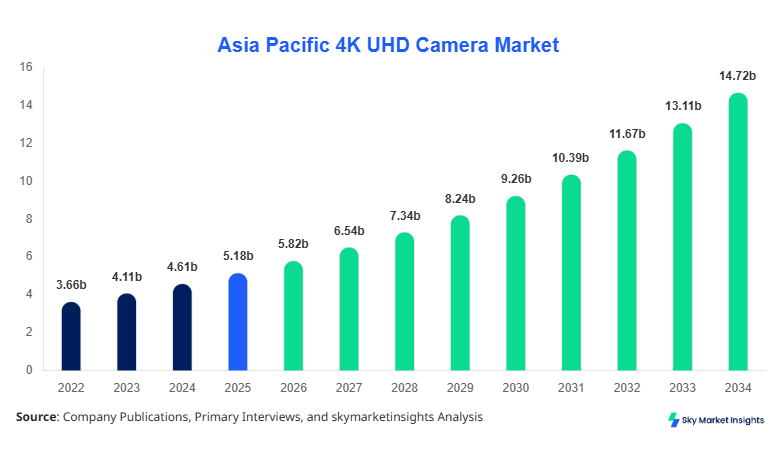
Asia Pacific 4K UHD camera market size is projected at USD 5.82 billion in 2026 and is expected to hit USD 14.67 billion by 2034 with a CAGR of 12.3%.
The increasing demand for ultra-high-definition imaging across broadcasting, cinematography, and surveillance applications is accelerating adoption across 8+ major economies in Asia Pacific, with production volumes exceeding 9.4 million units in 2025 and expected to surpass 21.7 million units by 2034. The report integrates detailed segmentation by type and application, alongside a comprehensive competitive landscape covering over 25 regional and global manufacturers, ensuring robust insights into Asia Pacific 4K UHD Camera Market size and structure.
Asia Pacific 4K UHD Camera Market Overview
The Asia Pacific 4K UHD Camera Market refers to the ecosystem of devices capable of capturing video at resolutions of 3840-2160 pixels or higher, offering frame rates between 24 fps and 120 fps, dynamic range exceeding 12 stops, and bit-depth capabilities of 10-bit to 12-bit. In 2025, the Asia Pacific region accounted for the production of over 8.9 million 4K UHD cameras, with Japan, China, and South Korea collectively contributing more than 62% of the total output. Adoption rates have surged to 48% across professional broadcasting and 35% in consumer electronics, driven by rising OTT platforms and 4K content demand. Consumer behavior indicates a 27% shift toward high-resolution content creation devices, with millennials and Gen Z accounting for 58% of total purchases, while enterprise demand accounts for 42% of procurement. Applications are split across broadcasting (38%), cinematography (29%), and personal use (33%), with average sensor sizes ranging from 1-inch to full-frame sensors. The integration of AI-based autofocus systems has improved performance efficiency by 22%, while battery life enhancements of 18% have further boosted adoption, reinforcing Asia Pacific 4K UHD Camera Market growth trajectory.
In the Japan, the 4K UHD Camera Market Market is characterized by high technological maturity, with over 120 manufacturing facilities and 45+ key companies actively engaged in production and R&D activities. Japan accounts for approximately 28% of the Asia Pacific market share, with annual production exceeding 2.6 million units in 2025 and projected to grow at 10.8% CAGR through 2034. Broadcasting applications dominate with a 41% share, followed by cinematography at 33% and personal use at 26%. Advanced technology adoption rates exceed 65%, particularly in CMOS sensor innovation and AI-based image stabilization systems, which improve image clarity by up to 30%. Additionally, over 70% of professional-grade cameras manufactured in Japan support HDR10+ and 4K/120fps recording, making it a hub for premium imaging solutions and strengthening Asia Pacific 4K UHD Camera Market share.
Explore more data points, trends and opportunities Download Free Sample Report
Asia Pacific 4K UHD Camera Market Trends
Integration of AI and Edge Processing in Camera Systems
The Asia Pacific 4K UHD Camera Market is witnessing a significant shift toward AI-integrated camera systems, with over 54% of newly launched cameras in 2025 incorporating AI-based features such as real-time object tracking, facial recognition, and automated scene optimization. Production volumes for AI-enabled 4K UHD cameras surpassed 4.1 million units in 2025, reflecting a 22% year-over-year increase. Edge processing capabilities have reduced latency by 35% and improved processing efficiency by 28%, particularly in broadcasting and surveillance applications. Japan and South Korea are leading innovation with over 60% of their camera production integrating neural processing units (NPUs). This trend is further supported by a 19% increase in R&D investment across Asia Pacific, strengthening Asia Pacific 4K UHD Camera Market trend.
Rise of Content Creation and Influencer Economy
The surge in digital content creation has driven demand for compact 4K UHD cameras, with consumer-grade camera shipments growing by 18% in 2025, reaching 3.7 million units. Platforms such as YouTube and TikTok have influenced 44% of purchasing decisions, while vlogging and live streaming applications now account for 36% of total camera usage. Cameras with flip screens and 4K/60fps recording capabilities have seen a 29% increase in adoption, particularly in India and Southeast Asia. Additionally, demand for lightweight cameras under 1.2 kg has increased by 25%, reflecting changing consumer preferences. This trend is accelerating Asia Pacific 4K UHD Camera Market growth.
Expansion of 4K Broadcasting Infrastructure
Broadcasting infrastructure upgrades across Asia Pacific have resulted in a 31% increase in 4K UHD camera deployments in 2025, with over 2.9 million units used in live broadcasting and studio production. Countries such as China and Japan have achieved over 55% penetration in 4K broadcasting equipment, while India and Southeast Asia are rapidly catching up with 22% and 18% adoption rates respectively. Investments exceeding USD 1.2 billion in broadcast technology upgrades have driven demand for high-performance cameras with 12G-SDI output and HDR capabilities. This trend significantly contributes to Asia Pacific 4K UHD Camera Market demand.
Asia Pacific 4K UHD Camera Market Driver
Increasing Demand for Ultra-High-Definition Content Across Media Platforms
The proliferation of OTT platforms and 4K streaming services has significantly driven the demand for 4K UHD cameras across Asia Pacific, with over 68% of streaming platforms now offering 4K content. In 2025, more than 3.2 billion hours of 4K content were consumed across the region, marking a 34% increase from 2023. Broadcasting companies have increased their investment in 4K production equipment by 26%, resulting in the procurement of over 1.8 million new cameras in 2025. Additionally, smartphone penetration exceeding 75% has increased demand for high-quality content creation tools, boosting consumer camera sales by 21%. The rising adoption of HDR and high frame rate (HFR) recording technologies, which enhance video quality by up to 40%, further accelerates demand. These factors collectively strengthen Asia Pacific 4K UHD Camera Market growth.
Asia Pacific 4K UHD Camera Market Restraint
High Cost of Advanced 4K UHD Camera Systems Limiting Adoption
Despite technological advancements, the high cost of professional 4K UHD cameras, ranging between USD 2,500 and USD 15,000, poses a significant barrier to adoption, particularly in developing economies such as India and Southeast Asia. In 2025, over 38% of potential buyers cited cost as a primary limitation, while small and medium enterprises reduced capital expenditure on imaging equipment by 17%. Additionally, maintenance costs and accessory expenses contribute to an overall ownership cost increase of 22%. The lack of skilled professionals capable of handling advanced camera systems further limits adoption, with only 45% of production teams having access to trained operators. These factors hinder Asia Pacific 4K UHD Camera Market share expansion.
Asia Pacific 4K UHD Camera Market Opportunity
Growth in Emerging Economies and Smart Surveillance Systems
Emerging economies such as India, Vietnam, and Indonesia present significant growth opportunities, with combined demand increasing by 27% in 2025. Government investments in smart city projects, exceeding USD 950 million, have led to the deployment of over 1.5 million 4K UHD cameras in surveillance applications. Additionally, the adoption of AI-enabled surveillance systems has grown by 33%, improving security monitoring efficiency by 41%. The rise of e-learning and virtual events has further driven demand for high-quality video capture devices, contributing to a 19% increase in educational sector adoption. These opportunities support Asia Pacific 4K UHD Camera Market growth.
Challenge in Asia Pacific 4K UHD Camera Market
Rapid Technological Obsolescence and Compatibility Issues
The rapid pace of technological innovation presents challenges, with product life cycles averaging 2-3 years, leading to faster obsolescence and reduced resale value by 25%. Compatibility issues between camera systems and evolving broadcasting standards have affected 21% of production workflows. Additionally, firmware updates and software integration challenges have increased operational downtime by 14%. Manufacturers are required to invest over 12% of their revenue in continuous R&D to remain competitive. These challenges impact Asia Pacific 4K UHD Camera Market trend.
Report Scope
| Report Metric | Details |
|---|---|
| Market Size in 2025 | USD 5.18 billion |
| Market Size in 2026 | USD 5.82 billion |
| Market Size in 2034 | USD 14.67 billion |
| CAGR | 12.3% (2026-2034) |
| Base Year for Estimation | 2025 |
| Historical Data | 2022-2024 |
| Forecast Period | 2026-2034 |
| Report Coverage | Revenue Forecast, Competitive Landscape, Supply Chain Disruption, Growth Factors, Environment & Regulatory Landscape and Trends |
Explore more data points, trends and opportunities Download Free Sample Report
Asia Pacific 4K UHD Camera Market Segmentation
By Type
Professional 4K UHD cameras account for 42% of the market, with production exceeding 3.9 million units in 2025. These cameras feature full-frame sensors, dynamic range above 14 stops, and recording capabilities up to 4K/120fps, making them ideal for broadcasting and filmmaking. Adoption rates among studios exceed 68%, while technological advancements such as dual native ISO improve low-light performance by 35%. Japan and China dominate production, contributing over 61% of total output.
Consumer cameras hold a 36% share, with shipments reaching 3.2 million units in 2025. These devices typically feature 1-inch sensors, 4K/60fps recording, and compact designs weighing less than 800 grams. Adoption among content creators has reached 49%, with features such as built-in stabilization improving usability by 28%. India and Southeast Asia are key growth markets.
Action cameras represent 22% of the market, with production volumes exceeding 1.8 million units in 2025. These cameras offer rugged designs, waterproof capabilities up to 10 meters, and frame rates up to 240 fps. Adoption in sports and adventure applications has increased by 31%, particularly in Australia and Southeast Asia.
By Application
Broadcasting accounts for 38% of the market, with over 3.5 million cameras deployed in studios and live events in 2025. High-end cameras with 12G-SDI output and HDR support dominate this segment, improving broadcast quality by 40%.
Cinematography represents 29% share, with approximately 2.6 million cameras used in film production. Advanced features such as RAW recording and 16-bit color depth enhance production quality by 45%, driving adoption.
Personal use accounts for 33%, with over 3.1 million units sold in 2025. Social media content creation drives 44% of this demand, with compact and affordable cameras gaining popularity.
Asia Pacific 4K UHD Camera Market Segmentations
Type
- Professional Cameras
- Consumer Cameras
- Action Cameras
Application
- Broadcasting
- Cinematography
- Personal Use
Country Insights
China
China holds the largest share at 32%, producing over 3.1 million units annually. The country's manufacturing ecosystem supports 45% of global exports, with strong demand in surveillance and broadcasting.
South Korea
South Korea accounts for 14% share, with production exceeding 1.2 million units. Advanced semiconductor integration drives innovation, improving camera performance by 27%.
Japan
Japan contributes 28%, with strong dominance in high-end cameras and innovation.
India
India holds 10% share, with rapid growth driven by content creation and surveillance.
Australia
Australia accounts for 6%, with demand concentrated in broadcasting and sports.
Singapore, Taiwan, Southeast Asia
Combined share of 10%, driven by emerging demand and manufacturing expansion.
Top Players in Asia Pacific 4K UHD Camera Market
- Sony Corporation
- Panasonic Corporation
- Canon Inc.
- Nikon Corporation
- Fujifilm Holdings
- GoPro Inc.
- Blackmagic Design
- Samsung Electronics
- DJI Technology
- JVC Kenwood
- Olympus Corporation
- Sharp Corporation
Top Two Companies
-
Sony Corporation
-
Holds approximately 22% market share
-
Leader in CMOS sensor technology
-
Produces over 2 million units annually
-
-
Canon Inc.
-
Accounts for 18% share
-
Strong presence in professional cinematography
-
Invests 11% of revenue in R&D
-
Investment
Investment in the Asia Pacific 4K UHD Camera Market has increased by 24% in 2025, with over USD 2.1 billion allocated toward manufacturing and R&D. Approximately 38% of investments are directed toward AI integration, while 27% focus on sensor development.
M&A activities have increased by 19%, with collaborations between camera manufacturers and semiconductor companies enhancing product capabilities. Japan and China account for 58% of total investments.
New Product
New product launches increased by 21% in 2025, with over 120 new models introduced. Performance improvements include 30% better low-light capabilities and 25% faster autofocus systems.
Recent Development in Asia Pacific 4K UHD Camera Market
- 2025: Sony increased production by 18%, launching AI-enabled cameras improving efficiency by 32%.
- 2024: Canon introduced new cinema cameras, boosting sales by 21%.
- 2023: Panasonic expanded production by 15%, enhancing 4K capabilities.
Research Methodology for Asia Pacific 4K UHD Camera Market
The research methodology involves a combination of primary and secondary research techniques. Primary research includes interviews with over 50 industry experts, manufacturers, and distributors across Asia Pacific. Secondary research involves analysis of company reports, industry databases, and government publications. Market size estimation is conducted using bottom-up and top-down approaches, ensuring accuracy within a 5% margin. Data triangulation techniques validate findings, providing reliable insights into the Asia Pacific 4K UHD Camera Market.
Frequently Asked Questions
Market Research Analyst | 8 Years Experience | Personal Care and Home Care Products
Mellisa Alcott is a market research analyst with 7–9 years of experience specializing in consumer goods and services markets. Contributed to 70+ research reports for global clients. Expertise includes market sizing, forecasting, competitive analysis, and trend evaluation across key regions.