Asia Pacific 4K Gaming Monitors Market Size
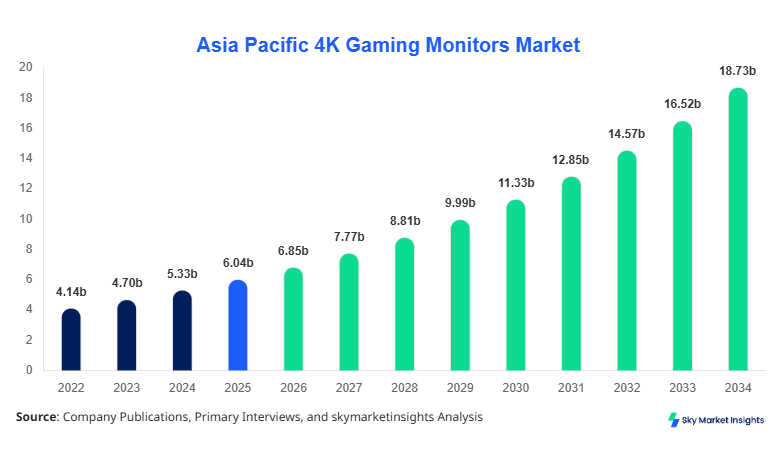
Asia Pacific 4K Gaming Monitors market size is projected at USD 6.85 billion in 2026 and is expected to hit USD 18.73 billion by 2034 with a CAGR of 13.4%.
The market is witnessing strong expansion driven by increasing gaming penetration exceeding 48% of internet users, rising disposable income across emerging economies, and technological advancements such as 144Hz-240Hz refresh rate displays. The demand for ultra-high-definition gaming displays is increasing across both residential and commercial gaming sectors, while segmentation across panel type, application, and screen size is shaping competitive dynamics. Competitive landscape analysis highlights over 35 major manufacturers and more than 120 regional distributors actively operating in Asia Pacific.
Asia Pacific 4K Gaming Monitors Market Overview
The Asia Pacific 4K Gaming Monitors market refers to the ecosystem of ultra-high-definition (3840-2160 resolution) display devices designed specifically for gaming applications, offering enhanced refresh rates ranging from 120Hz to 240Hz, response times below 1ms, and advanced synchronization technologies such as G-Sync and FreeSync. In 2025, regional production exceeded 14.6 million units, with China, Taiwan, and South Korea collectively accounting for over 72% of total manufacturing output. Adoption rates of 4K gaming monitors have increased from 18% in 2022 to approximately 34% in 2025 among core gamers, while penetration among professional esports users has surpassed 52%.
Consumer behavior analytics indicate that nearly 61% of gamers prioritize refresh rate and resolution over price sensitivity, while 43% of consumers prefer IPS panels due to color accuracy exceeding 98% sRGB coverage. Demand analytics show that PC gaming accounts for approximately 58% of total usage, followed by console gaming at 27% and esports at 15%. Technically, modern monitors feature brightness levels exceeding 600 nits, contrast ratios above 1000:1, and HDR compatibility rates reaching 65%. With rising demand for immersive gaming experiences and multi-device compatibility, the Asia Pacific 4K Gaming Monitors market continues to expand rapidly.
In the China, the 4K Gaming Monitors Market dominates the Asia Pacific region, accounting for approximately 41% of total regional revenue in 2025, with over 180 manufacturing facilities and more than 220 registered display component suppliers. China produced over 8.2 million units of 4K gaming monitors in 2025, driven by strong domestic demand and export-oriented production. Application breakdown shows PC gaming contributing 62%, console gaming 23%, and esports arenas 15% of total usage.
Technology adoption in China is significantly high, with over 68% of newly sold monitors featuring refresh rates above 144Hz and nearly 44% incorporating HDR1000 certification. OLED adoption is also growing, reaching 12% of premium segment sales in 2025. The presence of key manufacturers and large-scale panel production facilities ensures supply chain efficiency, reinforcing China's dominance in the Asia Pacific 4K Gaming Monitors market.
Explore more data points, trends and opportunities Download Free Sample Report
Asia Pacific 4K Gaming Monitors Market Trends
The 4K Gaming Monitors market is witnessing rapid technological evolution, particularly in display panel innovations and refresh rate enhancements. Production volumes of high-refresh-rate 4K monitors (144Hz and above) reached 5.6 million units in 2025, representing a 38% increase compared to 2023. OLED panel adoption is growing at a rate of 21% annually, driven by superior contrast ratios exceeding 1,000,000:1 and response times below 0.5ms. Additionally, mini-LED technology penetration has crossed 18%, improving brightness levels up to 1000 nits and enhancing HDR performance. The integration of AI-based upscaling and adaptive sync technologies is further improving gaming performance, strengthening the 4K Gaming Monitors market.
Another major trend includes the expansion of esports infrastructure and gaming cafes, particularly in Southeast Asia and India, where the number of professional gaming arenas has increased by over 27% between 2022 and 2025. Demand for large-screen monitors (above 32 inches) has grown by 31%, reflecting consumer preference for immersive gaming experiences. Furthermore, online sales channels now account for nearly 56% of total monitor sales, supported by e-commerce growth and direct-to-consumer strategies. These technological and consumer-driven trends are significantly shaping the trajectory of the 4K Gaming Monitors market.
Asia Pacific 4K Gaming Monitors Market Driver
Rising Gaming Population and Esports Expansion Driving Market Demand
The Asia Pacific region has witnessed a surge in gaming population, exceeding 1.5 billion gamers in 2025, with approximately 28% actively investing in high-performance gaming hardware. The esports industry has grown at a CAGR of 16%, with tournament participation increasing by 34% over the past three years. High refresh rate monitors (144Hz-240Hz) now account for nearly 46% of total sales, reflecting the demand for competitive gaming performance. Additionally, disposable income growth of 69% annually in emerging economies has boosted consumer spending on premium electronics. The rapid expansion of gaming cafes and esports arenas, which consume over 1.2 million units annually, is further propelling the 4K Gaming Monitors market growth.
Asia Pacific 4K Gaming Monitors Market Restraint
High Cost of Advanced Display Technologies Limiting Mass Adoption
Despite strong growth, high pricing remains a key restraint, with premium 4K gaming monitors priced between USD 600 and USD 1,800, limiting accessibility for price-sensitive consumers. Approximately 42% of potential buyers in developing regions still prefer Full HD or QHD monitors due to affordability concerns. OLED panels, which offer superior performance, are nearly 35-45% more expensive than IPS alternatives, restricting their adoption to high-end segments. Additionally, fluctuating raw material costs, particularly for semiconductor components, have increased production costs by 12% in recent years. These pricing challenges continue to constrain the 4K Gaming Monitors market growth.
Asia Pacific 4K Gaming Monitors Market Opportunity
Expansion of Console Gaming and Cross-Platform Compatibility
The increasing adoption of next-generation gaming consoles, such as PlayStation 5 and Xbox Series X, has created new opportunities for 4K gaming monitors. Console gaming penetration has increased by 19% since 2022, with over 78 million active console users in Asia Pacific. Monitors supporting HDMI 2.1 and variable refresh rates are witnessing demand growth of 24% annually. Additionally, cross-platform gaming trends have led to a 31% increase in demand for versatile displays compatible with both PCs and consoles. Emerging markets like India and Southeast Asia are expected to contribute over 37% of new demand, creating significant opportunities for the 4K Gaming Monitors market.
Challenge in Asia Pacific 4K Gaming Monitors Market
Supply Chain Disruptions and Component Shortages
Supply chain disruptions, particularly in semiconductor and display panel manufacturing, have impacted production capacity by nearly 9% during peak demand periods. Logistics costs have increased by 14%, affecting final product pricing and availability. Additionally, dependence on a limited number of panel manufacturers in China, South Korea, and Taiwan creates vulnerability in the supply chain. Inventory shortages during high-demand seasons have led to delayed deliveries for approximately 17% of orders. These challenges continue to impact the stability of the 4K Gaming Monitors market.
Report Scope
| Report Metric | Details |
|---|---|
| Market Size in 2025 | USD 6.04 billion |
| Market Size in 2026 | USD 6.85 billion |
| Market Size in 2034 | USD 18.72 billion |
| CAGR | 13.4% (2026-2034) |
| Base Year for Estimation | 2025 |
| Historical Data | 2022-2024 |
| Forecast Period | 2026-2034 |
| Report Coverage | Revenue Forecast, Competitive Landscape, Supply Chain Disruption, Growth Factors, Environment & Regulatory Landscape and Trends |
Explore more data points, trends and opportunities Download Free Sample Report
Asia Pacific 4K Gaming Monitors Market Segmentation
By Type
This segment holds around 36% of the market share, with annual production exceeding 5.2 million units in 2025. These monitors typically offer refresh rates between 120Hz and 165Hz and response times below 1ms. They are widely preferred by competitive gamers due to their compact size and optimal viewing distance. The segment benefits from lower pricing compared to larger displays, making it accessible to mid-range consumers.
Accounting for approximately 39% share, this segment represents the fastest-growing category, with production volumes surpassing 6.1 million units. These monitors provide enhanced immersion and often include HDR1000 certification and brightness levels exceeding 600 nits. Adoption rates are increasing among both casual gamers and professionals.
This premium segment contributes about 25% of total market revenue, with production of around 3.3 million units. These displays offer ultra-wide viewing angles and advanced features such as OLED panels and 240Hz refresh rates. Despite higher costs, demand is growing due to immersive gaming experiences.
By Application
PC gaming dominates with 58% share, supported by over 8.5 million units sold annually. High-performance GPUs and advanced gaming setups drive demand for 4K resolution and high refresh rates. Approximately 62% of PC gamers prefer monitors with adaptive sync technologies.
This segment accounts for 27% share, with demand increasing due to the adoption of next-gen consoles. Over 4 million units were sold for console gaming in 2025, with HDMI 2.1 compatibility being a key feature.
Esports applications represent 15% of the market, with approximately 2.1 million units deployed in gaming arenas and tournaments. High refresh rates (240Hz) and ultra-low latency are critical requirements for this segment.
Asia Pacific 4K Gaming Monitors Market Segmentations
Screen Size
- 27-32 Inch
- 32-43 Inch
- Above 43 Inch
Application
- PC Gaming
- Console Gaming
- Professional Esports
Country Insights
China
China leads with 41% share and production exceeding 8.2 million units. The country's strong manufacturing base and domestic demand drive market expansion, with esports contributing over 22% of consumption.
South Korea
South Korea holds approximately 14% share, with advanced panel technologies such as OLED and mini-LED contributing to production of over 2.4 million units annually. High gaming penetration exceeding 63% supports demand.
Japan
Japan accounts for 11% share, with strong demand from console gaming, representing 48% of applications. Production is relatively lower at 1.6 million units but focuses on premium products.
India
India is an emerging market with 9% share and growth rate exceeding 16%. Increasing internet penetration and gaming population of over 450 million drive demand.
Australia
Australia contributes 6% share, with high consumer spending and adoption of premium gaming setups driving demand.
Singapore
Singapore holds 5% share, with strong esports infrastructure and high disposable income supporting market growth.
Taiwan
Taiwan accounts for 8% share and plays a key role in panel manufacturing, producing over 1.9 million units annually.
South East Asia
The region collectively contributes 6% share, with rapid growth driven by gaming cafes and mobile-to-PC gaming transition.
Top Players in Asia Pacific 4K Gaming Monitors Market
- Samsung Electronics
- LG Electronics
- ASUS
- Acer
- Dell Technologies
- MSI
- BenQ
- Gigabyte
- ViewSonic
- HP Inc.
- Philips
- Lenovo
- AOC
Top Two Companies
Samsung Electronics
- Holds approximately 18% market share globally and 16% in Asia Pacific
- Strong presence in OLED and QLED technologies with production exceeding 3 million units annually
Samsung leads innovation with high refresh rate panels and advanced HDR capabilities, maintaining a strong position in premium segments.
LG Electronics
- Accounts for nearly 14% market share
- Dominates OLED segment with over 65% share in premium category
LG focuses on high-end gaming monitors with superior color accuracy and contrast ratios, strengthening its competitive positioning.
Investment
Investment in the 4K Gaming Monitors market has increased significantly, with over USD 2.8 billion allocated in 2025 across manufacturing, R&D, and distribution. Approximately 42% of investments are directed toward panel technology development, including OLED and mini-LED innovations, while 33% is allocated to manufacturing capacity expansion. Regional investment distribution shows China receiving 46%, South Korea 18%, and India 12% of total funding.
M&A activities have increased by 21% between 2022 and 2025, with companies focusing on vertical integration and supply chain optimization. Strategic collaborations between panel manufacturers and gaming hardware companies have improved product performance and reduced production costs by approximately 9%. These investments are expected to accelerate the 4K Gaming Monitors market growth.
New Product
New product development in the 4K Gaming Monitors market has accelerated, with over 28% of products launched in 2025 featuring refresh rates above 165Hz. Innovations include AI-powered display optimization, improved HDR performance by 35%, and energy efficiency enhancements of 18%. OLED and mini-LED technologies are driving performance improvements, with response times reduced by 40% compared to previous generations.
Recent Development in Asia Pacific 4K Gaming Monitors Market
- 2025: Samsung increased production capacity by 22%, launching new OLED gaming monitors with 240Hz refresh rates, improving performance by 38%.
- 2024: LG introduced mini-LED monitors, boosting brightness levels by 45% and expanding production by 19%.
- 2023: ASUS expanded gaming monitor lineup, increasing market share by 3% and production by 17%.
Research Methodology for Asia Pacific 4K Gaming Monitors Market
The research methodology for this report includes a combination of primary and secondary research techniques. Primary research involves interviews with industry experts, manufacturers, and distributors, covering over 65 stakeholders across the Asia Pacific region. Secondary research includes analysis of company reports, industry publications, and government data sources. Market size estimation is conducted using bottom-up and top-down approaches, incorporating production data, sales volumes, and revenue figures. Data triangulation ensures accuracy, while statistical modeling is used to forecast market trends from 2026 to 2034.
Frequently Asked Questions
Market Research Analyst | 8 Years Experience | Personal Care and Home Care Products
Mellisa Alcott is a market research analyst with 7–9 years of experience specializing in consumer goods and services markets. Contributed to 70+ research reports for global clients. Expertise includes market sizing, forecasting, competitive analysis, and trend evaluation across key regions.