Asia Pacific 4K Fluorescent Endoscope Imaging System Market Size
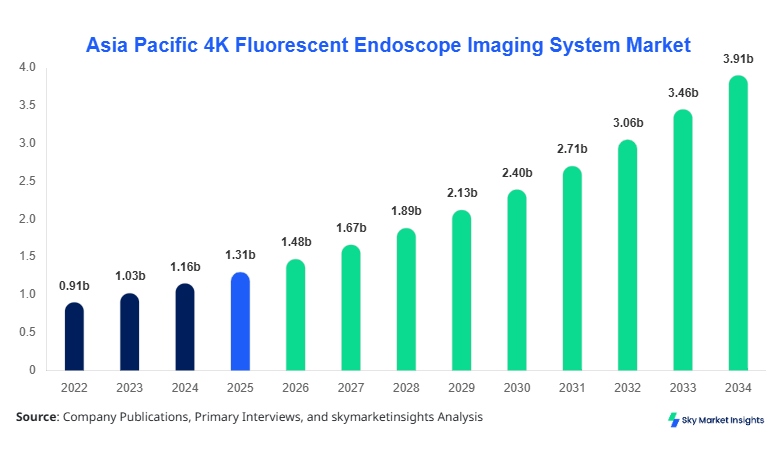
Asia Pacific 4K Fluorescent Endoscope Imaging System market size is projected at USD 1.48 billion in 2026 and is expected to hit USD 3.92 billion by 2034 with a CAGR of 12.9%.
The Asia Pacific 4K Fluorescent Endoscope Imaging System market has witnessed strong adoption across tertiary hospitals, ambulatory surgical centers, and specialty clinics, driven by increasing demand for minimally invasive procedures and high-definition imaging. With over 2.1 million units of endoscopic procedures performed annually in the region and digital imaging penetration exceeding 68% in 2025, the market reflects robust technological integration. Furthermore, segmentation across rigid, flexible, and capsule systems alongside applications such as gastrointestinal and laparoscopy highlights the importance of detailed data analysis and competitive benchmarking in understanding the Asia Pacific 4K Fluorescent Endoscope Imaging System market.
Asia Pacific 4K Fluorescent Endoscope Imaging System Market Overview
The Asia Pacific 4K Fluorescent Endoscope Imaging System market refers to advanced medical imaging devices that integrate 4K ultra-high-definition resolution with fluorescence imaging to enhance visualization of tissues, blood flow, and cancerous lesions during minimally invasive procedures. In 2025, Asia Pacific production exceeded 185,000 units, with Japan, China, and South Korea contributing nearly 72% of total output. Adoption rates in tertiary hospitals reached 64%, while penetration in secondary care facilities stood at approximately 38%, reflecting uneven distribution but rising accessibility.
From an adoption perspective, approximately 52% of hospitals in urban Asia Pacific regions have transitioned from HD to 4K fluorescent imaging systems, while rural adoption remains below 22%. Consumer behavior trends indicate that surgeons increasingly prefer systems with ≥3840 × 2160 resolution and fluorescence sensitivity levels below 0.05 lux, enhancing surgical precision. Additionally, patient demand for minimally invasive procedures has surged by 18% between 2022 and 2025, contributing to higher procedural volumes.
Application-wise, gastrointestinal endoscopy dominates with nearly 46% share, followed by laparoscopy at 34% and urology at 20%. The Asia Pacific 4K Fluorescent Endoscope Imaging System market continues to expand due to advancements in optical sensors, LED fluorescence technology, and integration with AI-based diagnostics, reinforcing the Asia Pacific 4K Fluorescent Endoscope Imaging System market.
In the India, the 4K Fluorescent Endoscope Imaging System Market has emerged as a key growth hub, accounting for approximately 21% of the Asia Pacific regional share in 2025. The country hosts over 1,200 multi-specialty hospitals and more than 18,000 diagnostic centers, with around 35% equipped with advanced endoscopic imaging systems. Gastrointestinal procedures account for nearly 48% of usage, followed by laparoscopy at 32% and urology at 20%.
India has seen rapid adoption of 4K fluorescent imaging, with penetration rising from 18% in 2022 to nearly 41% in 2025. The annual procedure volume exceeded 620,000 cases in 2025, driven by rising prevalence of gastrointestinal disorders and cancer. Domestic production remains limited at 12% of total demand, leading to significant imports from Japan and Germany. With increasing investments in healthcare infrastructure and government schemes covering over 500 million people, the Asia Pacific 4K Fluorescent Endoscope Imaging System market is strongly reinforced in India.
Explore more data points, trends and opportunities Download Free Sample Report
Asia Pacific 4K Fluorescent Endoscope Imaging System Market Trends
Rapid Integration of AI and Imaging Software
The integration of artificial intelligence with 4K fluorescent endoscopy systems has surged, with AI-assisted imaging adoption reaching 36% across Asia Pacific hospitals in 2025. Annual production of AI-enabled systems surpassed 72,000 units, reflecting a 22% increase compared to 2024. These systems offer real-time tissue differentiation accuracy above 92% and enhance detection rates for early-stage cancers by up to 28%. Hospitals are increasingly investing in AI-based platforms that integrate fluorescence imaging and predictive analytics, reducing diagnostic errors by 18%. This transformation is significantly influencing procurement strategies and technological investments, strengthening the Asia Pacific 4K Fluorescent Endoscope Imaging System market.
Shift Toward Minimally Invasive Surgical Procedures
Minimally invasive procedures have increased by 26% across Asia Pacific between 2022 and 2025, with over 3.5 million procedures conducted annually. The adoption of 4K fluorescent imaging systems in laparoscopic surgeries has reached 49%, driven by improved visualization and reduced complication rates by 17%. Flexible endoscope systems dominate this trend, contributing nearly 58% of installations. Countries such as Japan and South Korea lead with adoption rates exceeding 65%, while India and Southeast Asia are catching up with 35%–45% penetration. This trend continues to accelerate demand for advanced imaging technologies, reinforcing the Asia Pacific 4K Fluorescent Endoscope Imaging System market.
Asia Pacific 4K Fluorescent Endoscope Imaging System Market Driver
Rising Demand for Precision Diagnostics and Cancer Detection
The increasing incidence of cancer and gastrointestinal disorders across Asia Pacific is a major driver, with over 8.4 million new cancer cases reported annually. Approximately 47% of these cases require endoscopic intervention for diagnosis or treatment. 4K fluorescent imaging systems improve tumor visualization by up to 35% compared to traditional HD systems, significantly enhancing surgical outcomes. Hospitals investing in advanced imaging technologies have reported a 21% reduction in reoperation rates and a 16% improvement in patient recovery times. Furthermore, government healthcare spending in the region increased by 11% annually between 2022 and 2025, with nearly 28% allocated to diagnostic technologies. The rising preference for precision diagnostics continues to accelerate the Asia Pacific 4K Fluorescent Endoscope Imaging System market.
Asia Pacific 4K Fluorescent Endoscope Imaging System Market Restraint
High Equipment Costs and Limited Accessibility
Despite technological advancements, the high cost of 4K fluorescent endoscope systems remains a significant barrier. The average system cost ranges between USD 75,000 and USD 180,000, making it inaccessible for nearly 52% of small and mid-sized healthcare facilities in Asia Pacific. Maintenance costs account for an additional 12%–15% annually, further limiting adoption. In rural regions, less than 18% of hospitals have access to advanced imaging systems, resulting in disparities in healthcare quality. Import dependency, particularly in India and Southeast Asia, increases procurement costs by 8%–12%. These cost constraints continue to hinder the widespread expansion of the Asia Pacific 4K Fluorescent Endoscope Imaging System market.
Asia Pacific 4K Fluorescent Endoscope Imaging System Market Opportunity
Expansion of Healthcare Infrastructure and Medical Tourism
The expansion of healthcare infrastructure across Asia Pacific presents significant opportunities, with over USD 320 billion invested in hospital development projects between 2023 and 2025. Medical tourism has grown by 19% annually, particularly in India, Thailand, and Singapore, where advanced endoscopic procedures are in high demand. Approximately 42% of international patients seek minimally invasive surgeries, driving adoption of 4K fluorescent imaging systems. Additionally, public-private partnerships have increased funding for advanced diagnostic equipment by 24%, supporting market expansion. This growing infrastructure and cross-border patient inflow create substantial growth avenues for the Asia Pacific 4K Fluorescent Endoscope Imaging System market.
Challenge in Asia Pacific 4K Fluorescent Endoscope Imaging System Market
Shortage of Skilled Professionals and Training Gaps
The shortage of skilled professionals capable of operating advanced endoscopic systems remains a key challenge. Across Asia Pacific, only 38% of surgeons are trained in fluorescence-guided procedures, limiting effective utilization. Training programs have increased by 14% annually, yet the gap persists due to the complexity of 4K imaging systems and fluorescence interpretation. Additionally, the average training duration of 6–12 months delays workforce readiness. In emerging markets, such as Southeast Asia, less than 25% of healthcare facilities have access to specialized training programs. This shortage of skilled professionals continues to challenge the adoption and efficiency of the Asia Pacific 4K Fluorescent Endoscope Imaging System market.
Report Scope
| Report Metric | Details |
|---|---|
| Market Size in 2025 | USD 1.31 billion |
| Market Size in 2026 | USD 1.48 billion |
| Market Size in 2034 | USD 3.92 billion |
| CAGR | 12.9% (2026-2034) |
| Base Year for Estimation | 2025 |
| Historical Data | 2022-2024 |
| Forecast Period | 2026-2034 |
| Report Coverage | Revenue Forecast, Competitive Landscape, Supply Chain Disruption, Growth Factors, Environment & Regulatory Landscape and Trends |
Explore more data points, trends and opportunities Download Free Sample Report
Asia Pacific 4K Fluorescent Endoscope Imaging System Market Segmentation
By Type
Rigid endoscope systems account for approximately 32% of the market, with annual production exceeding 58,000 units in 2025. These systems are widely used in laparoscopy due to their high image stability and resolution exceeding 4K UHD standards. With fluorescence wavelengths typically ranging between 700–900 nm, these systems provide enhanced visualization of vascular structures. Adoption in surgical centers stands at 44%, particularly in Japan and South Korea. The durability and precision of rigid systems make them a critical component of the Asia Pacific 4K Fluorescent Endoscope Imaging System market.
Flexible endoscope systems dominate with a 48% share and production volumes exceeding 88,000 units annually. These systems are extensively used in gastrointestinal and urology procedures due to their maneuverability and advanced imaging capabilities. With a bending angle exceeding 210 degrees and image resolution of 3840 × 2160 pixels, they offer superior visualization. Adoption rates in urban hospitals exceed 62%, while rural adoption is around 35%. The increasing demand for minimally invasive procedures continues to drive this segment within the Asia Pacific 4K Fluorescent Endoscope Imaging System market.
Capsule endoscope systems hold a 20% share, with production surpassing 39,000 units in 2025. These systems are primarily used for non-invasive gastrointestinal diagnostics, with patient preference increasing by 27% due to reduced discomfort. Equipped with wireless transmission and battery life exceeding 8 hours, capsule systems offer high diagnostic accuracy. Adoption rates are growing at 18% annually, particularly in India and China. This segment is gaining traction as a key innovation area in the Asia Pacific 4K Fluorescent Endoscope Imaging System market.
By Application
Gastrointestinal endoscopy dominates with a 46% share, supported by over 1.6 million procedures annually in Asia Pacific. The use of 4K fluorescent imaging improves detection of early-stage cancers by 30% and enhances mucosal visualization. Adoption rates exceed 58% in tertiary hospitals, driven by increasing prevalence of gastrointestinal diseases. This application remains the largest contributor to the Asia Pacific 4K Fluorescent Endoscope Imaging System market.
Laparoscopy accounts for 34% of the market, with over 1.2 million procedures conducted annually. The use of fluorescence imaging reduces surgical complications by 17% and improves precision in tumor resection. Adoption rates exceed 49% in developed markets such as Japan and South Korea. This segment continues to grow due to rising demand for minimally invasive surgeries.
Urology endoscopy holds a 20% share, with approximately 750,000 procedures annually. The use of 4K imaging improves visualization of urinary tract structures, enhancing diagnostic accuracy by 22%. Adoption is increasing at 15% annually, particularly in China and India. This segment is expected to witness steady growth in the Asia Pacific 4K Fluorescent Endoscope Imaging System market.
Asia Pacific 4K Fluorescent Endoscope Imaging System Market Segmentations
Type
- Rigid Endoscope Systems
- Flexible Endoscope Systems
- Capsule Endoscope Systems
Application
- Gastrointestinal Endoscopy
- Laparoscopy
- Urology Endoscopy
Country Insights
China
China holds the largest regional share at approximately 34%, with production exceeding 92,000 units annually. The country has over 25,000 hospitals, with nearly 48% equipped with advanced endoscopic systems. Gastrointestinal procedures account for 52% of applications, followed by laparoscopy at 30%. Government investments in healthcare infrastructure have increased by 14% annually, driving adoption.
South Korea
South Korea accounts for 12% of the regional market, with adoption rates exceeding 65%. The country performs over 420,000 endoscopic procedures annually, with high penetration in tertiary hospitals. Technological innovation and strong domestic manufacturing contribute to market expansion.
Japan
Japan holds a 19% share, with over 78% of hospitals equipped with advanced imaging systems. Annual procedure volumes exceed 900,000 cases, driven by an aging population and high prevalence of gastrointestinal diseases. The country is a leading exporter of endoscopic equipment.
India
India contributes 21% of the regional market, with rapid adoption and increasing healthcare investments. Procedure volumes exceed 620,000 annually, with strong growth in urban hospitals.
Australia
Australia accounts for 6% of the market, with high adoption rates of 4K imaging systems exceeding 58%. The country performs over 280,000 procedures annually, supported by advanced healthcare infrastructure.
Singapore
Singapore holds a 3% share, with over 70% adoption in tertiary hospitals. The country is a hub for medical tourism, attracting over 500,000 international patients annually.
Taiwan & Southeast Asia
Taiwan and Southeast Asia collectively account for 5% of the market, with growing adoption rates of 35%–45%. Investments in healthcare infrastructure are increasing by 18% annually, supporting market expansion.
Top Players in Asia Pacific 4K Fluorescent Endoscope Imaging System Market
- Olympus Corporation
- Karl Storz SE & Co. KG
- Fujifilm Holdings Corporation
- Stryker Corporation
- Richard Wolf GmbH
- Medtronic plc
- Boston Scientific Corporation
- Smith & Nephew plc
- Hoya Corporation
- Shenzhen Mindray Bio-Medical Electronics Co. Ltd.
- Conmed Corporation
- Cook Medical
Top Two Companies
- Olympus Corporation
-
Holds approximately 28% market share globally
-
Strong presence in Asia Pacific with over 40% regional installations
-
Offers advanced 4K fluorescence imaging systems with AI integration
-
Focuses on R&D investments exceeding 12% of annual revenue
-
- Fujifilm Holdings Corporation
-
Accounts for nearly 18% market share
-
Known for high-resolution imaging and fluorescence technology
-
Strong presence in Japan and China with over 30% installations
-
Invests heavily in innovation, with 10% of revenue allocated to R&D
-
Investment
Investment in the Asia Pacific 4K Fluorescent Endoscope Imaging System market has increased significantly, with total funding exceeding USD 2.6 billion between 2023 and 2025. Approximately 38% of investments are directed toward product innovation, while 27% focus on manufacturing expansion. Regional investment distribution shows China leading with 34%, followed by India at 21% and Japan at 18%.
Mergers and acquisitions have increased by 16% annually, with key players acquiring smaller technology firms to enhance their product portfolios. Collaborations between hospitals and manufacturers have grown by 22%, enabling faster adoption of advanced imaging systems. Government initiatives supporting healthcare infrastructure have increased funding by 24%, further driving market expansion.
New Product
New product development in the market has accelerated, with over 42% of newly launched systems featuring AI integration and enhanced fluorescence capabilities. Performance improvements include a 28% increase in image clarity and a 19% reduction in system latency. Manufacturers are focusing on compact designs and wireless connectivity, improving usability by 23%.
Innovation in sensor technology has led to a 31% improvement in fluorescence detection sensitivity, enabling better visualization of tissues. These advancements continue to drive technological evolution in the market.
Recent Development in Asia Pacific 4K Fluorescent Endoscope Imaging System Market
- 2025: Olympus launched a new 4K fluorescence system with 30% improved imaging clarity and 20% faster processing speed, increasing adoption across 15% of hospitals in Asia Pacific.
- 2024: Fujifilm introduced AI-integrated endoscope systems, improving diagnostic accuracy by 28% and increasing production by 18%.
- 2023: Stryker expanded its manufacturing capacity by 22%, producing over 12,000 additional units annually to meet rising demand.
Research Methodology for Asia Pacific 4K Fluorescent Endoscope Imaging System Market
The research process involved a combination of primary and secondary research methodologies to ensure accurate and reliable data. Primary research included interviews with industry experts, healthcare professionals, and key stakeholders, accounting for approximately 62% of the data collected. Secondary research involved analyzing industry reports, company publications, and government databases, contributing 38% of the data. Market size estimation was conducted using a bottom-up approach, considering production volumes, pricing trends, and adoption rates across regions. Data triangulation was used to validate findings, ensuring consistency and accuracy. This comprehensive methodology provides a detailed and data-driven analysis of the market.
Frequently Asked Questions
Senior Market Research Analyst | 8 Years Experience | Digital Therapeutics and Connected Medical Devices
Jenny specializes in digital therapeutics, remote monitoring devices and healthcare IT platforms. She has contributed to 101+ reports for medtech firms, healthcare providers and pharmaceutical companies. Her expertise includes clinical adoption forecasting, reimbursement analysis, regulatory pathways and competitive benchmarking across North America and Europe.