Top 10 Companies in Fire Alarm and Detection Market
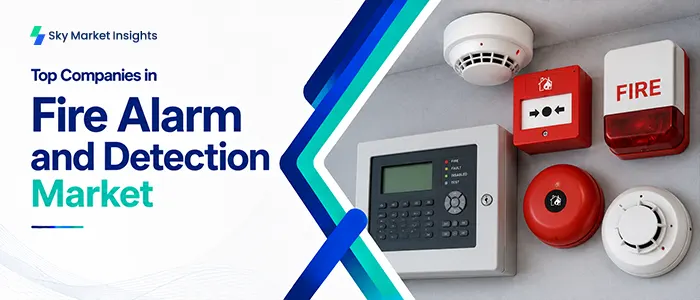
The Top 10 Leading Companies in Fire Alarm and Detection Market are competing through advanced detection technologies, integrated safety platforms, intelligent control panels, addressable systems, and connected building solutions. The market includes fire detection and alarm equipment such as smoke detectors, heat detectors, manual call points, fire alarm control panels, notification devices, emergency communication systems, and related monitoring technologies. The competitive landscape includes 10 major companies, ranging from diversified industrial technology providers to specialized fire and life-safety manufacturers. Procurement decisions increasingly focus on detection accuracy, system interoperability, installation requirements, lifecycle costs, cybersecurity, maintenance, and regulatory compliance. For commercial buildings, industrial facilities, infrastructure projects, healthcare environments, and residential applications, buyers are increasingly evaluating complete fire safety ecosystems rather than standalone devices.
Market Overview
The fire alarm and detection market is structured around several major product categories, including smoke detectors, heat detectors, flame detectors, fire alarm control panels, notification appliances, manual call points, and integrated monitoring systems. These products support applications across commercial buildings, manufacturing facilities, warehouses, transportation infrastructure, healthcare facilities, hospitality properties, and residential buildings.
From a procurement perspective, the market can broadly be evaluated across 3 major technology approaches: conventional systems, addressable systems, and intelligent/networked systems. Conventional systems generally compete on installation simplicity and cost, while addressable and intelligent systems provide more detailed device-level identification and diagnostic capabilities.
Pricing varies according to system complexity, detector technology, installation requirements, and integration capabilities. Basic detection devices typically represent the lower-cost portion of procurement, while integrated addressable panels, intelligent detectors, emergency communication systems, and networked fire safety platforms occupy higher-value segments.
The competitive environment includes 10 leading companies in the supplied company set. These companies compete through product breadth, regional distribution, system integration capabilities, service networks, technology development, and relationships with building owners, contractors, engineering firms, and facility operators.
Top 10 Leading Companies in Fire Alarm and Detection Market
1. Gentex Corporation
Gentex Corporation is a major participant in sensing, fire protection, and safety technology, with capabilities spanning detection and signaling solutions. Its portfolio includes smoke detection technologies and related safety products designed for residential and commercial applications. The company's positioning is supported by its engineering capabilities and emphasis on integrating sensing technologies into broader safety environments. For procurement teams, Gentex can be relevant where reliable detection, compact product design, and integration with building safety systems are priorities. Its strategy centers on technological development and diversification across safety-related product categories. The company competes in a market where detector accuracy, reliability, regulatory compliance, and lifecycle performance influence purchasing decisions. Its specialized expertise in sensing technologies provides a differentiated position within the wider fire alarm and detection ecosystem.
2. Halma Plc

Halma Plc operates as a diversified safety, health, and environmental technology group with significant exposure to fire and life-safety applications. Its portfolio spans detection, sensing, monitoring, and safety technologies used across buildings and industrial environments. The company benefits from a broad portfolio approach, allowing customers to address multiple safety requirements through specialized technologies. Halma's competitive positioning is strengthened by its presence across several niche safety markets and its emphasis on innovation. For procurement professionals, the company offers opportunities to consolidate safety technology requirements while maintaining specialized product capabilities. Its strategy emphasizes technology development, complementary product businesses, and expansion across international markets. In fire detection, its capabilities support applications where early warning, reliable monitoring, and integration with broader safety infrastructure are important purchasing criteria.
3. Hochiki Corporation

Hochiki Corporation is a specialized fire detection and life-safety technology company with a strong focus on fire alarm systems. Its product portfolio includes automatic fire detectors, fire alarm control panels, notification equipment, emergency systems, and related components. The company is particularly positioned around dedicated fire protection expertise rather than diversified industrial equipment. Hochiki's products serve commercial buildings, industrial facilities, infrastructure projects, and other applications requiring reliable fire detection. Its strategy emphasizes detector technology, system reliability, engineering development, and international distribution. For procurement managers, Hochiki represents a specialized supplier capable of supporting complete fire alarm architectures. Its competitive strength is associated with product specialization, system compatibility, detection performance, and established fire-safety engineering capabilities.
4. Honeywell International Inc.

Honeywell International Inc. maintains a broad position in building technologies, automation, and fire and life-safety systems. Its fire protection portfolio includes detection devices, fire alarm control panels, notification technologies, monitoring solutions, and integrated building safety systems. Honeywell's diversified technology base allows fire alarm systems to connect with broader building management, security, and automation infrastructure. This integrated approach is important for large commercial buildings, industrial facilities, airports, healthcare properties, and infrastructure projects. The company's strategy focuses on connected systems, automation, digital monitoring, and intelligent building technologies. Procurement teams often evaluate Honeywell where system integration and centralized management are important. Its broad technology portfolio provides a competitive advantage when customers require fire detection alongside other building automation and safety functions.
5. Johnson Controls

Johnson Controls is a major building technology and fire safety provider with a broad portfolio covering fire detection, alarm systems, suppression, building controls, and integrated safety solutions. Its fire protection offerings support commercial, industrial, healthcare, institutional, and infrastructure applications. The company differentiates itself through its ability to combine fire safety with building automation and facility management technologies. Its portfolio includes detection devices, control panels, notification systems, monitoring solutions, and integrated platforms. Johnson Controls' strategy emphasizes connected buildings, lifecycle services, system modernization, and technology integration. For procurement professionals, this creates value where projects require a combination of equipment supply, installation support, maintenance, and long-term system management. Its broad service capabilities also strengthen its position in large and technically complex building projects.
6. Napco Security Technologies Inc.
Napco Security Technologies Inc. participates in the electronic security and fire protection market through alarm, detection, communication, and integrated security technologies. Its portfolio supports commercial and institutional applications requiring coordinated fire and security protection. The company focuses on technologies that connect detection and alarm functionality with broader electronic security infrastructure. This positioning allows it to compete in projects where customers seek integrated protection rather than isolated fire alarm equipment. Napco's strategy emphasizes product innovation, connected systems, and channel-based distribution. Procurement teams can consider its solutions for facilities requiring scalable alarm architectures and integration with security systems. Its competitive positioning is strengthened by its specialized focus on electronic security and fire protection, particularly where fire and security systems need to operate within a coordinated infrastructure.
7. Nittan Company Ltd.

Nittan Company Ltd. is a specialized fire detection manufacturer offering technologies designed for commercial, industrial, institutional, and infrastructure applications. Its portfolio includes fire detectors, control equipment, alarm devices, and associated fire safety components. The company emphasizes detection reliability and system performance, making it relevant to projects where early identification of fire conditions is critical. Nittan's competitive strategy focuses on fire detection engineering, product development, and international market participation. Its specialized portfolio enables procurement teams to evaluate dedicated fire safety technologies rather than relying exclusively on diversified automation suppliers. The company competes through detection accuracy, product compatibility, reliability, and the ability to support different building configurations and fire safety requirements.
8. Robert Bosch GmbH

Robert Bosch GmbH provides fire detection and building safety technologies as part of its broader building technology portfolio. Its fire protection solutions include detectors, fire alarm panels, notification equipment, monitoring systems, and integrated safety technologies. Bosch benefits from extensive engineering capabilities across electronics, automation, security, and connected technologies. This allows fire detection products to be incorporated into broader building management and security environments. Its strategy increasingly emphasizes intelligent connectivity, centralized monitoring, and integrated building solutions. Procurement professionals can consider Bosch for projects requiring interoperability between fire protection, security, access control, and building management systems. Its diversified technology portfolio provides opportunities for large facilities to simplify system integration and manage multiple building technologies through coordinated platforms.
9. Siemens

Siemens is a major industrial technology provider with extensive capabilities in building automation and fire safety. Its fire detection portfolio includes intelligent detectors, fire alarm control systems, notification technologies, and integrated building safety platforms. Siemens positions fire protection as part of a broader connected-building architecture, allowing fire alarm systems to interact with automation and management technologies. Its strategy emphasizes digitalization, intelligent detection, centralized monitoring, and lifecycle optimization. For procurement decision-makers, Siemens is particularly relevant for large commercial, industrial, infrastructure, and institutional projects requiring sophisticated integration. Its competitive advantage comes from combining fire safety with automation, controls, digital infrastructure, and building management technologies.
10. Cooper Wheelock Inc.

Cooper Wheelock Inc. is recognized for fire alarm notification appliances and life-safety signaling technologies. Its portfolio includes horns, strobes, horn-strobes, speakers, visual notification devices, and other signaling equipment used in fire alarm systems. The company occupies an important position within the notification segment because effective fire protection requires both accurate detection and reliable occupant notification. Its strategy emphasizes dependable signaling products, installation flexibility, system compatibility, and compliance-oriented design. Procurement professionals evaluate Cooper Wheelock products based on coverage requirements, audible and visual notification performance, installation characteristics, and compatibility with fire alarm control systems. Its specialized focus gives it a distinct competitive position among broader fire and building technology providers.
Competitive Landscape Insights
The competitive landscape contains 10 major companies with different strategic strengths. Specialized suppliers such as Hochiki, Nittan, and Cooper Wheelock focus strongly on fire detection and notification, while diversified technology companies such as Honeywell, Siemens, Bosch, and Johnson Controls integrate fire protection with automation, security, and building management.
Pricing can be divided into 3 broad procurement levels: basic conventional equipment, addressable fire alarm systems, and intelligent integrated platforms. Conventional solutions generally compete on upfront affordability, while intelligent systems command higher investment because of advanced diagnostics, networking, monitoring, and integration capabilities.
Supply chains depend on detectors, electronic components, control panels, signaling equipment, communication modules, sensors, and installation accessories. Buyers increasingly prioritize product availability, interoperability, maintenance support, replacement-part availability, and long-term technical service alongside initial equipment pricing.
The Top 10 Leading Companies in Fire Alarm and Detection Market demonstrate diverse competitive strategies across detection, notification, control, automation, and integrated building safety. Gentex, Halma, Hochiki, Honeywell, Johnson Controls, Napco, Nittan, Bosch, Siemens, and Cooper Wheelock each bring distinct capabilities to the market. For procurement decision-makers, the most important selection factors include detection reliability, system compatibility, installation complexity, lifecycle support, integration capabilities, and total cost of ownership. As fire safety systems become increasingly connected and intelligent, suppliers with broad technology portfolios, specialized detection expertise, and strong service capabilities are positioned to remain important partners for commercial, industrial, institutional, and infrastructure projects.
Author : Diana Liska
Senior Market Research Analyst | 9 Years Experience | Industrial Automation, Robotics, and Digital Twins
Diana Liska is a market research analyst with 7–9 years of experience specializing in manufacturing and industrial markets. Contributed to 70+ research reports for global clients. Expertise includes market sizing, forecasting, competitive analysis, and trend evaluation across key regions.
