Top 10 Companies in Agricultural Drone Market
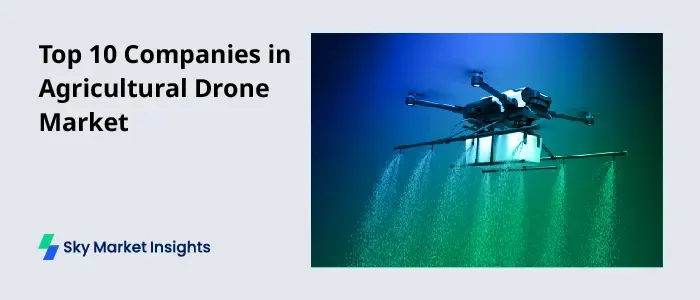
The agricultural drone market has evolved into a core pillar of precision farming, enabling farmers to monitor crop health, optimize inputs, and improve yields with data-driven decisions. These drones perform tasks such as aerial spraying, crop mapping, soil analysis, and real-time surveillance across large farmland areas.
Globally, over 350,000 agricultural drones are actively deployed, covering more than 500 million hectares of farmland annually. The average cost of a professional agricultural drone ranges between $5,000 and $25,000, depending on payload capacity and software integration. Adoption continues to accelerate across Asia-Pacific and North America, driven by labor shortages and the need for efficient resource utilization.
This article explores the top 10 companies in agricultural drone market, offering a detailed view of their capabilities, positioning, and strategic direction.
Market Overview
The agricultural drone market demonstrates strong industrial-scale adoption across key regions:
- Asia-Pacific dominates with ~45% market share, led by China and India
- North America holds ~25% share, driven by large-scale mechanized farming
- Europe accounts for nearly 18% of total deployment volume
In terms of production and usage:
- Annual global production exceeds 120,000 units
- Average drone spraying capacity ranges between 10 to 20 liters per flight
- High-end drones cover 15–25 hectares per hour, improving operational efficiency by over 40% compared to manual methods
Pricing benchmarks vary by segment:
- Entry-level mapping drones: $2,000–$6,000
- Mid-range spraying drones: $8,000–$15,000
- Advanced AI-integrated systems: $18,000–$30,000
The market continues shifting from standalone hardware to integrated ecosystems combining hardware, analytics, and farm management software.
Top 10 Companies in Agricultural Drone Market
DJI

DJI leads the global agricultural drone market with an estimated 60–70% market share in commercial drone segments. The company has deployed over 200,000 agricultural drones worldwide, covering more than 300 million hectares annually. Its flagship Agras series, including models like T40 and T50, supports payload capacities of up to 40 liters, making them ideal for large-scale spraying operations.
DJI’s strength lies in its vertically integrated ecosystem, combining hardware, flight control systems, and AI-based analytics. The company invests heavily in automation, enabling features such as obstacle avoidance, terrain following, and variable-rate spraying. Its drones can cover up to 20 hectares per hour, significantly reducing labor costs.
Strategically, DJI focuses on expanding in emerging markets such as India and Southeast Asia, where mechanization demand is rising. Its pricing ranges from $10,000 to $25,000, positioning it competitively across both mid-range and premium segments.
XAG Co., Ltd.

XAG ranks among the most advanced agriculture-focused drone companies, with operations across 40+ countries. The company has deployed over 100,000 drones, serving millions of hectares globally. Its P-series drones specialize in precision spraying and seeding, with payload capacities reaching 20–30 liters.
XAG differentiates itself through a fully autonomous farming ecosystem. Its drones integrate with ground robots and smart irrigation systems, creating a connected farm infrastructure. The company’s drones achieve coverage efficiency of up to 18 hectares per hour.
Revenue from agricultural solutions contributes a significant portion of XAG’s business, supported by strong adoption in China’s large-scale farming regions. Pricing typically ranges between $8,000 and $20,000, making it accessible for mid-sized farms.
XAG continues to invest in AI-driven crop monitoring and real-time analytics, strengthening its position as a full-stack precision agriculture provider.
Yamaha Motor Co., Ltd.

Yamaha pioneered agricultural UAV technology and remains a key player with its unmanned helicopter systems. The company has deployed over 2,800 units globally, primarily in Japan and parts of Asia. Unlike multirotor drones, Yamaha’s helicopters can carry payloads exceeding 30 liters, enabling longer flight durations.
The company focuses on high-reliability systems suited for large-scale farming operations. Its drones can cover approximately 15 hectares per hour, making them effective for rice and specialty crops.
Yamaha’s agricultural drone business contributes to its broader robotics and automation portfolio, with annual revenues exceeding $15 billion across divisions. The company emphasizes durability, regulatory compliance, and long lifecycle performance.
Pricing for Yamaha’s UAV systems often exceeds $30,000, positioning it in the premium segment. Its strategy centers on high-value markets requiring robust and scalable aerial spraying solutions.
Parrot S.A.
Parrot focuses on data-driven agriculture through advanced imaging and mapping solutions. Its Bluegrass drone platform integrates multispectral sensors that analyze crop health, nitrogen levels, and irrigation needs.
The company operates in over 100 countries and has built a strong presence in precision agriculture and surveying. Its drones are widely used for crop scouting, with coverage capabilities of up to 30 hectares per flight depending on terrain.
Parrot generates revenue primarily through enterprise drone solutions and software integration. Its agricultural drones fall within the $5,000–$10,000 price range, targeting mid-sized farms and agronomists.
The company’s strategy emphasizes partnerships with agritech platforms and analytics providers, enabling seamless data integration. Parrot continues to invest in AI-based crop diagnostics, positioning itself as a leader in agricultural intelligence rather than hardware volume.
PrecisionHawk, Inc.

PrecisionHawk operates at the intersection of drone hardware and advanced analytics. The company specializes in aerial data collection, offering solutions for crop health monitoring, yield prediction, and risk assessment.
Its platform processes millions of acres of agricultural data annually, providing actionable insights to agribusinesses and large-scale farms. The company’s drones focus on mapping rather than spraying, with flight coverage of 20–40 hectares per mission.
PrecisionHawk’s enterprise contracts and software subscriptions drive its revenue, estimated in the hundreds of millions range. Its pricing varies based on service packages rather than hardware alone.
Strategically, the company emphasizes AI-driven analytics and regulatory compliance. Its partnerships with government agencies and agribusiness firms strengthen its position as a data-first agriculture technology provider.
Trimble Inc.

Trimble integrates drones into its broader precision agriculture ecosystem, which includes GPS guidance, farm management software, and IoT solutions. The company operates in over 150 countries and serves thousands of agribusiness clients.
Its drone solutions enhance field mapping, land surveying, and crop monitoring. Trimble’s systems integrate seamlessly with its existing hardware, enabling end-to-end farm management.
The company generates annual revenues exceeding $3.5 billion, with agriculture representing a significant segment. Its drone-related offerings typically fall within the $10,000–$20,000 range when bundled with software solutions.
Trimble’s strategy focuses on ecosystem integration rather than standalone drone sales. This approach strengthens customer retention and creates long-term value through data-driven decision-making.
AgEagle Aerial Systems Inc.

AgEagle specializes in fixed-wing drones designed for large-area mapping and surveying. Its drones can cover up to 100 hectares per flight, making them suitable for expansive agricultural operations.
The company provides both hardware and data analytics platforms, enabling farmers to monitor crop health and optimize resource allocation. AgEagle operates globally, with a strong presence in North America.
Revenue remains in the tens of millions range, reflecting its niche positioning. Its drones are priced between $8,000 and $18,000, depending on configuration.
AgEagle focuses on scalability and efficiency, targeting enterprise-level farming operations. Its strategy includes expanding into international markets and enhancing its software capabilities.
DroneDeploy

DroneDeploy leads in drone software, providing cloud-based platforms for aerial data analysis. Its solutions process over 1 billion acres of aerial data annually, serving agriculture, construction, and energy sectors.
The company supports multiple drone hardware platforms, making it hardware-agnostic. Its agricultural applications include crop scouting, field mapping, and yield optimization.
DroneDeploy operates on a subscription-based model, with pricing ranging from $1,000 to $5,000 annually per user. This model ensures recurring revenue and scalability.
The company’s strategy focuses on AI-driven analytics and automation. Its platform integrates with farm management systems, enabling seamless data-driven workflows.
Autel Robotics

Autel Robotics has emerged as a strong competitor in the commercial drone market. Its EVO series drones offer high-resolution imaging and robust flight performance.
The company targets enterprise users, including agriculture, with drones capable of covering 15–20 hectares per flight. Pricing ranges between $7,000 and $18,000, depending on specifications.
Autel operates globally and continues expanding its distribution network. Its strategy focuses on innovation in imaging technology and competitive pricing.
The company positions itself as a reliable alternative to established market leaders, gaining traction in regions seeking diversified supply chains.
Yuneec International

Yuneec International offers commercial drones for agriculture, focusing on reliability and ease of use. Its H520 platform supports multispectral imaging and crop monitoring.
The company operates across multiple regions, serving enterprise and government clients. Its drones can cover approximately 20 hectares per mission, depending on configuration.
Pricing typically falls within the $6,000–$15,000 range, making it competitive in the mid-tier segment. Yuneec emphasizes safety features and stable flight systems.
Strategically, the company focuses on enterprise adoption and partnerships with agritech providers. Its consistent product performance supports steady growth in the agricultural drone market.
Competitive Landscape Insights
The agricultural drone market exhibits a concentrated yet evolving competitive structure:
- DJI dominates with ~65% share, followed by XAG at 10–12%
- Remaining players collectively hold 20–25% share
Pricing segmentation:
- Low-end: Below $6,000 (mapping drones)
- Mid-range: $8,000–$15,000 (spraying drones)
- Premium: Above $20,000 (AI-integrated systems)
Supply chain insights:
- China leads manufacturing with over 70% production share
- Software and analytics providers are primarily based in the US and Europe
- Integration between hardware and software defines competitive advantage
The market is shifting toward platform-based ecosystems combining drones, analytics, and automation.
Conclusion
The top 10 companies in agricultural drone market highlight a clear industry transition from standalone drone manufacturing to integrated precision agriculture solutions. Market leaders such as DJI and XAG dominate hardware, while companies like DroneDeploy and PrecisionHawk drive value through analytics and software.
Agricultural drones now serve as critical tools for improving efficiency, reducing costs, and enhancing yield outcomes. As adoption increases across emerging and developed markets, companies that combine hardware innovation with data intelligence will shape the future of precision farming.
Author : Henry Smith
Senior Market Research Analyst | 8 Years Experience | Precision Agriculture and AgriTech Platforms
Henry Smith is a market research analyst with 7–9 years of experience specializing in agriculture markets. Contributed to 70+ research reports for global clients. Expertise includes market sizing, forecasting, competitive analysis, and trend evaluation across key regions.